Harveer Sahni

Harveer Sahni
Author Harveer Sahni

Avery Dennison

Avery Dennison
Sustainability at Avery Dennison
Showing posts with label packaging development. Show all posts

Tuesday, September 1, 2026

SANJAY GHOSHAL HEAD PACKAGING DIAGEO- "THIRTY YEARS ON THE PACK!"

Pack Stories-1

Inside Sanjay Ghoshal's journey from by lanes  of Kolkata to the highways of Indian packaging Industry, and why he believes Indian Packaging Industry has a lot to give to the economic development of our country.

Sanjay Ghoshal is one of the more familiar faces on the Indian packaging conference circuit — a speaker whose sessions draw full rooms and whose career reads like a map of the industry itself. Over three decades he has moved through India Foils, Huhtamaki, Hindustan Unilever, Dr. Reddy's and Havells, and today he heads packaging development at Diageo India, the global Alcobev major. Audiences keep coming back to hear him because few people have seen the business from as many angles: sales, procurement, supply chain and R&D, on both sides of the packaging value chain.

His family's story begins with Partition of India. Ghoshal's parents moved to Kolkata from what was then East Bengal — later East Pakistan, and today Bangladesh — and both went on to spend their careers at the Steel Authority of India Limited (SAIL). He was schooled (during which he won two National Scholarships in 1987 and 1989) and did his undergraduate studies in Kolkata, graduating from Presidency University, Kolkata in 1994, before moving to Mumbai for postgraduate studies in Packaging which he passed with 1st position and Gold Medal from the Indian Institute of Packaging (IIP) in 1996. An internship at Unilever followed, and — while he was still finishing at IIP — a job offer came from India Foils, that he accepted. He never went back to Kolkata. He also went on to complete Advanced post graduate studies in 2009 from Loughborough University, UK as part of the Unilever Technical leadership program.

He spent four and a half years at India Foils and six and half years in Huhtamaki- PPL, based in Mumbai, in a front-line business development role. It set the pattern for the first half of his career: roughly eleven to twelve years on the front line of business, dealing directly with key accounts/customers. He never saw a contradiction between studying packaging technology and building a career in sales. "Sales needs a lot of understanding of packaging," he says, the two, in his experience, were never really separate disciplines.

A sunrise industry, and a policy tailwind

Ghoshal traces his decision to enter packaging back to the economic reforms of the early 1990s. When the then finance minister Manmohan Singh opened up the Indian economy, it changed the country's trajectory — dismantling the License Raj and the bureaucratic hurdles that had constrained industry for decades. Packaging, he felt, stood to benefit directly from that shift.

"I was told at that time that packaging is a great opportunity. It was an emerging opportunity because India... as the then finance minister, Manmohan Singh opened up the Indian economy. So that changed the face of the country. And Packaging is great barometer of the economic development of a country. "

The logic was straightforward: as consumption and exports grew, products would need to be packaged well to sell, and the government of the day — keen to protect and promote sectors from cars to food — had every incentive to back the industry. Packaging, in other words, was less a gamble than a bet on where India's economy was clearly headed. Looking back, Ghoshal believes it was the right call — even if the institution that trained him, IIP, has not kept pace with the industry it helped seed.


Supply side or demand side — which is better?

After more than a decade in sales and marketing at companies like India Foils and Huhtamaki, Ghoshal made a deliberate switch — from the supply side of packaging, where materials and machinery are made, to the demand side, where the brand owners consume them. In the years since, he has held packaging procurement leadership at Havells and supply chain and R&D roles at Unilever, giving him a rare, full view of the value chain from both ends.

Asked which side he would recommend, his answer is candid rather than diplomatic.

"Perhaps I would have done better if I had stayed back in supply side or stayed back in sales roles. On that side, packaging is at the core of their business. In the demand side, packaging is never at the center — it is in fringes of their business."

At a company like Diageo or Unilever, he explains, the center of gravity is always the product — Alcoholic spirits in his current role or Homecare/Personal care products, when he was at Unilever —packaging remained a critical yet peripheral function. At India Foils or Huhtamaki, by contrast, packaging was not a supporting act; it was the core business. The transition between the two worlds, he adds, is not one many packaging professionals attempt, and it was not easy for him either. Brand-side companies tend to offer better compensation, he notes, but the visibility and centrality that come with being a supplier are harder to replicate.

The Big Bets – paving the patch for future.

In 2014-15, “Development of Medical device” had emerged as a mission critical task for the generic pharmaceutical companies with ambitions to launch their generic formulations in the mature markets like the US and the European Union(EU). It is not only the packaging that needed to work exactly the way the innovator drug did, but also the drug-device combination that warranted similarity from functional and human factor point of view which needed approval by the local FDA. Developing a new drug delivery device from scratch or finding one available with due “Freedom to Operate” turned out to be a serious challenge for the large Indian generic pharma industry. The challenge Ghoshal had to go through during his DRL stint was to accurately characterize innovator drug-device combination and ensure equivalence for the generic device without stepping into the minefield of patents and IP(Indian Pharmacopoeia) barriers. The work Ghoshal did on creating device readiness specifically in the space of complex peptide Injectables for US ANDA (FDA Abbreviated New Drug Application) or other market filings in those early days built the fundamentals for today’s preparedness even with a few Indian device manufacturers. The ability to learn fast- fail fast attitude and entrepreneurial mindset became his biggest companion during those challenging moments.

Mono material Sachet
It was during his stint at Unilever, he was working on creating mono material-based sachet in 2012-2013, way before the current Indian PWM(Plastic Waste Management)  mandates of recyclability, mono-materiality circularity came into being. It was an uphill task in those days to find the right solutions in terms of films, ink and over print varnish systems and tear ergonomics of the sachet at the retail just like an otherwise multilayer sachet structure based on oriented film. Understanding the science and engineering behind the seal and perforation jaw design was big deal and incorporating them into the existing VFFS (Vertical Form Fill Seal) machine was even more challenging. Though it was not implemented commercially at that time as a sustainable alternative, it built the toolbox of solutions and learnings which were put to use subsequently when the need for mono-materiality became more compelling post 2000. Passion for innovation, External curiosity and Multi Stakeholder collaborative approach were demonstrated by him at every stage of such a future forward project.

Diageo's PET Shift
His journey of transition from Glass to PET for the alcoholic beverages segment was an excruciating and exciting one at the same time. The pioneering efforts of shifting an age-old format like glass to a new age format like PET was not only technically challenging to implement at scale but also intellectually stimulating. Technological interventions through supplier collaborations to bring about the lightest PET bottle in the alcobev category without impacting the conventional consumer experience of pouring their favorite liquid from a relatively heavy glass bottle. In 2023-24, there were very few benchmarks or references for designing a PET bottle that had the potential to recruit new consumer cohort and help grow a brand beyond prevalent market growth rates. Since this was adding plastics to Diageo’s overall portfolio, ensuring that the plastic bottle is 100% recyclable, 100% recycled and has the required PCR recycled content, was a non-negotiable imperative. At that time, Diageo became the first alcobev company in India to launch a “glass bottle look alike” PET bottle with 100% PCR FCM recycled PET which was also 100% recyclable and 100% circular. This seminal piece of work lead by Ghoshal had an enormous impact and went on to inspire the future glass to PET shifts across many other brands in the spirits category. Teamwork, decisiveness, agility and focus on progress over perfection helped Ghoshal deliver such a pioneering project for Diageo India.

Looking ahead

Diageo Paper based packaging


Having reached a reasonably senior level with a large brand owner, Ghoshal is candid about what comes next. Staying on the current path, he says, is one option — but the pull toward going back to the manufacturing side of packaging, where his career began, is growing.


"If I really want to use my knowledge, learnings and wisdom  which I have gathered over the last 30 years, being fortunate to sit across both sides of the table, then I think I should go back to the packaging industry and try to serve that industry. Because that's where my heart lies."

He has not ruled out entrepreneurship — either building something of his own on the supply side or partnering with an existing player to chart new growth. What he is clear about is staying within packaging itself, rather than moving into manufacturing or brand building. "Packaging is my core skill, my core competence," he says.

Family, and advice for the next generation

Ghoshal's wife is a business leader at ArcelorMittal. Their two children — a son in class 12 and a daughter in class 10 — are, by his account, charting their own paths: the son toward engineering, the daughter toward the liberal arts. "They get to decide their future for themselves," he says.

For young people considering a career in packaging, his advice goes beyond technical training.

"Along with their packaging learning, they should also very seriously hone their skills, their communication skills, their executive presence. They should build their leadership skills and continue a strong connect with the industry alongside what they are learning at the institute."

It is a message rooted in his own career — one built as much on adaptability and frontline experience as on formal packaging education, and one he clearly hopes the next generation, and the institutions training them, will take to heart.

Interviewed & written by Harveer Sahni Chairman Weldon Celloplast Ltd. New Delhi

Monday, May 5, 2025

LABELS FRATERNITY LAUDS LMAI’S PANEL DISCUSSION

 LABELS FRATERNITY LAUDS LMAI’S PANEL DISCUSSION


 LMAI, the labels Manufacturers association of India organised a panel discussion titled, “Label buyers’ challenges with quality, Sustainability & Innovation” on the 2nd of May 2025 Hotel Radisson Blu, New Delhi. The event was attended by a “house full” of leading label printers and suppliers as sponsors. The distinguished panel consisted of leading brands Nestle, Diageo, Reckitt Benckiser, Amway, Dabur and Sun Pharma. The panel moderated by the author Harveer Sahni, Chairman Weldon Celloplast Limited and member of Board of Director LMAI. The panel on stage consisted of Arijit Mondal(Nestle), Sanjay Ghoshal( Diageo), Naveen Stuart (Reckitt Benckiser), Swati Gupta(Amway), Sidharth Sharma(Dabur) and Mohit Mittal (Sun Pharma). The delivery of responses by panelists to questions by the moderator, left the audience spellbound. Ruma Ghatak head Packaging at Nestle was a special invitee. The program was initiated by the hard-working LMAI secretary Jaideep Singh who had made untiring efforts to organize this amazing event, this was followed by the welcome speech by the LMAI President Rajesh Chadha. 

Pradeep Saroha director label expo updated the audience on the next edition of Labelexpo Europe in Barcelona Spain. Jaideep Singh shared a presentation of the upcoming LMAI biennial conference at Udaipur from 3-6 July 2025. Organising committee member Sandhya Shetty conducted the agenda efficiently. Dinesh Mahajan Vice President LMAI gave the vote of thanks. This was followed by an interactive question and answer session.

Audience

The congregation was highly appreciative of the knowledge delivering panel discussions and their responses to LMAI team and the moderator are as follows. The responses are reproduced here unedited and as received.

Mrs. Kusum Dunglay Director Redunn Labels Gurgaon: A truly impressive and well-executed event. Congratulations to LMAI and the brand owners for putting together such a memorable event.

Manish Hansoti, Founder and Managing Director S.Kumar Group Ahmedabad: Thank you for putting together such an incredible event. Your careful attention to details, from the label printer’s perspectives created an atmosphere that perfectly matched with unanswered questions from label printers to Brand owners. I especially appreciate how you handle without any boring topics. The event's success is a testament to your planning abilities and dedication. I am truly grateful for all your hard work in making this event so special.

Anuj Bhargava, Founder Kumar Labels NOIDA: Well organised event by LMAI. Intriguing questions by Label Pitamah Harveer Ji. Brand owners shared valuable insights. Always good to connect with fellow industry colleagues. Many thanks to LMAI for organising this cosy event.

Rakesh Mahajan, Director Prakash Labels Noida: It is refreshing to see buyers and sellers coming together to address common challenges. This exchange can drive innovation and growth in the label printing sector.

Yoshita Goel from Any Graphics Noida: The LMAI panel discussion held on 2nd May 2025 was a remarkable success and quite knowledgeable. The interactive session among the panelists was intellectual and brainstorming towards the printing and packaging industry.

Yogesh Agarwal Print Pack New Delhi: The event was very well-organized, and the panel discussion was insightful and engaging. Sincere thanks to Harveer Sahni Ji for moderating and conducting such a meaningful and well-curated session.

K M Manoj Director Avery Dennison: It was great to see some of the prominent packaging professionals share their views about pressure sensitive labels. The conversations  around emerging regulations, how labels can be more sustainable and actions to tackle the common challenges were insightful.

Ranesh Bajaj Managing Director Vinsak: Well organised and very informative panel discussion. It was great to hear brand owners sharing details which are critical to the growth of label convertors as they align their future plans.

Bhaumik Mehta Director Flueron Inks: It was a pleasure for us to have sponsored this event for our friends and colleagues in the label industry. The panelist, the moderator and the audience were all in sync on the topic of discussion. It was insightful to see how the brands perceive procurement, supply chain partners and their own responsibility towards sustainable solutions. What struck out was the Q and A which the panelists took their time and put the answers in perspective on the business.

Innovation and Sustainability not just in products and services but in growth and prosperity is as much essential for all partners involved and this to me was a fantastic outlook. Cheers to LMAI for hosting this and giving us an opportunity to be a part of this amazing initiative for the industry.

Inderjit Singh Toyo Inks: We are thrilled to have attended the panel discussion on Label buyers’ challenges with focus on quality, sustainability and innovation organized by LMAI (Label Manufacturers Association of India). The discussions reinforced the importance of collaborative efforts to drive sustainability, ensuring regulatory alignment while adopting innovative and sustainable approaches.

The event was an incredible experience, filled with inspiring discussions and I had the pleasure of meeting and connecting with some amazing brand owners and partners. Looking forward to applying these new learnings and continuing the conversations to fulfill the brand owner’s requirements.

Gautam Kothari Managing Director Worldpack: LMAI Event Sheds Light on Label Buyers’ Pressing Challenges. The LMAI event held last evening proved to be a timely and insightful gathering for stakeholders across the label manufacturing ecosystem. With a sharp focus on the challenges faced by label buyers, the panel brought together key voices from FMCG, pharma, and logistics sectors who shared first-hand accounts of the evolving demands and operational bottlenecks in label procurement and usage. Overall, the LMAI event succeeded in bringing buyer concerns to the forefront, sparking necessary dialogue around innovation, transparency, and strategic partnerships in the label industry.

Ashwani Kumar RSM Kurz: The recent LMAI event fostered a productive dialogue between brand owners and industry leaders regarding key challenges and potential solutions in the label manufacturing sector. Discussions highlighted the detrimental impact of price pressures and reverse auction practices on innovation, alongside the complexities of liner recycling. Brand owners underscored their requirements for superior quality, competitive pricing, and dependable partnerships, with Swati emphasizing the role of partners in brand protection. Mr. Naveen (Reckitt) articulated that effective anti-counterfeiting necessitates products being both easily recognizable and difficult to replicate. The increasing significance of track and trace technologies for ensuring product authenticity and enhancing supply chain transparency, as demonstrated by Dabur's application, was also a key takeaway.

Pradeep Saroha Director Labelexpo India: "The LMAI's 'Amazing Brand Owner Evening' was a resounding success! The interactive event brought together numerous brand owners and printers to discuss innovation and sustainability. It was a fantastic platform for networking and exploring new ideas."

The panelists also commented.

L-R: Mohit Mittal, Arijit Mondal, Sanjay Ghoshal, Harveer Sahni, Swati Gupta, Naveen Stuart, Sidharth Sharma

Arijit Mondal 
Global Packaging Development Lead Nestle: Thank you Harveer ji and panelists for super engaging discussion. It has been a super enriching experience to meet all of u in person and our super capable label fraternity. I am looking forward to another time together in the near future too.

Swati Gupta Senior Manager Open Innovation and Packaging Development Amway: Thank you, Harveer ji and all fellow panelists. Great perspectives and learning!

Sidharth Shankar Sharma DGM-Purchase Dabur: Thanks Everyone for being such a wonderful fellow panelist. Special thanks to Harveer ji for bringing us to such a platform.

Sanjay Ghoshal Head of Packaging Diageo: Thank you very much Harveer ji and the LMAI. It is my honour and privilege to be part of such an elite panel and such an august audience. It is truly a great platform for the exchange of thoughts and wisdom between the demand and Supply side of label/labelling industry.

Naveen Stuart Cluster Packaging manager - Health - SoA Reckitt Benckiser: Thankyou sir and everyone at LMAI. It was a perfectly organised event and an excellent platform to share views.

Mohit Mittal Senior Manager Packaging Development Sun Pharma: The LMAI panel discussion event was a well-organized and insightful event, bringing together key industry stakeholders, innovative technologies, and valuable networking opportunities. The sessions were informative and addressed current challenges and future trends in the label manufacturing sector. Looking forward to more such impactful gatherings in the future.

Jaideep Singh Director Zodiac Reprographics Hyderabad: Thank you each one of you to add immense value to the panel discussion event with your insights on the perspective of labels in each of your industries .We  as label printers feel reassured labels will play an important part of your brand perception and create an impact  and value perception which is important to grow your industry through the value our labels will be able to provide.

Deepanshu Goel, Founder & Managing Director Creative Graphics Noida: This was an ensemble of renowned packaging development specialists. Great learning!

Amol Naval, National Manager, Maxcess India: We had a wonderful experience at the LMAI event. It was both interactive and informative for all attendees, offering a valuable platform for close engagement and networking with existing and potential customers. Thanks to the LMAI team for organizing such an insightful gathering that brought together end users, label manufacturers, and solution providers under one roof.

Raman Anandchahl Neovation Graphics Private Limited Gurgaon: It was a pleasure to attend such a well-conducted event. The entire session was highly informative, especially for someone like me who is always eager to learn. This event was also particularly special for me, as my elder daughter, Nitya Anandchahl, who joined our business just last month, was introduced to the industry for the first time here. She interacted with the panelists and many other industry stalwarts throughout the day. I was truly happy to see how warmly everyone welcomed her and wished her success in the future. Seeing the next generation step in with such enthusiasm makes me feel assured that the future of our beautiful label industry is in safe hands.

 More Images from the event:

Harveer Sahni, Pardeep-Avery Dennison, Gautam Kothari, Chenga Reddy

Registration

Rajesh Chadha President LMAI


Ranesh Bajaj Vinsak

KD Sahni wit Rajesh Nema

Jaideep Singh
Sandhya Shetty


Pradeep Saroha-Labelexpo


Aditya Chadha -Questions time

Chenga Reddy- Hyderabad at Q&A


Bhaumik Mehta Flueron Inks at Q&A

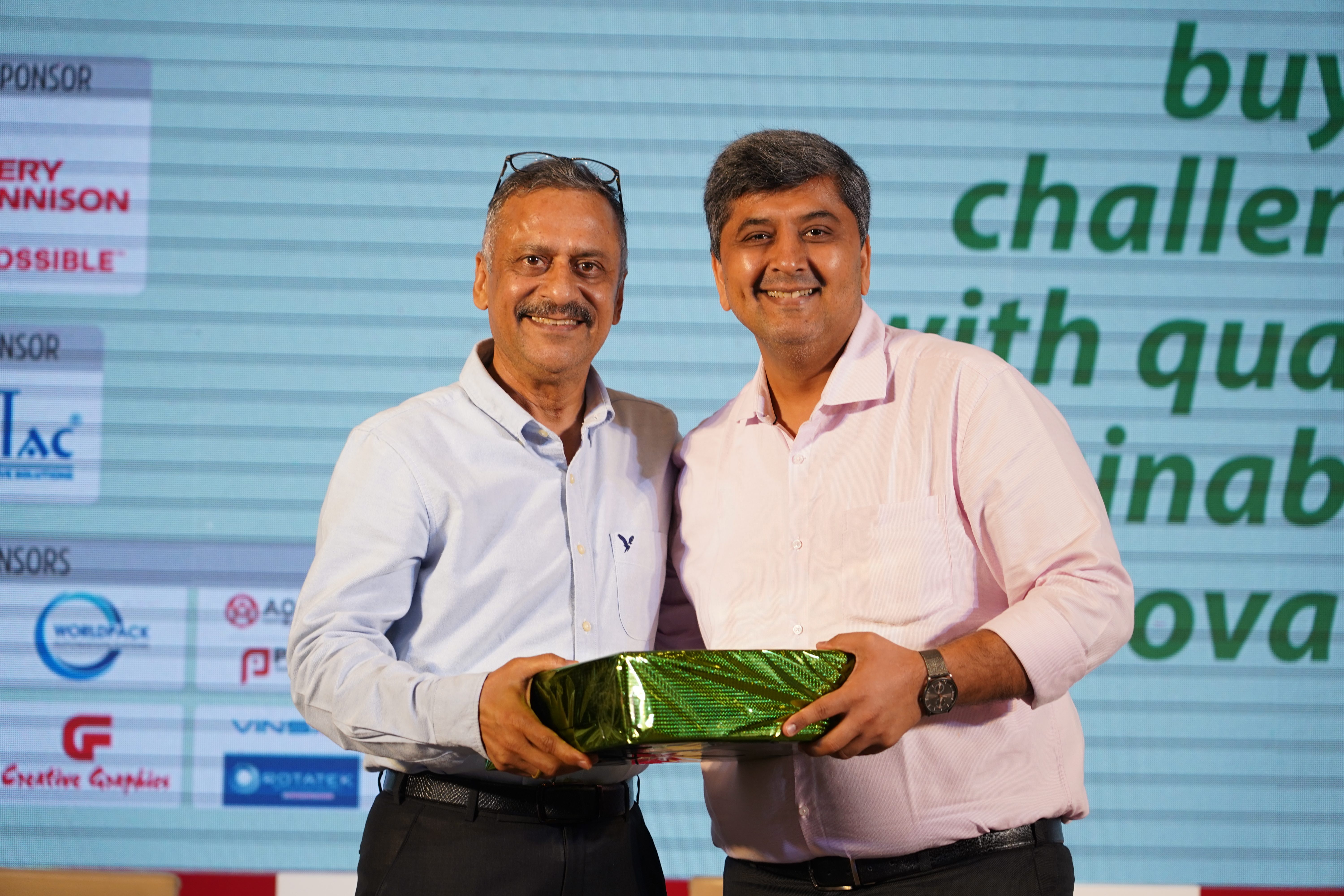
Raman Anandchahl felicitating Manoy-Avery Dennison


Jaideep Sing felicitating Ruma Ghatak Head Pkg Nestle

Dinesh Mahajan felicitating Pinkesh Kothari-Pulisi

Vote of thanks by Dinesh Mahajan


Wednesday, January 18, 2023

Sustainability and circular economy in manufacturing labels


Sustainability in its simplest terms means, giving back to Mother-Earth or environment, society, or economy, whatever you draw from it. It ultimately delivers a message for us to leave a safer planet with minimum or no depletion of resources, for generations that follow, after meeting your own imperative needs. Let us for example consider just paper. Long years ago, with development of paper, there was  a lot of promotions to increase its usage, but then it was realized that paper production was hugely dependent on wood and increased usage meant deforestation. It is an accepted fact that forests are very important for a healthy environment and climate. It was on this realization that a lot of emphasis started to be put on avoiding unnecessary paper usage. Even now responsible company emails have a footnote advising not to print unless absolutely necessary. On the other hand, there are statutory directives to paper mills to aid afforestation so as to increase the forest cover and replenish the amount of wood extracted. However still, usage of paper is sustainable when produced with implementation of replenishing the inputs used. Moreover, the paper waste is re-pulpable to again produce paper or paper board aiding circular economy. Production of all manufactured goods and services should avoid or reduce using resources that cannot be replaced and whose depletion will adversely impact the environment. As mentioned above, paper is mostly produced from wood whose extended use in paper production leads to deforestation. For this reason, a lot of manufacturers do a life cycle analysis of products to achieve a level of sustainability.

Brand owners and large label user companies have now started insisting on FSC certified paper usage. Forest Stewardship Council (FSC) is a globally recognized certification system that ensures that the forests are managed sustainably. Products that are manufactured from responsibly harvested forests are identified with the FSC logo, which is considered the “gold standard” of forest certification by major environmental groups.


Circular economy

Circular economy also referred to as circularity and CE, refers to a type of process for  production and consumption, which conforms to reusing, repairing, refurbishing or recycling materials and products. Since CE helps in reducing raw material requirement, carbon footprint and aids sustainability, it has gained popularity. It also helps in conservation of important resources. For an example of CE, milk pouches are made of mono polymers like LDPE for packaging which is easily recycled or reprocessed to again convert to plastic granules that can be remolded into usable plastic products. On the flip side, multi-polymer multi-layered film pouches are not recyclable and end up in landfills impacting environment adversely as they also do not biodegrade. However, there is work being done to develop processes that will enable these also to be recycled. The government of India is actively formulating policies and promoting projects that will drive the country towards a circular economy system. It is estimated that a circular economy path adopted by India could bring in annual benefits of 40 lakh crores or approximately US$ 624 billion in 2050.

Labels

The material for labelstock consists of many elements and sustainability cannot be in the total laminate, each component must be sustainable and contribute. The self-adhesive label laminate primarily consists of face stock with or without a primer or lamination, pressure sensitive adhesive and siliconized release paper or film. To be sustainable each element must be dwelled upon separately. The life cycle of each of these is different and an analysis needs to be done in-depth to make decisions towards achieving sustainability goals. Climate change and environmental concerns have now become issues that cannot be ignored and need to be attended to, at national and global levels. With increased statutory government directives to reduce carbon footprint and make sustainability an imperative, manufacturers are under pressure to re-engineer their products and their packaging. Leading brands have committed themselves to sustainability and circular economy to reduce their carbon footprint. Labels also being  a part of packaging must be designed to achieve maximum level of sustainability and circular economy. FMCG brand owners are now preferring packaging solutions that will enable them to achieve decrease in their carbon footprint ensuring recycling of packaging material which is environment friendly. It is thus necessary to dwell on the different components of self-adhesive labels and their diverse usage. In India Avery Dennison has launched a matrix and liner recycling program to aid these needs. The liner collected from converters is sent to a company who repulps the liner mixed with wastepaper to produce tissue for shoe industry or other paper board items. The matrix is converted to briquettes and used as fuel.

Face materials

The label face material is the actual performing part of the label that after application stays with the product during its entire lifecycle. Variety of substrates are used to be the label depending on its performance and aesthetics. These can be papers that are either coated or uncoated, plastic films or other materials. Even paper labels laminated with films are in use. Unlaminated paper is, as such, largely re-pulpable and converted to become recycled paper or paperboard to be reused but here we need to understand that in case of self-adhesive labels, paper alone does not get affixed to the product, it has an adhesive with it. The final label with the adhesive goes on to the product while the waste matrix after die-cutting in converting is waste that often goes to landfills impacting the environment adversely. It can also be shredded and molded as pellets or bricks to be used as fuel. To that extent we can consider the waste matrix sustainable as it is put to constructive use.  However still, the label that is affixed on the product has to be disposed along with the adhesive and the package it is on. So, we need to use special adhesives for the label to be re-pulpable in case of use on paper based packaging, or removable or washed off for recycling, when applied on reusable glass containers. We dwell on adhesives later in this article. Going backwards label buyers also have started insisting for their vendors to use FSC certified papers. FSC® or Forest Stewardship Council® certified paper is paper that has been harvested in a responsible manner. FSC stands for sustainable sourcing that puts forests and people first.

In case of filmic labels besides adhesive, it is another issue with worldwide movement against use of plastics wherever avoidable. The reason for this is that plastics are largely not biodegradable or non-compostable, so they are not ecofriendly. With EPR becoming mandatory in India, companies are constantly trying to use materials that can be recycled or reused. According to EPR or Extended Producers Responsibility,  which is the responsibility of Producers, Importers and Brand-owners to ensure processing of their plastic packaging waste through recycling, re-use or end of life disposal (such as co-processing/Waste-to-energy/Plastic to-oil/roadmaking/industrial-composting). The impact is evident from the fact that most companies are shifting towards paper based packaging or even paper based self-adhesive tapes. Many filmic labels are based on mono polymer PE, PP or PET so if they are used on bottles made with same polymer these can be recycled provided the adhesive is compatible. Some companies have been making changes in manufacturing to improve the recyclability of product packaging and look at ways of reducing carbon footprint.  New films, made with 30-50% post-consumer recycled material or made with biobased materials, are offered that aid the circular economy and reduce the use of fossil based packaging while reducing carbon footprint. Some of these films available are fully compostable. Specially designed thinner films that are converted to  be used for highspeed labeling are being preferred as using less material, is a good step toward sustainability.

Adhesives

Often when assessing the sustainability of a packaging, people tend to overlook the impact of adhesives that are an inherent part of the package. An adhesive that may hinder the recyclability or maybe non compostable will become a setback for the efforts to make labels and stickers sustainable. An adhesive must be chosen, such that it will comply with end-of-life process to recycle and reuse or be compostable. With advancements in technology, adhesives are derived from either natural or synthetic raw materials. A general perception, that adhesives formulated with natural inputs may be sustainable and those made from synthetics are not sustainable, is not true as a rule. Both types of adhesives can be developed and formulated to perform and yet conform to sustainability. It is important to study and select adhesive for labels based on your need. Let us for example consider self-adhesive beer labels in returnable glass bottles. In this case the adhesive should be compostable and easily washable to separate from the glass bottle for the bottle to be washed and reused while the label in the water can also be separated, recycled or dispose without adversely impacting environment. In case of PE bottles with PE labels, the adhesive should be compatible, such that it can be shredded granulated along with the bottle for remolding.  For each application the selection of adhesive is important.

Release liners

Over fifty percent of self-adhesive labelstock used for manufacturing labels or stickers  is generated as waste in converting. This is a known and accepted fact. The waste, more often than not, goes to landfills impacting environment. The release liner that protects the adhesive until the label is dispensed and applied, forms a major part of the waste generated. Since many years companies have been looking at options to either do away with the liner or reducing the waste generated by the liner. Paper based liners form more than 80% release liners used for self-adhesive labels. The paper-based liners include Glassine, SCK, CCK and Poly coated papers. Linerless labels have been considered and used for some years now but due to growing need for better aesthetics, die-cutting complex shapes and embellishments, they have limited use. To reduce the tonnage of liner waste going to landfills as a sustainability endeavor, there has been talk of reducing the caliper/grammage of liner used but not much headway has been made in this direction.

In India and Europe, glassine is largely used as the preferred release liner and accounts to over 70% of all paper liners used. For long, release papers were not considered recyclable due to the silicone coating which after crosslinking becomes inert. However with development in technology, some companies in Europe and USA  developed a de-siliconization process after which the paper can be processed to reproduce base papers for siliconizing. In the process, siliconized liner is repulped in water containing chemicals to release the silicone and remove the small silicone particles like in the process used for deinking of repulped printed papers. The de-siliconized pulp can then be used to produce new products, such as fine and specialty papers like release liner, label face, writing and printing papers. Thereby achieving circularity.


There has been substantial growth in use of filmic liners that are thinner and can take more labels per roll. The residual filmic liner can be recycled, enabling circularity. To achieve an elevated level of circular economy and sustainability, “CELAB” (Circular Economy for Labels),  was set up by 50 industry-leading companies representing the entire value chain that have come together to create a sustainable pressure sensitive labeling industry by offering solutions and providing education to enable matrix and liner recycling. It is an ad-hoc coalition empowered to reach across the entire supply chain and leverage the expertise of industry participants to promote a circular economy for self-adhesive label materials. CELAB’s members comprise industry members both large and small, and with both global and regional market presence. It also includes companies up and down the value chain of the matrix and liner industry. According to CELAB, “Like many other grades of film, silicone coated filmic release liners are recycled by regrinding the film into chips/pellets which can then be mixed with ‘virgin’ polymer and re-introduced to a film extrusion line for production of new polymeric film.”


Self-adhesive or pressure sensitive labels industry was at one time considered to be generating waste that was polluting the environment but gradually all-around efforts are driving in sustainability and recyclability. It is a matter of time the processes will evolve and the industry will shed the waste generating tag and grow.


Written by Harveer Sahni, Chairman Weldon Celloplast Limited New Delhi-India January 2023