Harveer Sahni

Harveer Sahni
Author Harveer Sahni

Avery Dennison

Avery Dennison
Sustainability at Avery Dennison
Showing posts with label sustainability. Show all posts

Monday, May 5, 2025

LABELS FRATERNITY LAUDS LMAI’S PANEL DISCUSSION

 LABELS FRATERNITY LAUDS LMAI’S PANEL DISCUSSION


 LMAI, the labels Manufacturers association of India organised a panel discussion titled, “Label buyers’ challenges with quality, Sustainability & Innovation” on the 2nd of May 2025 Hotel Radisson Blu, New Delhi. The event was attended by a “house full” of leading label printers and suppliers as sponsors. The distinguished panel consisted of leading brands Nestle, Diageo, Reckitt Benckiser, Amway, Dabur and Sun Pharma. The panel moderated by the author Harveer Sahni, Chairman Weldon Celloplast Limited and member of Board of Director LMAI. The panel on stage consisted of Arijit Mondal(Nestle), Sanjay Ghoshal( Diageo), Naveen Stuart (Reckitt Benckiser), Swati Gupta(Amway), Sidharth Sharma(Dabur) and Mohit Mittal (Sun Pharma). The delivery of responses by panelists to questions by the moderator, left the audience spellbound. Ruma Ghatak head Packaging at Nestle was a special invitee. The program was initiated by the hard-working LMAI secretary Jaideep Singh who had made untiring efforts to organize this amazing event, this was followed by the welcome speech by the LMAI President Rajesh Chadha. 

Pradeep Saroha director label expo updated the audience on the next edition of Labelexpo Europe in Barcelona Spain. Jaideep Singh shared a presentation of the upcoming LMAI biennial conference at Udaipur from 3-6 July 2025. Organising committee member Sandhya Shetty conducted the agenda efficiently. Dinesh Mahajan Vice President LMAI gave the vote of thanks. This was followed by an interactive question and answer session.

Audience

The congregation was highly appreciative of the knowledge delivering panel discussions and their responses to LMAI team and the moderator are as follows. The responses are reproduced here unedited and as received.

Mrs. Kusum Dunglay Director Redunn Labels Gurgaon: A truly impressive and well-executed event. Congratulations to LMAI and the brand owners for putting together such a memorable event.

Manish Hansoti, Founder and Managing Director S.Kumar Group Ahmedabad: Thank you for putting together such an incredible event. Your careful attention to details, from the label printer’s perspectives created an atmosphere that perfectly matched with unanswered questions from label printers to Brand owners. I especially appreciate how you handle without any boring topics. The event's success is a testament to your planning abilities and dedication. I am truly grateful for all your hard work in making this event so special.

Anuj Bhargava, Founder Kumar Labels NOIDA: Well organised event by LMAI. Intriguing questions by Label Pitamah Harveer Ji. Brand owners shared valuable insights. Always good to connect with fellow industry colleagues. Many thanks to LMAI for organising this cosy event.

Rakesh Mahajan, Director Prakash Labels Noida: It is refreshing to see buyers and sellers coming together to address common challenges. This exchange can drive innovation and growth in the label printing sector.

Yoshita Goel from Any Graphics Noida: The LMAI panel discussion held on 2nd May 2025 was a remarkable success and quite knowledgeable. The interactive session among the panelists was intellectual and brainstorming towards the printing and packaging industry.

Yogesh Agarwal Print Pack New Delhi: The event was very well-organized, and the panel discussion was insightful and engaging. Sincere thanks to Harveer Sahni Ji for moderating and conducting such a meaningful and well-curated session.

K M Manoj Director Avery Dennison: It was great to see some of the prominent packaging professionals share their views about pressure sensitive labels. The conversations  around emerging regulations, how labels can be more sustainable and actions to tackle the common challenges were insightful.

Ranesh Bajaj Managing Director Vinsak: Well organised and very informative panel discussion. It was great to hear brand owners sharing details which are critical to the growth of label convertors as they align their future plans.

Bhaumik Mehta Director Flueron Inks: It was a pleasure for us to have sponsored this event for our friends and colleagues in the label industry. The panelist, the moderator and the audience were all in sync on the topic of discussion. It was insightful to see how the brands perceive procurement, supply chain partners and their own responsibility towards sustainable solutions. What struck out was the Q and A which the panelists took their time and put the answers in perspective on the business.

Innovation and Sustainability not just in products and services but in growth and prosperity is as much essential for all partners involved and this to me was a fantastic outlook. Cheers to LMAI for hosting this and giving us an opportunity to be a part of this amazing initiative for the industry.

Inderjit Singh Toyo Inks: We are thrilled to have attended the panel discussion on Label buyers’ challenges with focus on quality, sustainability and innovation organized by LMAI (Label Manufacturers Association of India). The discussions reinforced the importance of collaborative efforts to drive sustainability, ensuring regulatory alignment while adopting innovative and sustainable approaches.

The event was an incredible experience, filled with inspiring discussions and I had the pleasure of meeting and connecting with some amazing brand owners and partners. Looking forward to applying these new learnings and continuing the conversations to fulfill the brand owner’s requirements.

Gautam Kothari Managing Director Worldpack: LMAI Event Sheds Light on Label Buyers’ Pressing Challenges. The LMAI event held last evening proved to be a timely and insightful gathering for stakeholders across the label manufacturing ecosystem. With a sharp focus on the challenges faced by label buyers, the panel brought together key voices from FMCG, pharma, and logistics sectors who shared first-hand accounts of the evolving demands and operational bottlenecks in label procurement and usage. Overall, the LMAI event succeeded in bringing buyer concerns to the forefront, sparking necessary dialogue around innovation, transparency, and strategic partnerships in the label industry.

Ashwani Kumar RSM Kurz: The recent LMAI event fostered a productive dialogue between brand owners and industry leaders regarding key challenges and potential solutions in the label manufacturing sector. Discussions highlighted the detrimental impact of price pressures and reverse auction practices on innovation, alongside the complexities of liner recycling. Brand owners underscored their requirements for superior quality, competitive pricing, and dependable partnerships, with Swati emphasizing the role of partners in brand protection. Mr. Naveen (Reckitt) articulated that effective anti-counterfeiting necessitates products being both easily recognizable and difficult to replicate. The increasing significance of track and trace technologies for ensuring product authenticity and enhancing supply chain transparency, as demonstrated by Dabur's application, was also a key takeaway.

Pradeep Saroha Director Labelexpo India: "The LMAI's 'Amazing Brand Owner Evening' was a resounding success! The interactive event brought together numerous brand owners and printers to discuss innovation and sustainability. It was a fantastic platform for networking and exploring new ideas."

The panelists also commented.

L-R: Mohit Mittal, Arijit Mondal, Sanjay Ghoshal, Harveer Sahni, Swati Gupta, Naveen Stuart, Sidharth Sharma

Arijit Mondal 
Global Packaging Development Lead Nestle: Thank you Harveer ji and panelists for super engaging discussion. It has been a super enriching experience to meet all of u in person and our super capable label fraternity. I am looking forward to another time together in the near future too.

Swati Gupta Senior Manager Open Innovation and Packaging Development Amway: Thank you, Harveer ji and all fellow panelists. Great perspectives and learning!

Sidharth Shankar Sharma DGM-Purchase Dabur: Thanks Everyone for being such a wonderful fellow panelist. Special thanks to Harveer ji for bringing us to such a platform.

Sanjay Ghoshal Head of Packaging Diageo: Thank you very much Harveer ji and the LMAI. It is my honour and privilege to be part of such an elite panel and such an august audience. It is truly a great platform for the exchange of thoughts and wisdom between the demand and Supply side of label/labelling industry.

Naveen Stuart Cluster Packaging manager - Health - SoA Reckitt Benckiser: Thankyou sir and everyone at LMAI. It was a perfectly organised event and an excellent platform to share views.

Mohit Mittal Senior Manager Packaging Development Sun Pharma: The LMAI panel discussion event was a well-organized and insightful event, bringing together key industry stakeholders, innovative technologies, and valuable networking opportunities. The sessions were informative and addressed current challenges and future trends in the label manufacturing sector. Looking forward to more such impactful gatherings in the future.

Jaideep Singh Director Zodiac Reprographics Hyderabad: Thank you each one of you to add immense value to the panel discussion event with your insights on the perspective of labels in each of your industries .We  as label printers feel reassured labels will play an important part of your brand perception and create an impact  and value perception which is important to grow your industry through the value our labels will be able to provide.

Deepanshu Goel, Founder & Managing Director Creative Graphics Noida: This was an ensemble of renowned packaging development specialists. Great learning!

Amol Naval, National Manager, Maxcess India: We had a wonderful experience at the LMAI event. It was both interactive and informative for all attendees, offering a valuable platform for close engagement and networking with existing and potential customers. Thanks to the LMAI team for organizing such an insightful gathering that brought together end users, label manufacturers, and solution providers under one roof.

Raman Anandchahl Neovation Graphics Private Limited Gurgaon: It was a pleasure to attend such a well-conducted event. The entire session was highly informative, especially for someone like me who is always eager to learn. This event was also particularly special for me, as my elder daughter, Nitya Anandchahl, who joined our business just last month, was introduced to the industry for the first time here. She interacted with the panelists and many other industry stalwarts throughout the day. I was truly happy to see how warmly everyone welcomed her and wished her success in the future. Seeing the next generation step in with such enthusiasm makes me feel assured that the future of our beautiful label industry is in safe hands.

 More Images from the event:

Harveer Sahni, Pardeep-Avery Dennison, Gautam Kothari, Chenga Reddy

Registration

Rajesh Chadha President LMAI


Ranesh Bajaj Vinsak

KD Sahni wit Rajesh Nema

Jaideep Singh
Sandhya Shetty


Pradeep Saroha-Labelexpo


Aditya Chadha -Questions time

Chenga Reddy- Hyderabad at Q&A


Bhaumik Mehta Flueron Inks at Q&A

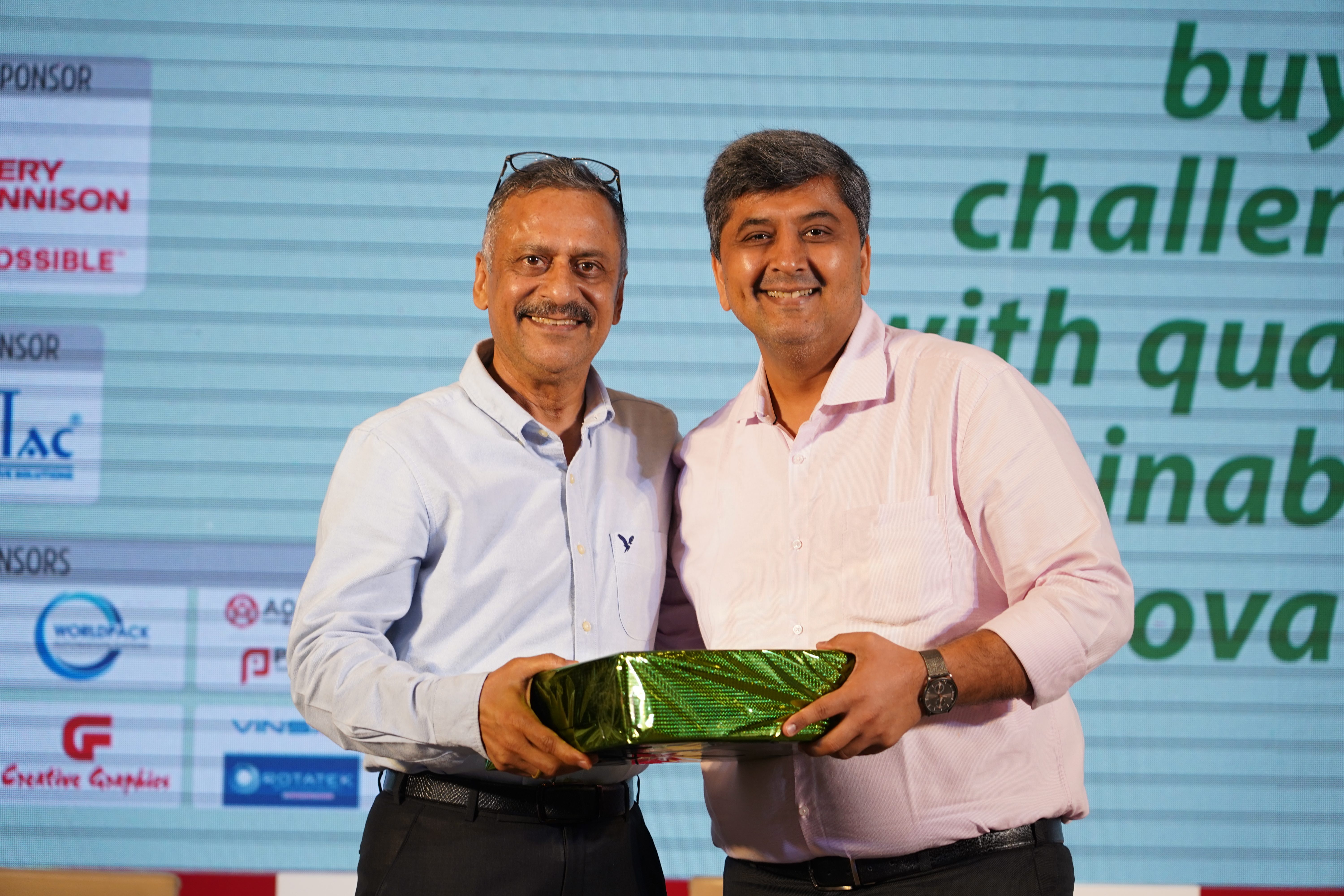
Raman Anandchahl felicitating Manoy-Avery Dennison


Jaideep Sing felicitating Ruma Ghatak Head Pkg Nestle

Dinesh Mahajan felicitating Pinkesh Kothari-Pulisi

Vote of thanks by Dinesh Mahajan


Wednesday, April 16, 2025

Sustainability, an imperative: India’s label printers make efforts!


Sustainability is the ability to sustain, carry on or endure for longer periods of time. The definition of sustainability has undergone a sea change over the years. Gradually it conveyed the message referring to environmental protection, in real terms it means using natural resources such that their benefits are available to future generations. Moving on, it is the thought process evolved to give back to mother earth, whatever we draw from it. We need to replenish the depleting resources. There was a time when depending on forests for wood to be used in various applications was a way of life, whether it was for construction, furniture, firewood for cooking or heating, or then producing paper. It soon became evident that increasing deforestation was adversely impacting the environment. Reducing forest cover was impacting on animals’ natural habitat leading to human-animal conflict, soil erosion, fewer crops, flooding, disruption of water cycles, greenhouse gas emissions, changes in the climatic conditions. There arose an urgent and imperative need to curtail the depleting forest cover. In India, the government enacted various laws; the Forest Conservation Act of 1980, the Wildlife (Protection) Act of 1972, and the Compensatory Afforestation Fund Act of 2016, along with initiatives like the National Afforestation Program and the Green India Mission. The paper industry rose to the need and started setting up and managing plantations, growing more wood than they consumed. They are now taking more steps using alternate materials like wood chips and veneer waste from the wood industry, agricultural byproducts like sugarcane bagasse, wheat or paddy straw for pulp production and increasing use of recycled paper fibers instead of virgin pulp.

No Label Look
The first half of the 20th century was witnessing the invention of the wonder material, “Plastics”, the evolution of which is a magical story. It largely replaced glass as packaging material by virtue of which packages became lighter, breakages reduced, aesthetics of packages improved and the “use and throw” or disposable packaging became evident everywhere. Toward the early second half of 20th century, plastics raw materials had started being manufactured and used in India, the usage spread fast across the country. By the 1970s plastic films gave rise to another rapidly evolving growing industry, “flexible packaging”! Households found it convenient and affordable to buy refill packs. Self-adhesive labels, which were predominantly made of paper until the 1990s, began transitioning to filmic materials. With the transparent films being adopted as face materials, started catching the fancy of the FMCG brands as they also provided the “No-Label Look” which aesthetically appealed to the consumers. While a large part of glass bottles transformed into usage of plastic bottles, the labels evolved from paper to filmic. With the evolution and  growing use, polyethylene as a versatile material, stretchable labels were produced to adorn squeezable shampoo and sauce bottles.

Single use plastics, banned!
It was also until the early 1970s that the primary packaging was labelled glass bottles, the secondary packaging was folding cartons and tertiary packaging was wooden cases. Thereafter kraft paper based corrugated cartons started replacing the heavy wooden cases. The steel strapping used to secure wooden cases was done away with. Glued flaps and remoistenable paper tapes were used to secure the corrugated board cartons, reinforced with plastic strapping. When plastic films evolved in the 1970s, self-adhesive BOPP tapes started being manufactured in India. These BOPP tapes replaced the paper tapes, and their usage grew rapidly across the country. It was a century of plastics! Plastics became a gigantic industry impacting all segments of industry from packaging, to automotive, electronics, sanitary hardware, engineering, hand tools and almost all segments of industry and society. By the 1980s, plastic was recognized as a potential environmental hazard, due to its non-biodegradability. Over the years this problem has escalated with several tons of plastic scrap dumped in oceans, landfills and elsewhere. They break down into microscopic particles that affect the health of humans, marine environments, and wildlife. Governments around the world started to enact laws to reduce the usage of plastics in day-to-day applications. In 2002, Bangladesh was the first country to ban single-use plastic bags and promote the use of jute or cloth bags in an effort protect the environment that was getting polluted due to rampant dumping of plastic bags and packaging. In July 2022 Government of India under their Plastic Waste Management Amendment Rules, 2021, banned the manufacture, import, stocking, distribution, sale, and use of identified single-use plastic items.

Non-renewable energy sources like coal, oil, and natural gas are used to make plastics, contributing to CO2 emissions and climate change. To reduce the impact and aid sustainability, Indian government started to promote the renewable energy sources like solar power, replacing fuel run passenger vehicle with electric vehicles, encourage and drive in programs leading to afforestation, preservation of water resources like rivers and water bodies, etc. These endeavors have led to the adoption of the principal of  four Rs of sustainability which are Reduce, Reuse, Recycle, and Recover leading to minimizing waste and resource consumption, promoting environmental responsibility, and fostering a circular economy. 

Reduce: It is making efforts to minimize waste and using less materials to arrive at the final product. Examples of industry’s efforts include; In 2022 liquor major Pernod-Ricard decided to do away with the secondary packs, the monocartons. This resulted in reduction of  7310 tons of carbon emissions every year while saving 2.5 lakh trees and reducing the waste going to landfills by 18745 tons. Diageo, another leading beverage brand, followed suit.

Reuse: We remember that in old times we used to have soft drink and beer bottles that were reused, though that concept has not re-emerged to the complexities involved in collection and cleaning, but several companies promote containers that find use after consumption of contents, reusable shopping bags are being preferred, and clothes also find usage after repurposing.

Recycle: This is a very important part of sustainability. It involves sorting to separate used material going waste and reprocessing to create usable material. Materials such as paper, plastic, glass and metal can be reprocessed or recycled to produce usable products.

Recover: This involves generating new products or energy from waste.

For self-adhesive labels industry it is a complex exercise as the label laminate is a multilayered multiple product construction. The label laminate consists of face material, PS adhesive, silicone and release base liner material. 50% of the laminate goes as waste before its application on the end product. The trimming from the slitting of laminate jumbo rolls, the waste matrix after die-cutting with pressure sensitive adhesive on it and the total release liner is waste that is either incinerated or goes to landfills. The label industry recognizes this and realizes that it is time that they make efforts towards  sustainable manufacturing. The author has requested many label printers on their endeavors toward this cause. Some who in numbers are a minor part of the total industry have responded about their efforts. A much larger effort is needed for the sake of this noble cause of sustainability, environmental protection and saving the depleting of natural resources for future generations. The responses are listed below.

Kuldip Goel of ANY Graphics NOIDA is the past President of Label manufacturers association of India and his initiative on sustainability are an inspiration for others in the industry. While building their new factory they have followed IGBC(Indian Green Building Council) Guidelines to create a certified green factory. Their application for Platinum Green Lead Rating which signifies a commitment to achieving the highest level of sustainability and environmental responsibility in building design and construction, is under process. Kuldip adds, “We have unwavering dedication to Innovations, and Sustainability. We have invested in impeccable infrastructure, cutting-edge technology, and a team of skilled professionals to create an environmentally friendly green infrastructure. For using renewable energy, we installed solar panels to generate 700KVA power for our captive use. 50 KL STP (Sewerage treatment plant) and 5KL ETP (Effluent treatment plant) are in place. All lights in the building are LED - to save energy. Our generators are run with PNG (Piped Natural Gas) fuel. The factory rooftop and all sides are insulated to minimize heat transfer between outside and inside. In areas within factory that have higher levels of fumes while in production, TFA AIRCONDITIONING is installed, which means the system has sensor based “Treated Fresh Air” option. There is a centrally located courtyard that has forest inside and the oxygen generated therein is being used in production areas. More than 1000 oxygen emitting trees and plants have been planted. These are special plants and not fancy decorative ones. For facilitating movement of handicapped and physically disabled easy access is provided within the factory premises.”

Krish Chhatwal, Kwality offset New Delhi; We are investing in ecofriendly technologies such as digital printing and waterless printing, to reduce waste, energy consumption, emissions and optimizing our production processes to increase efficiency.

Anuj Bhargav, Kumar Labels Noida; We are now 100% on LED UV with more than 100 units installed under one roof, reducing our energy consumption substantially. We have invested in renewable energy resources; Solar Panel installation is underway. Adopting recyclability, rPET(Recycled PET) liner is commercialized and its usage is growing. rPET labels were commercialized past year and rPET labels on rPET liner have been recently launched. We are committed to remaining sustainable and keep adopting alternatives and available options. 

Rajesh Chadha Update Prints Gurgaon: We are continuously putting  emphasis on energy and waste reduction by investing in right equipment using efficient processes, taking up regular maintenance of machines for optimal performance, training staff toward sustainability. 

Priyank Vasa Unick Fix-a-form Ahmedabad:

We participate in the matrix recycling program run by Avery Dennison for matrix waste and release liner materials saving it from going to landfills, impacting environment. We are getting FSC certification leading to usage of sustainably manufactured paper. We are planning to install rooftop solar panels for captive generation of renewable energy. We offer our customers sustainable products to select from with the help of our label stock suppliers.

Manish Hansoti S.Kumar Multi Products Pvt.Ltd.: 

We reduced energy consumption by implementing energy-efficient lighting and HVAC systems. A 300 KVA solar plant covers 30% of our electricity needs. We implement water-saving measures, including recycling water and using a reverse borewell. We partnered with Avery Dennison to recycle label stock waste and run recycling programs for paper, plastic, and other materials. Most of our mercury UV systems have been converted to LED UV to save energy. For packaging, we use paper-based gum tape instead of BOPP. We regularly apply lean manufacturing principles to reduce waste and improve efficiency.

Manoj Kochar Holoflex Kolkata: We conducted an audit of our electrical efficiency and brought about changes. As a result of this we saved about 15% energy consumption. We have invested in new energy efficient and automated machines to produce finished labels with highly reduced wastages.

Mahendra Shah Renault Paper Palghar: Our Investments in fully servo auto register press have enabled us to produce with less wastage and improved efficiency. We invested in a semi rotary press for short runs, new job proofing , base coats  and overprint varnishes for complex short runs without much wastage of material and energy. Having color matching systems offline to save press time and electricity as well. We try to use more recycled material or green material. Investment in an ink kitchen is in the process of cutting down on ink wastages. We send our waste matrix and trim waste etc. to certified recyclers.

Himanshu Kapur, JK Fine Print Mumbai: We have tied up with an NGO for recycling trims, waste matrix and other production label waste. All other waste material goes to a cement plant for generation of energy via a catalytic converter. Wastewater is treated completely before discharge. We promote wash off labels. We are in the process of converting UV drying to LED to conserve electricity.

All UV lamps are ethically disposed with mercury separated. We are planning to promote rPet as a liner to replace glassine liners.

B K Manjunath Global Printing and Packaging Bengaluru: One of our key sustainability initiatives is the installation of solar panels on our rooftop to harness renewable energy meeting 40% of our energy consumption. We invested in advanced waste management systems, including a Sewage Treatment Plant (STP) and Effluent Treatment Plant (ETP) with a combined capacity of 10 KLD (Kilo Liters per Day). This facility ensures that all wastewater generated during operations is treated and disposed in an environmentally responsible manner. We have a rainwater harvesting system with a capacity of 1 lakh liters, supporting water conservation. We are FSC® (Forest Stewardship Council®) Certified, enabling us to supply cartons, labels, and leaflets made from responsibly sourced materials. 

Rajeev Nair Stallion Systems, Kochi: In our endeavor to be a sustainable producer, we have switched over to LED to reduce power consumption. Investment is made in new faster converting equipment with increased width to produce bigger volumes efficiently with reduced wastages. We have initiated the usage of thinner liners to reduce material usage. We now source our requirement of thermal transfer ribbons from manufacturers who are fully compliant to European Standards despite the products being priced higher. We are in the process of getting our EPR registration completed. 

It is a good sign that our label converters have understood the imperative need for sustainability are taking measures to implement. Though these are initial endeavors and much more needs to be done . It is hoped that industry at large will recognize the need to leave behind a safer planet for the generations that follow. 

Written by Harveer Sahni, Chairman Weldon Celloplast Limited New Delhi April 2025

Friday, February 17, 2023

Driving profitability in labels!

 Driving profitability in labels, with embellishments, digital printing & hybrid printing

Self-adhesive or pressure sensitive labels industry in India has grown steadily right from the time of its initial entry into India to be indigenously produced in the mid-1960s when a screen printer manually created the first label. Thereafter, label manufacturing has evolved and completely transformed  technically over the years. Initially, small and slow very narrow web letter presses, 4 or 5inch wide, from the eastern part of the world were used to print with blocks and die-cut labels with flatbed dies in roll form. These presses eventually started going wider in printing width with growth in demand. The need for increased production in 1980s brought in the adoption of rotary flexographic printing presses. However, since the flexo plate technology was just evolving, usage of letterpress block printing was still growing. It was in the new millennium that developments brought in prepress and plate making technologies, made it possible for printers to decrease their dependence on letterpress printing technology and invest in flexo presses that eventually became modular and print widths going wider with increased speeds. Toward the middle of the first decade of the new millennium, the pop and Mom retail stores, known as Kirana stores catering to consumers, started being replaced by the entry of organized retail outlets and with it, came the increase in demand for labels and packaging. When it was realized the customer’s point of purchase decision to lift the product off the shelf is the driver for sales, brands felt the imperative need for attractive labels and packaging. Different print technologies started being employed and presses with advanced capabilities started being developed and offered. While all this transformation was happening, the label industry in India was all along registering a robust double-digit growth. It was largely accepted fact that even though labels are a very small part of the large packaging industry, it was more profitable. Due to this, the number of label printers kept growing, investments also came in from established offset printing companies. With cheaper label presses coming from China and availability of good affordable machines in India, the label printing capacities have grown exponentially. This increase in capacities, the pandemic, the strikes in Finnish paper mills, the Ukraine war, the re-emergence of Covid in China,  etc. brought the margins in the labels industry under intense  pressure. Raw material prices have since escalated, freight rates, salaries and overheads have increase while competition does not leave room for increase in selling prices. In such a difficult scenario, label converters are looking at options to drive in profitability.

Opinion and comments of label printers across India was sought on how to drive-in better margins in the label production in the given circumstances. Three questions were posed to all, their response is somewhat similar, yet some do have apprehensions about the steps that are suggested whether they will actually drive in margins? However still, a direction on the way forward appears to be an imperative. The  printers in the diverse geographical zones who contributed their views are as follows;

North:

Anuj Bhargava, Kumar Labels NOIDA hereinafter referred to as (AB)

Rajeev Chhatwal, Kwality Offset New Delhi (RC)

West:

Mahendra Shah, Renault Paper, Palghar (MS)

Himanshu Kapur, J K Fine Prints Mumbai (HK)

Priyank Vasa, Unick fix-a-form, Ahmedabad (PV)

East:

Manoj Kochhar, Holoflex Kolkata (MK)

South:

Raveendran Selvarajan, Seljegat Sivakasi (RS)

Lakshminarayanan Parthasarthy, Signode India Ltd. (Wintek) Bangalore (LP)

Question: Do you agree that Embellishments, Digital printing & Hybrid printing or converting are important steps to get better prices for labels?

AB: Yes, value added labels do add to margins. However still, the main buyers are few. Startups or premium products cannot add volumes where multiple players offer value additions. 

RC: Embellishments certainly will get you a better price if you have a technical edge over your competition. Just a  different printing process does not get you more price from customers. One needs to decide which process to use to get better return based on machine capabilities .

Hybrid is still not suited for the Indian Market. However good converting and finishing is important for short runs on digital to reduce wastage.


MS: Yes, I agree. With increase of just-in-time orders, shorter runs and demand for innovations,  it is economical and faster to produce with Digital printing. Embellishments complemented with other capabilities, aid improvement in value addition.


HK: More technical the labels are, better is the margin. Unfortunately, large companies expect more for less. The basics of costing has been lost by most label converters. Embellishments also add to costs, but to recover those costs is difficult.


PV: We aim for the best process fit for a job, be it digital, flexo, hybrid or offset. That is the only way to master production cost. Digital embellishment always gives an edge and keeps business secure but does not always guarantee increased profitability, it comes with its own limitations. 


MK: I agree that Embellishments, Digital printing & Hybrid printing or converting are important steps to get better prices for labels. Value addition invariably leads to a better realization. Brand protection elements such as hologram, security inks, security designing also add value.


RS: Not only embellishments, but also innovations along with having capabilities for attending to needs of customers are important. If food and pharma customer needs labels with water-based inks, we need to have those capabilities. If they need booklet labels it becomes an imperative to be able to create them. Every printing process has its own specialty so when you are able to create labels with Hybrid and digital technologies, then of course selling prices are better.

LP: QR codes and AR (Augmented Reality) in labels, connecting consumer to the brand – is what we see as way forward for profitability . Embellishment leads to aesthetics, shelf appeal, increased sale and brand value for better profits to the buyers and converters.

Question: Have you taken any steps in this direction to increase your capabilities?

AB: We are always focused to value added labels. We have capabilities do embellishments like 3-D effects, embossing, textured foiling, screen printing and many other such processes that enhance the aesthetics of product.

RC: We have already invested in converting equipment with finishing and embellishing capabilities like foiling, Screen printing, Lamination etc. Our range of labels includes- Foil stamped/embossed labels, labels with tactile effects, Laminated, 3-D embossed, Variable data and Holographic labels etc.

MS: Since long, our customer profile is such that embellishments and employment of multiple print technologies is an imperative, for this reason we invested in hybrid presses many years back. Currently to achieve just in time capabilities we are investing in digital printing which will also give us additional production time on our main printing presses.

HK: We have always invested to be a capable company, right from inception so have the capacity to do all types of embellishments.

PV: Yes, we have added digital capabilities. Having multiple printing technologies at our disposal, enables us to pick and choose processes that are best suited for a particular job depending on the complexity of decoration required. 

MK: We are constantly trying to scale up our capabilities of adding diverse authentication features and other embellishments such as foiling, registered hologram stamping, variable data printing and finding new materials that are unique.

RS: At Seljegat we always endeavour to stay invested and capable with the latest developments. We have already installed machines with multiple capabilities, and we prefer all inline. We can do embellishments, special varnishes, multilayer labels, digital for variable or personalized labels, embossing, etc. We are always ready to cater to the changing needs of customers, nowadays pharma and food companies are demanding labels to be done with water-based inks or low migration inks, we have immediately empowered ourself suitably to serve them. In today’s time if we cannot deliver that extra, then we get lost in the crowd of intense competition.

LP: We are already having all capabilities and exploring AR in labels as next step towards Brand connect and Brand promotion. 

Question: What in your opinion are factors that can drive in better margins? Please mention steps at given prices of inputs.

AB: Label companies should invest in making labelstocks for captive use, negotiate hard while buying machines and for buying raw materials.

RC: As competition gets aggressive, systems need to be designed to reduce wastages, increase productivity and buy raw material at competitive prices. Making our internal systems strong is the only way out to drive-in better margins.

MS: We started the process of optimizing production costs, long time back. We collected data of all ongoing jobs for past 3 years and calibrated all processes as per the following;

a) We dwell on actual time needed for the job and check if the processes are complying with targeted numbers.

b) If not complying what's the core reason and if for some reasons not meeting norms,  can solutions be found?

c) Evaluating, if no solution is possible, is the job generating profit for the company? 

d) If not , either get the price increase or discard such jobs to save time for more sustainable jobs.

HK: Rather than controlling the input prices on which we have no control, we should focus on getting better prices from clients. We need to factor-in the basics like label waste that is completely non-recyclable and cannot be salvaged. Label machines are capital intensive we must add the impact of cost of investment in the total price of end product.

PV: To improve profitability;

Freight cost management is an imperative, it can save lot of money.

Process improvements and wastage control is necessary. One should start with small steps like exact web sizes, proper sheet layout, special sizes for volume jobs, ink management and keeping a track of low moving stocks.

Refrain from unhealthy competition.

Learn from your mistakes as a team. Take all complaints seriously. Try implementing simple solutions. 

Update monthly  performance chart of individual operators,  give them incentives for faster turnaround and increased capacity utilization. Take corrective steps to reduce downtime due breakdowns. 

·      MK: Key to improve margins is to provide customised solutions by understanding what the customer needs. We try to incorporate various levels of authentication, embellishments and decoration to tailor solutions that best meet their needs. If a customer cannot afford to pay for the hologram, we focus on enhancing the printed authentication features keeping costs under control, and yet get a price that enhances our profitability while the customer appreciates the value we deliver.

RS:  For driving in better margins, the instant reaction is to buy cheaper but if we have to think of steps at given raw material prices then one has to research internally and implement changes. As a first step we have opted for equipment and steps for faster changeover time between jobs to increase productivity. We have invested in a system for make ready to be completed before one job ends. The changeover time for us has reduced from one and half hour to just thirty minutes. For job set up we were using fresh labelstock but now we use rejected, old and leftover unusable stocks. Next, we are now switching over to LED UV as its operational and lamp replacement cost is lower. New equipment has been ordered and will be installed soon. We plan to install an automatic butt slicer for non-stop production. Reducing wastages is also on our radar and we constantly work on it.

LP: The following steps are necessary to drive in profits;

Watertight operations, control on wastages and minimising set-up waste.

Reducing overhead costs, improving efficiency and OEE (Overall equipment effectiveness).

Propose embellishments to customer making the label more premium to claim better realisation.

Summation:

Price increase is an ongoing process, the impact of inflation is felt every year along with that of other unavoidable circumstances. So, manufacturers need to gradually increase selling prices to maintain a healthy bottom line. Unfortunately, that is an ideal scenario but in actual the selling prices are driven by market dynamics and competition. In the present situation, for the label industry, it is time to look internally and evaluate. Based on the views of the printing fraternity it is largely agreed that embellishments, security features and innovative concepts on labels that enhance the shelf appeal and lead to better sales volumes for brands, can help get better prices. The simpler the label is, more is the competition. As indigenously produced label presses have come within the reach of middle level printers, the competition in that segment has become intense. Moreover, with organized retail and ecommerce becoming the predominant selling systems, need for more decorative labels, IT enabled labels and personalized variably printed labels  with security features has escalated. Not long-ago setup of label jobs took an hour or more with 2 or 3 persons on each press and at least 100 meters of material being used before final saleable production commenced. With increased automation, advanced automatic registration controls, higher speeds, etc. now a single operator can setup a job in just a few meters in about 15-30 minutes, with increased productivity, less wastages and quick changeovers between jobs by keeping the next jobs ready. Using exact size materials and not generating offcuts is also a necessity. These are changes that add to margins and reduced operational expenses.

Food and pharma safety and health concerns are matters of importance for discerning customers, this, along with statutory rules for toxic or unsafe materials used in converting labels, are to be avoided. There is an increased demand for non-migration and water-based inks because UV inks are considered somewhat hazardous for direct food contact and skin contact applications. Printers need to have such capabilities to supply as demanded by print buyers. Most companies feel that to reduce costs there is need for internal production systems and the workflow to be strengthened or monitored continuously to reduce downtimes at each stage, opt for more automation to reduce manpower and use energy efficient machines, equipment or systems.


Finally, time has come when EPR (Extended producer responsibility) compliance has become mandatory. Sustainability and circular economy are becoming a social responsibility for earth to be a safer planet. Large FMCG companies and brands have already started opting for or expressing preference to buy from certified green companies. It will not be out of place that producing in compliance, may as well add to cost but it may also qualify for better pricing for this good social cause.


Written by Harveer Sahni Chairman, Weldon Celloplast Limited, New Delhi February 2023

Wednesday, January 18, 2023

Sustainability and circular economy in manufacturing labels


Sustainability in its simplest terms means, giving back to Mother-Earth or environment, society, or economy, whatever you draw from it. It ultimately delivers a message for us to leave a safer planet with minimum or no depletion of resources, for generations that follow, after meeting your own imperative needs. Let us for example consider just paper. Long years ago, with development of paper, there was  a lot of promotions to increase its usage, but then it was realized that paper production was hugely dependent on wood and increased usage meant deforestation. It is an accepted fact that forests are very important for a healthy environment and climate. It was on this realization that a lot of emphasis started to be put on avoiding unnecessary paper usage. Even now responsible company emails have a footnote advising not to print unless absolutely necessary. On the other hand, there are statutory directives to paper mills to aid afforestation so as to increase the forest cover and replenish the amount of wood extracted. However still, usage of paper is sustainable when produced with implementation of replenishing the inputs used. Moreover, the paper waste is re-pulpable to again produce paper or paper board aiding circular economy. Production of all manufactured goods and services should avoid or reduce using resources that cannot be replaced and whose depletion will adversely impact the environment. As mentioned above, paper is mostly produced from wood whose extended use in paper production leads to deforestation. For this reason, a lot of manufacturers do a life cycle analysis of products to achieve a level of sustainability.

Brand owners and large label user companies have now started insisting on FSC certified paper usage. Forest Stewardship Council (FSC) is a globally recognized certification system that ensures that the forests are managed sustainably. Products that are manufactured from responsibly harvested forests are identified with the FSC logo, which is considered the “gold standard” of forest certification by major environmental groups.


Circular economy

Circular economy also referred to as circularity and CE, refers to a type of process for  production and consumption, which conforms to reusing, repairing, refurbishing or recycling materials and products. Since CE helps in reducing raw material requirement, carbon footprint and aids sustainability, it has gained popularity. It also helps in conservation of important resources. For an example of CE, milk pouches are made of mono polymers like LDPE for packaging which is easily recycled or reprocessed to again convert to plastic granules that can be remolded into usable plastic products. On the flip side, multi-polymer multi-layered film pouches are not recyclable and end up in landfills impacting environment adversely as they also do not biodegrade. However, there is work being done to develop processes that will enable these also to be recycled. The government of India is actively formulating policies and promoting projects that will drive the country towards a circular economy system. It is estimated that a circular economy path adopted by India could bring in annual benefits of 40 lakh crores or approximately US$ 624 billion in 2050.

Labels

The material for labelstock consists of many elements and sustainability cannot be in the total laminate, each component must be sustainable and contribute. The self-adhesive label laminate primarily consists of face stock with or without a primer or lamination, pressure sensitive adhesive and siliconized release paper or film. To be sustainable each element must be dwelled upon separately. The life cycle of each of these is different and an analysis needs to be done in-depth to make decisions towards achieving sustainability goals. Climate change and environmental concerns have now become issues that cannot be ignored and need to be attended to, at national and global levels. With increased statutory government directives to reduce carbon footprint and make sustainability an imperative, manufacturers are under pressure to re-engineer their products and their packaging. Leading brands have committed themselves to sustainability and circular economy to reduce their carbon footprint. Labels also being  a part of packaging must be designed to achieve maximum level of sustainability and circular economy. FMCG brand owners are now preferring packaging solutions that will enable them to achieve decrease in their carbon footprint ensuring recycling of packaging material which is environment friendly. It is thus necessary to dwell on the different components of self-adhesive labels and their diverse usage. In India Avery Dennison has launched a matrix and liner recycling program to aid these needs. The liner collected from converters is sent to a company who repulps the liner mixed with wastepaper to produce tissue for shoe industry or other paper board items. The matrix is converted to briquettes and used as fuel.

Face materials

The label face material is the actual performing part of the label that after application stays with the product during its entire lifecycle. Variety of substrates are used to be the label depending on its performance and aesthetics. These can be papers that are either coated or uncoated, plastic films or other materials. Even paper labels laminated with films are in use. Unlaminated paper is, as such, largely re-pulpable and converted to become recycled paper or paperboard to be reused but here we need to understand that in case of self-adhesive labels, paper alone does not get affixed to the product, it has an adhesive with it. The final label with the adhesive goes on to the product while the waste matrix after die-cutting in converting is waste that often goes to landfills impacting the environment adversely. It can also be shredded and molded as pellets or bricks to be used as fuel. To that extent we can consider the waste matrix sustainable as it is put to constructive use.  However still, the label that is affixed on the product has to be disposed along with the adhesive and the package it is on. So, we need to use special adhesives for the label to be re-pulpable in case of use on paper based packaging, or removable or washed off for recycling, when applied on reusable glass containers. We dwell on adhesives later in this article. Going backwards label buyers also have started insisting for their vendors to use FSC certified papers. FSC® or Forest Stewardship Council® certified paper is paper that has been harvested in a responsible manner. FSC stands for sustainable sourcing that puts forests and people first.

In case of filmic labels besides adhesive, it is another issue with worldwide movement against use of plastics wherever avoidable. The reason for this is that plastics are largely not biodegradable or non-compostable, so they are not ecofriendly. With EPR becoming mandatory in India, companies are constantly trying to use materials that can be recycled or reused. According to EPR or Extended Producers Responsibility,  which is the responsibility of Producers, Importers and Brand-owners to ensure processing of their plastic packaging waste through recycling, re-use or end of life disposal (such as co-processing/Waste-to-energy/Plastic to-oil/roadmaking/industrial-composting). The impact is evident from the fact that most companies are shifting towards paper based packaging or even paper based self-adhesive tapes. Many filmic labels are based on mono polymer PE, PP or PET so if they are used on bottles made with same polymer these can be recycled provided the adhesive is compatible. Some companies have been making changes in manufacturing to improve the recyclability of product packaging and look at ways of reducing carbon footprint.  New films, made with 30-50% post-consumer recycled material or made with biobased materials, are offered that aid the circular economy and reduce the use of fossil based packaging while reducing carbon footprint. Some of these films available are fully compostable. Specially designed thinner films that are converted to  be used for highspeed labeling are being preferred as using less material, is a good step toward sustainability.

Adhesives

Often when assessing the sustainability of a packaging, people tend to overlook the impact of adhesives that are an inherent part of the package. An adhesive that may hinder the recyclability or maybe non compostable will become a setback for the efforts to make labels and stickers sustainable. An adhesive must be chosen, such that it will comply with end-of-life process to recycle and reuse or be compostable. With advancements in technology, adhesives are derived from either natural or synthetic raw materials. A general perception, that adhesives formulated with natural inputs may be sustainable and those made from synthetics are not sustainable, is not true as a rule. Both types of adhesives can be developed and formulated to perform and yet conform to sustainability. It is important to study and select adhesive for labels based on your need. Let us for example consider self-adhesive beer labels in returnable glass bottles. In this case the adhesive should be compostable and easily washable to separate from the glass bottle for the bottle to be washed and reused while the label in the water can also be separated, recycled or dispose without adversely impacting environment. In case of PE bottles with PE labels, the adhesive should be compatible, such that it can be shredded granulated along with the bottle for remolding.  For each application the selection of adhesive is important.

Release liners

Over fifty percent of self-adhesive labelstock used for manufacturing labels or stickers  is generated as waste in converting. This is a known and accepted fact. The waste, more often than not, goes to landfills impacting environment. The release liner that protects the adhesive until the label is dispensed and applied, forms a major part of the waste generated. Since many years companies have been looking at options to either do away with the liner or reducing the waste generated by the liner. Paper based liners form more than 80% release liners used for self-adhesive labels. The paper-based liners include Glassine, SCK, CCK and Poly coated papers. Linerless labels have been considered and used for some years now but due to growing need for better aesthetics, die-cutting complex shapes and embellishments, they have limited use. To reduce the tonnage of liner waste going to landfills as a sustainability endeavor, there has been talk of reducing the caliper/grammage of liner used but not much headway has been made in this direction.

In India and Europe, glassine is largely used as the preferred release liner and accounts to over 70% of all paper liners used. For long, release papers were not considered recyclable due to the silicone coating which after crosslinking becomes inert. However with development in technology, some companies in Europe and USA  developed a de-siliconization process after which the paper can be processed to reproduce base papers for siliconizing. In the process, siliconized liner is repulped in water containing chemicals to release the silicone and remove the small silicone particles like in the process used for deinking of repulped printed papers. The de-siliconized pulp can then be used to produce new products, such as fine and specialty papers like release liner, label face, writing and printing papers. Thereby achieving circularity.


There has been substantial growth in use of filmic liners that are thinner and can take more labels per roll. The residual filmic liner can be recycled, enabling circularity. To achieve an elevated level of circular economy and sustainability, “CELAB” (Circular Economy for Labels),  was set up by 50 industry-leading companies representing the entire value chain that have come together to create a sustainable pressure sensitive labeling industry by offering solutions and providing education to enable matrix and liner recycling. It is an ad-hoc coalition empowered to reach across the entire supply chain and leverage the expertise of industry participants to promote a circular economy for self-adhesive label materials. CELAB’s members comprise industry members both large and small, and with both global and regional market presence. It also includes companies up and down the value chain of the matrix and liner industry. According to CELAB, “Like many other grades of film, silicone coated filmic release liners are recycled by regrinding the film into chips/pellets which can then be mixed with ‘virgin’ polymer and re-introduced to a film extrusion line for production of new polymeric film.”


Self-adhesive or pressure sensitive labels industry was at one time considered to be generating waste that was polluting the environment but gradually all-around efforts are driving in sustainability and recyclability. It is a matter of time the processes will evolve and the industry will shed the waste generating tag and grow.


Written by Harveer Sahni, Chairman Weldon Celloplast Limited New Delhi-India January 2023