Harveer Sahni

Harveer Sahni
Author Harveer Sahni

Avery Dennison

Avery Dennison
Sustainability at Avery Dennison
Showing posts with label PSA. Show all posts

Wednesday, April 17, 2024

Rajesh Chadha; From small beginnings to big success!

 The history of Rajesh Chadha, Managing Director of Update Prints Pvt. Ltd., which owes its inception and inheritance to P C Chadha & Co. started by his grandfather, is an interesting one. The first thoughts on letterpress, managing waste problems and family support were all highlights along the way that came on a journey from Kobe in Japan to New Delhi in India, following is the Indian Label converter’s history and thoughts for the future.

Update Factory

 The very beginning

In the late 1970s and early 1980s driving on the western part of New Delhi’s Ring Road, many factories could be seen from far away. One such tall building was the factory of P C Chadha & Co. in the Naraina Industrial Area with a signboard on top visible from far. Around the mid-1980s when I was a commercial siliconiser selling release papers, I came to know that P C Chadha & Co. manufactured stickers and was a prospective customer. It was then a matter of time before I supplied some reams of release paper to them. During one of my visits to them, I spent two hours discussing why the stickers they were supplying were curling. I was quite naïve then but with time and experience, I have written on my blog a very widely read article on controlling curl. The young man I met was Rajesh Chadha, who was running P C Chadha & Co. and is the present Managing Director of Update Prints Pvt. Ltd. which owes its inception and inheritance to P C Chadha & Co. started by his grandfather.

 Starting up

In 1924, young P C Chadha, living in Kobe, Japan, initiated an enterprise producing paper transfer labels with a vision that branding would be an important tool for sales of any consumer product, label being the face of any product. Sometime in the midst of turbulent times during World War II in 1942–43, P C Chadha decided to return to his homeland in Rawalpindi, then a part of undivided India and now in Pakistan. Little did he realize that in yet another five years he would have to move again! At the time of India’s partition in 1947 he came to Mumbai to set up his production for maintaining continuity in his passion for producing transfers, the labels of that time. Chadha soon came to recognise that the weather in Mumbai was not suitable for his product, and he moved operations to Pune. Before long he was still restless at the location and travelled up North in India to Patel Nagar in New Delhi where he set up his factory on a 150 square yards plot. He initially worked from home and later from his small factory.

Sewing machine with transfer labels
As an entrepreneur’s son, the author had seen his father get advertisement boards hand painted by artists for advertising their stationery products. There was no alternative then. When one saw the transfer labels one used to wonder how they could achieve such exquisite printing direct on sewing machines, postal vans, crockery etc. Years later as the label industry was evolving into screen printing, I saw the same exquisite type of printing, which was different from screen printing, in my cousin’s factory making automotive filters. I realised they were using transfer labels like the ones P C Chadha & Co. produced. I was amazed to learn that the process employed by Chadha for printing was lithography. Based on the principle that oil and water do not mix, printing is done using stone blocks. In 1950 P C Chadha was joined in the business by his son Tilak Raj Chadha. They bought a used lithographic printing machine from England to expand their paper transfers business. Evolving further they later shifted to printing on cylinder type printing press using Zinc blocks mounted on wooden bases.

 Major changes

Major changes started to happen when P C Chadha’s grandson Rajesh Chadha joined the business in 1976. The same year they moved factory from Patel Nagar to a 600 square yards plot in the nearby Naraina Industrial Area. With Rajesh at the helm, in 1978 he started to produce stickers by the manual screen-printing process. For the next ten years screen printing business became the mainstay for Chadhas. One of the first major decisions taken by Rajesh Chadha was to buy a European automatic Svecia Screen printing machine to print a full 20” x 30” sheet, quite big for that time. The 1990s was a very eventful decade for the Indian label industry. It was the time when many of today’s stalwarts in the Indian label industry became visible. For Rajesh Chadha also, it was time to shed the conventional image and adopt a modern look. It was during this period that the conventional sticker became an engineered label. Rajesh set up Update Prints in 1994 as his flagship venture thereon, gradually taking over all the business of P C Chadha & Co, which was eventually wound up later in 2009. Sensing the need to modernize with faster machines at Update Prints; he bought his first rotary flexo label press, a ”Focus“. There was no looking back after this.

 Investments

Rajesh and Aditya Chadha
In 2001 he bought an Orthotec intermittent letterpress at Labelexpo Asia held in Singapore. Two years later he impulsively bought a Rotatek label press displayed at a New Delhi print exhibition, on an immediate payment basis in full, taking his industry colleagues by surprise. Update Prints under his leadership has been acquiring new state-of-the-art equipment at regular intervals. From the single 600 square yards factory the company was soon operating from three different plots, one of 1000 square yards and two of 600 square yards. It was now time to consolidate for a few years. In another strategic move in 2013, Update Prints moved all their manufacturing operations under one roof to a facility admeasuring almost 25,000 square yards in land area and 50,000 square feet shop floor. This exercise required the involvement of a huge amount of money, time, effort and commitment. The land was designated agricultural land. Setting up an industrial project on it was illegal. Many people in the area have done it but Rajesh Chadha is committed to tread the straight path. He got the land use changed to industrial. Any Indian will know the kind of effort and time this takes. Infrastructure was another problem; the nearest power feeder was far away and to expedite the matter of bringing power to the unit, Update Prints had to install 50 electricity poles at their own expense. The approach road to the unit was in shambles, it had to be re-laid at their own expense. Update Prints now employs over 100 workforce and has a total of eight label presses.

 Diverse technologies

Reminiscing about his work in the initial days in labels he says, ”The first label that I created was for Yardley Cosmetics“ he further adds that in those days he had bought two Newfoil three station hot-foiling presses. He used to love working with them creating innovative products. It was the most satisfying part for him because he could imagine and then create labels that would get appreciation from buyers. He has over the years equipped Update Prints with diverse technologies in label printing, decorating and finishing. Whether it is offset printed labels printed on his Rotatek Brava or labels created on flexo, letterpress, hot or cold foiling, screen printing, etc. his company is never left wanting for the ability to create. He is proud to say that  “I deliver quality, service and satisfaction to my customers and for this reason work comes to me automatically. I do not have to waste time running after work.” While discussing digital printing I was not surprised that his reaction was similar to that of a larger part of the Indian label fraternity, ”It does not make sense to me at this point of time. I can print good quality short runs cost effectively on offset and letterpress“. A very interesting change that I noted in Rajesh during my talks with him is that he has started to encourage Indian entrepreneurs who have excelled. While most of his equipment is imported yet in recent times he saw the potential in an Indian manufacturer of label presses, Multitec. He was not hesitant and bought the equipment. In fact, he has followed it up by acquiring two more.

Family life

Aditya on shopfloor
Rajesh Chadha being the elder son in his family, like in most migrant Punjabi families of that time in New Delhi, joined the business while he was still studying. He is an alumnus of New Delhi’s Salwan Public School and later studied commerce in Dayal Singh College for B.Com and finished with a master’s in commerce. His wife Anju is a master’s degree holder in English and takes an active interest in the business. Rajesh and Anju have two children who are both now married. Their daughter Upasna studied at the prestigious London School of Economics and spent time at Oxford University. Son Aditya, like his father, studied commerce from Delhi’s Shri Ram College of Commerce and later completed his MBA in marketing from ”Rutgers, The State University of New Jersey, USA“. Then after a one-and-a-half-year work experience in AT&T in the US, he returned to India to join his father at Update Prints as director. Rajesh fondly mentored him to take charge of this company.


Update Prints’ business has transformed over the years. They do very little transfer labels business now and largely produce self-adhesive labels. Their customers are mostly leading FMCG companies. Ten percent of their produce goes into export. While in Patel Nagar, waste management was a big problem for them. With the company growing continuously, disposal was becoming a gigantic issue. It was one of the reasons besides expansion that they moved to this present location some 35 Kilometers from Delhi. Here they have developed collectors who take the waste and convert it for various usages and applications. He strongly feels someone needs to work in the direction of managing or recycling this waste effectively and believes a solution will evolve. He also feels going linerless is also a good direction but like digital printing it will be some time before this technology becomes adaptable extensively.

 Rajesh Chadha is satisfied about the time he has spent in the label industry, he says, ”It is an interesting industry. There is lot of work and room for creativity and innovation“. He is proud of his achievements. He has led the company to consistently achieve an almost 20% per annum growth rate, which is above the perceived industry rate. He is beaming when he says, ”Growth comes naturally to my company because of the quality of our work. It is not fueled by huge borrowings from banks“. No wonder he heads a fully family owned successful and growing zero debt company!

 Written in May 2014 and updated in April2024.


Friday, February 17, 2023

Driving profitability in labels!

 Driving profitability in labels, with embellishments, digital printing & hybrid printing

Self-adhesive or pressure sensitive labels industry in India has grown steadily right from the time of its initial entry into India to be indigenously produced in the mid-1960s when a screen printer manually created the first label. Thereafter, label manufacturing has evolved and completely transformed  technically over the years. Initially, small and slow very narrow web letter presses, 4 or 5inch wide, from the eastern part of the world were used to print with blocks and die-cut labels with flatbed dies in roll form. These presses eventually started going wider in printing width with growth in demand. The need for increased production in 1980s brought in the adoption of rotary flexographic printing presses. However, since the flexo plate technology was just evolving, usage of letterpress block printing was still growing. It was in the new millennium that developments brought in prepress and plate making technologies, made it possible for printers to decrease their dependence on letterpress printing technology and invest in flexo presses that eventually became modular and print widths going wider with increased speeds. Toward the middle of the first decade of the new millennium, the pop and Mom retail stores, known as Kirana stores catering to consumers, started being replaced by the entry of organized retail outlets and with it, came the increase in demand for labels and packaging. When it was realized the customer’s point of purchase decision to lift the product off the shelf is the driver for sales, brands felt the imperative need for attractive labels and packaging. Different print technologies started being employed and presses with advanced capabilities started being developed and offered. While all this transformation was happening, the label industry in India was all along registering a robust double-digit growth. It was largely accepted fact that even though labels are a very small part of the large packaging industry, it was more profitable. Due to this, the number of label printers kept growing, investments also came in from established offset printing companies. With cheaper label presses coming from China and availability of good affordable machines in India, the label printing capacities have grown exponentially. This increase in capacities, the pandemic, the strikes in Finnish paper mills, the Ukraine war, the re-emergence of Covid in China,  etc. brought the margins in the labels industry under intense  pressure. Raw material prices have since escalated, freight rates, salaries and overheads have increase while competition does not leave room for increase in selling prices. In such a difficult scenario, label converters are looking at options to drive in profitability.

Opinion and comments of label printers across India was sought on how to drive-in better margins in the label production in the given circumstances. Three questions were posed to all, their response is somewhat similar, yet some do have apprehensions about the steps that are suggested whether they will actually drive in margins? However still, a direction on the way forward appears to be an imperative. The  printers in the diverse geographical zones who contributed their views are as follows;

North:

Anuj Bhargava, Kumar Labels NOIDA hereinafter referred to as (AB)

Rajeev Chhatwal, Kwality Offset New Delhi (RC)

West:

Mahendra Shah, Renault Paper, Palghar (MS)

Himanshu Kapur, J K Fine Prints Mumbai (HK)

Priyank Vasa, Unick fix-a-form, Ahmedabad (PV)

East:

Manoj Kochhar, Holoflex Kolkata (MK)

South:

Raveendran Selvarajan, Seljegat Sivakasi (RS)

Lakshminarayanan Parthasarthy, Signode India Ltd. (Wintek) Bangalore (LP)

Question: Do you agree that Embellishments, Digital printing & Hybrid printing or converting are important steps to get better prices for labels?

AB: Yes, value added labels do add to margins. However still, the main buyers are few. Startups or premium products cannot add volumes where multiple players offer value additions. 

RC: Embellishments certainly will get you a better price if you have a technical edge over your competition. Just a  different printing process does not get you more price from customers. One needs to decide which process to use to get better return based on machine capabilities .

Hybrid is still not suited for the Indian Market. However good converting and finishing is important for short runs on digital to reduce wastage.


MS: Yes, I agree. With increase of just-in-time orders, shorter runs and demand for innovations,  it is economical and faster to produce with Digital printing. Embellishments complemented with other capabilities, aid improvement in value addition.


HK: More technical the labels are, better is the margin. Unfortunately, large companies expect more for less. The basics of costing has been lost by most label converters. Embellishments also add to costs, but to recover those costs is difficult.


PV: We aim for the best process fit for a job, be it digital, flexo, hybrid or offset. That is the only way to master production cost. Digital embellishment always gives an edge and keeps business secure but does not always guarantee increased profitability, it comes with its own limitations. 


MK: I agree that Embellishments, Digital printing & Hybrid printing or converting are important steps to get better prices for labels. Value addition invariably leads to a better realization. Brand protection elements such as hologram, security inks, security designing also add value.


RS: Not only embellishments, but also innovations along with having capabilities for attending to needs of customers are important. If food and pharma customer needs labels with water-based inks, we need to have those capabilities. If they need booklet labels it becomes an imperative to be able to create them. Every printing process has its own specialty so when you are able to create labels with Hybrid and digital technologies, then of course selling prices are better.

LP: QR codes and AR (Augmented Reality) in labels, connecting consumer to the brand – is what we see as way forward for profitability . Embellishment leads to aesthetics, shelf appeal, increased sale and brand value for better profits to the buyers and converters.

Question: Have you taken any steps in this direction to increase your capabilities?

AB: We are always focused to value added labels. We have capabilities do embellishments like 3-D effects, embossing, textured foiling, screen printing and many other such processes that enhance the aesthetics of product.

RC: We have already invested in converting equipment with finishing and embellishing capabilities like foiling, Screen printing, Lamination etc. Our range of labels includes- Foil stamped/embossed labels, labels with tactile effects, Laminated, 3-D embossed, Variable data and Holographic labels etc.

MS: Since long, our customer profile is such that embellishments and employment of multiple print technologies is an imperative, for this reason we invested in hybrid presses many years back. Currently to achieve just in time capabilities we are investing in digital printing which will also give us additional production time on our main printing presses.

HK: We have always invested to be a capable company, right from inception so have the capacity to do all types of embellishments.

PV: Yes, we have added digital capabilities. Having multiple printing technologies at our disposal, enables us to pick and choose processes that are best suited for a particular job depending on the complexity of decoration required. 

MK: We are constantly trying to scale up our capabilities of adding diverse authentication features and other embellishments such as foiling, registered hologram stamping, variable data printing and finding new materials that are unique.

RS: At Seljegat we always endeavour to stay invested and capable with the latest developments. We have already installed machines with multiple capabilities, and we prefer all inline. We can do embellishments, special varnishes, multilayer labels, digital for variable or personalized labels, embossing, etc. We are always ready to cater to the changing needs of customers, nowadays pharma and food companies are demanding labels to be done with water-based inks or low migration inks, we have immediately empowered ourself suitably to serve them. In today’s time if we cannot deliver that extra, then we get lost in the crowd of intense competition.

LP: We are already having all capabilities and exploring AR in labels as next step towards Brand connect and Brand promotion. 

Question: What in your opinion are factors that can drive in better margins? Please mention steps at given prices of inputs.

AB: Label companies should invest in making labelstocks for captive use, negotiate hard while buying machines and for buying raw materials.

RC: As competition gets aggressive, systems need to be designed to reduce wastages, increase productivity and buy raw material at competitive prices. Making our internal systems strong is the only way out to drive-in better margins.

MS: We started the process of optimizing production costs, long time back. We collected data of all ongoing jobs for past 3 years and calibrated all processes as per the following;

a) We dwell on actual time needed for the job and check if the processes are complying with targeted numbers.

b) If not complying what's the core reason and if for some reasons not meeting norms,  can solutions be found?

c) Evaluating, if no solution is possible, is the job generating profit for the company? 

d) If not , either get the price increase or discard such jobs to save time for more sustainable jobs.

HK: Rather than controlling the input prices on which we have no control, we should focus on getting better prices from clients. We need to factor-in the basics like label waste that is completely non-recyclable and cannot be salvaged. Label machines are capital intensive we must add the impact of cost of investment in the total price of end product.

PV: To improve profitability;

Freight cost management is an imperative, it can save lot of money.

Process improvements and wastage control is necessary. One should start with small steps like exact web sizes, proper sheet layout, special sizes for volume jobs, ink management and keeping a track of low moving stocks.

Refrain from unhealthy competition.

Learn from your mistakes as a team. Take all complaints seriously. Try implementing simple solutions. 

Update monthly  performance chart of individual operators,  give them incentives for faster turnaround and increased capacity utilization. Take corrective steps to reduce downtime due breakdowns. 

·      MK: Key to improve margins is to provide customised solutions by understanding what the customer needs. We try to incorporate various levels of authentication, embellishments and decoration to tailor solutions that best meet their needs. If a customer cannot afford to pay for the hologram, we focus on enhancing the printed authentication features keeping costs under control, and yet get a price that enhances our profitability while the customer appreciates the value we deliver.

RS:  For driving in better margins, the instant reaction is to buy cheaper but if we have to think of steps at given raw material prices then one has to research internally and implement changes. As a first step we have opted for equipment and steps for faster changeover time between jobs to increase productivity. We have invested in a system for make ready to be completed before one job ends. The changeover time for us has reduced from one and half hour to just thirty minutes. For job set up we were using fresh labelstock but now we use rejected, old and leftover unusable stocks. Next, we are now switching over to LED UV as its operational and lamp replacement cost is lower. New equipment has been ordered and will be installed soon. We plan to install an automatic butt slicer for non-stop production. Reducing wastages is also on our radar and we constantly work on it.

LP: The following steps are necessary to drive in profits;

Watertight operations, control on wastages and minimising set-up waste.

Reducing overhead costs, improving efficiency and OEE (Overall equipment effectiveness).

Propose embellishments to customer making the label more premium to claim better realisation.

Summation:

Price increase is an ongoing process, the impact of inflation is felt every year along with that of other unavoidable circumstances. So, manufacturers need to gradually increase selling prices to maintain a healthy bottom line. Unfortunately, that is an ideal scenario but in actual the selling prices are driven by market dynamics and competition. In the present situation, for the label industry, it is time to look internally and evaluate. Based on the views of the printing fraternity it is largely agreed that embellishments, security features and innovative concepts on labels that enhance the shelf appeal and lead to better sales volumes for brands, can help get better prices. The simpler the label is, more is the competition. As indigenously produced label presses have come within the reach of middle level printers, the competition in that segment has become intense. Moreover, with organized retail and ecommerce becoming the predominant selling systems, need for more decorative labels, IT enabled labels and personalized variably printed labels  with security features has escalated. Not long-ago setup of label jobs took an hour or more with 2 or 3 persons on each press and at least 100 meters of material being used before final saleable production commenced. With increased automation, advanced automatic registration controls, higher speeds, etc. now a single operator can setup a job in just a few meters in about 15-30 minutes, with increased productivity, less wastages and quick changeovers between jobs by keeping the next jobs ready. Using exact size materials and not generating offcuts is also a necessity. These are changes that add to margins and reduced operational expenses.

Food and pharma safety and health concerns are matters of importance for discerning customers, this, along with statutory rules for toxic or unsafe materials used in converting labels, are to be avoided. There is an increased demand for non-migration and water-based inks because UV inks are considered somewhat hazardous for direct food contact and skin contact applications. Printers need to have such capabilities to supply as demanded by print buyers. Most companies feel that to reduce costs there is need for internal production systems and the workflow to be strengthened or monitored continuously to reduce downtimes at each stage, opt for more automation to reduce manpower and use energy efficient machines, equipment or systems.


Finally, time has come when EPR (Extended producer responsibility) compliance has become mandatory. Sustainability and circular economy are becoming a social responsibility for earth to be a safer planet. Large FMCG companies and brands have already started opting for or expressing preference to buy from certified green companies. It will not be out of place that producing in compliance, may as well add to cost but it may also qualify for better pricing for this good social cause.


Written by Harveer Sahni Chairman, Weldon Celloplast Limited, New Delhi February 2023

Monday, August 23, 2021

Abhay Datta, a printer's tryst with machine building

On any given day, 96-year-old S.N. Dutta, Satya Narayan Dutta, the patriarch of Dutta family of Dutta Press New Delhi, can be seen strolling on the shop floors of their printing or machine building units, interacting with workers, and imparting instructions. The man is active and an institution himself in printing. Dutta was born on 15th of August 1926, long years before the partition of India, in a family that hailed from Lahore, then a part of British ruled united India. His father was the head of accounts for Indian railways. Sometime in the 1940s as a young man, he developed an interest in printing so went to a family acquaintance, Kedar Nath Mehta, a master printer in Amritsar for a one-year training in the art of printing. They used to print on Chandler & Price platen presses and supply labels to Punjab based distilleries in Hamira and Khasa. Chandler & Price was founded in 1881 in Cleveland, Ohio and manufactured a series of hand-fed platen jobbing presses, as well as an automatic feeder for these presses.

Chandler and Price Machine
Love marriages were rare in those days before the partition of India, however S.N. Dutta during his training days at Kedar Nath Mehta’s facility, developed a liking for Mehta’s daughter and eventually married her. Post partition the Dutta’s moved to their Haveli, a traditional townhouse mansion in Darya Ganj Delhi. The Haveli was a heritage building that had earlier belonged to one Sir Syed Ahmed Khan, one of the Navratans of Mughal King Akbar. It was allotted to Duttas on migration from Lahore to Delhi after partition for a sum of Rupees 4000 only. In 1951 S.N. Dutta started his maiden startup venture “Dutta Press” with a Chandler and Price machine on the ground floor of their Haveli. He bought the printing press for Rupees 1200.00 and did not have the money to put an electric motor on it. So, initially the machine was foot operated with a peddle. As a memento and a reminder of their past, the machine still stands tall on a pedestal in the lobby of their Okhla factory. Thereafter from 1951-1965 Dutta was on the move continuously, he also set up his own typesetting and composing section, then added two more machines, following it up with buying a new Heidelberg GT Platen press for just four thousand Rupees, then in the mid 1970’s a Mercedes Super Cylinder Press from Printer’s House in Faridabad, Nibolo and some more letterpress cylinder machines. Customer base acquired during this period included those from segments like beer, whiskey and lubricants with main customer being Mohan Meakin. S N Dutta has two sons Rakesh and Abhay, as business had grown and the boys were now grown up, it was time to move to the next level of business. In 1980 they moved to a new factory in Okhla and imported their first Heidelberg KORD offset press and Heidelberg TP Foil stamping machine from Germany. Those were tough times of needing import license for all imports, yet firm resolve made them to move on.

Heidelberg Weisloch Factory
Abhay Datta the younger son of S.N. Dutta, born on 16th August 1961, is an Alumnus of St. Xaviers School Delhi. He was never a serious student but had other technical interests. Barely 16 years old and in school, he started experimenting with making music systems. On finishing school, he along with his friend Joseph George set up their maiden startup venture Systm India to make and sell music systems. Abhay proudly mentions that in a couple of years his company’s turnover was higher than that of Dutta Press. Young boys in business families are prompted to spend time in family production units and Abhay was no exception and whatever exposure he got was by way of his father mentoring him to have a penchant for perfection and zero tolerance in whatever he did. One fine day his father came to him and complained, “you make so much noise testing your music systems, speakers etc., neighbours are irritated . It is not a respectable business. He appealed to Abhay that they needed help in the printing business and that he should wind up this music equipment business and join him in the printing business. Obedient as he was with immense respect for his father, Abhay could not refuse his father’s request. Abhay’s elder brother Rakesh was better in finance and other marketing activities. In just a matter of minutes Abhay decided to hand over the music business to his friend Joseph and moved on to the printing business at Dutta Press. He was sent to Heidelberg training center in Germany for training in print technologies where he spent time in the Wiesloch factory understanding mechanics and engineering of offset presses. It was an eye-opening experience for him. In India we did not have CNC machines, no auto cad computers, all the planning was done manually on huge drafting boards. It was there in Germany that he gathered an eye for perfection, low tolerances, fine finishing, good appearance and machine safety norms. This was as his father had mentored him to be a zero-tolerance person.

UV Coating Machine
Once back in the Okhla factory Abhay had to begin at the lowest rung of the ladder. He was required to clean up the machines, sweep the floor, take care of staff, serve them tea and support them in small errands besides operating all the machines personally. He learnt to run all the machines like an operator, make negatives/positives and offset plates and foil stamping blocks himself. Those were days when there were no PS plates, so he learnt all the chemistries hands on. Graining offset plates, putting sand, marbles etc. in graining machines, he did all that himself. He was a total worker like any laborer in the factory doing all kinds of jobs that included printing varnishing cutting packing and dispatch. The experience has rubbed on so well on him that even today on the shop floor in hot and humid conditions with perspiration trickling down his torso he enjoys remaining amongst his workforces. He is a hardcore technical and shopfloor production-oriented person while brother Rakesh manages the white-collar part of management. With Abhay’s penchant for perfection, he proudly mentions that we made quality, such that print buyers would come looking for them. Since they were supplying to breweries and distilleries, they came across a challenge; solvent base varnishes on labels scuffed and needed to be replaced with Water based varnishes, but these would not work on existing hand fed varnishing machines produced locally due to slow drying. Abhay was given a task by his father to make a machine that could coat aqueous varnishes at high speeds. He developed an automatic machine with the help of Sanjay Gupta of Ronald Machinery and added an anilox roll with a motor and hot air dryer to do the varnish. It worked and that was when his tryst with machine building commenced. Later he started manufacturing fully automated high-speed machines to do aqueous and UV coating with anilox rollers and chamber doctor blade systems.

Abhay Datta on Shop Floor

After that there was no looking back in machine developments. Abhay was young, success encouraged him to research, experiment and develop more from a shed in the driveway of their Okhla factory, it has been a long journey with lot of hurdles. He then started converting hot stamping machine for own use and sales. Since in earlier days they had bought a Heidelberg hot stamping machine, from experience gained, Abhay could convert die cutting machines and the Chandler and Price machines into hot stamping machines. When stamping foil suppliers became aware of his capabilities to make hot stamping machines, he became an accredited suppliers to many companies who indulged in hot stamping. In 1992 he successfully started making UV coaters and till 2016 they have supplied over 250 offline UV coating machines in India and Abroad.


During his 1995 visit to Drupa, he was fascinated by an Aquaflex label press printing Smirnoff Vodka labels. Unlike the sheet fed converting, the press was unwinding, printing, embellishing, laminating, die-cutting and delivering finished labels at the end of line in a single pass. Abhay was convinced that this is the future. Those days there was no WhatsApp where he could take videos and upload to inform his family about the equipment. Wanting his father and brother to also look at the machine before deciding, he made a trunk call, described the machine and requested them to come and see. Three days later both his father and brother flew into Germany, they saw and fell in love with the machine. They became friends with the founder of Aquaflex, signed the deal to buy a press and also became the sole selling agents in India. They opted for an eight colour press with rotary hot foil stamping. It was a bold decision as rotary tooling for hot foiling was very expensive, cold foil was not there that time and most of their production for liquor labels needed foiling. In their factory they already had 20 Heidelberg hot foil machines running, they used to buy used Heidelberg platen machines and convert them into hot foil stamping machines by retrofitting, all done by Abhay himself. The Aquaflex ordered by them was displayed at Labelexpo Singapore in 1996 and then shipped to India for Dutta Press to start printing labels on a narrow web press. Till the end of the millennium 1999 they were only printing wet glue labels on this machine. Pressure sensitive adhesive (PSA) labels production commenced only in the new millennium in 2000, they kept adding Aquaflex presses in regularity.

Ultraflex Label Press
Between 1996 and 2003 as agents, they sold nine machines to customers like PPL, ITC, Modi Federal, Sai Packaging and others. They added four more press at Dutta Press. In 2001 Aqua flex got sold to Chromos USA . At this time when he was under pressure to offer a press to his customers, he met a software engineer who suggested the name of Shanti Pal Ahuja of Multitec and once the two met, they instantly decided to get together to build label presses. Abhay invited Ahuja to his facility and have a look at the Aquaflex label presses and to do reverse engineering of the press. A complete unit was removed from the Aquaflex and sent to Multitec facility in Faridabad. It was completely meticulously redrawn and the first Ultraflex machine was developed and sold to Nishi Labels in Ahmedabad and the second machine was exhibited at Nehru Centre in the first “India Labels show” which later became Labelexpo India. That machine got sold on the very first day of the show to Khosro Moradi, of Farah Banfash Manufacturing Company, Iran. Few years down, having sold over a dozen presses, their partnership fell apart and Multitec renamed their press as Ecoflex and Abhay Datta retained the name Ultraflex that he would build himself one day. Until such time for their own label manufacturing they invested in Bobst label presses

CNC Machines at UV Graphics
Passionate about making machinery himself, in 2017 after they bought their 3rd Bobst M5 press, Abhay visited Florence and was inspired to build his own flexo press. On return from Florence in September 2017, he dug deep into the Flexo Machines and studied other equipment that would enable him to build a narrow web label press. Keeping cost down and not compromising in automation he started planning a machine with zero waste and instant make ready. He launched his first Ultra flex made in his company UV Graphics. 


Ultraflex Plate Mounter
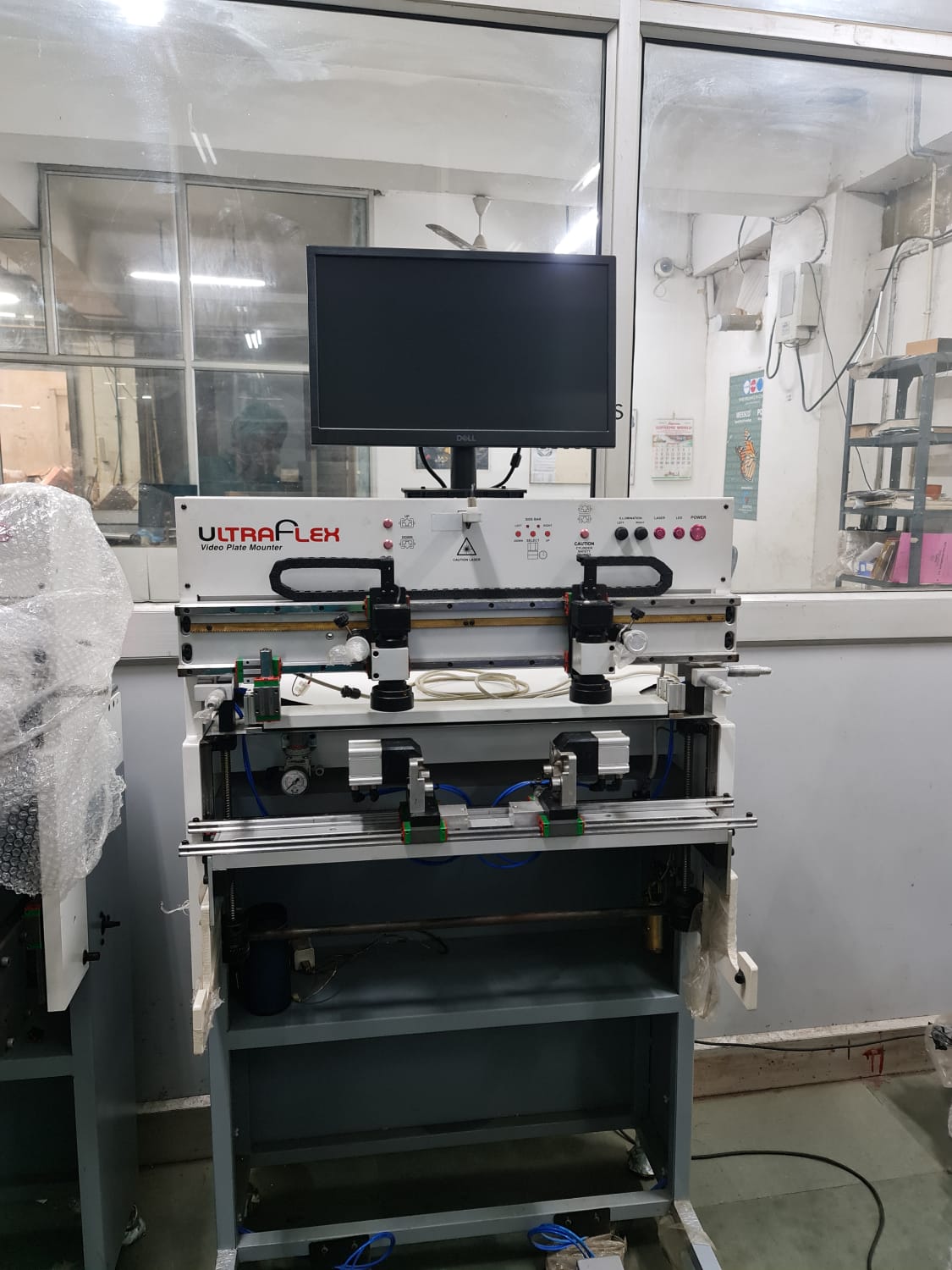
He insists that for a perfect and quick make ready, “a communication between the plate mounter and the machine is imperative.” Abhay also started making plate mounters. He asserts that with plates mounted on his plate mounters, the first meter of print which rolls out will be 99% in true register. This is his creativity. His machines and plate mounters are designed as perfectly complementary and compatible equipment  so as to make life easy for the machine operator. He claims that in 3-4 minutes you can perfectly mount an eight colour job on his plate mounter and have the machine running in full register within 3-5 meters. That says Abhay is our USP. Ultraflex machines offered by him are of international quality, fully servo driven with auto register control, it is value for money and affordable. Ever since, Abhay has already installed thirty-eight presses in India and abroad with the latest ten color machine being shipped to a prestigious customer in USA. This will be his first installation in North America and fifth machine being sold overseas.


Abhay has two sons Anuj and Akshay and a daughter Aallia. Both sons run the PSA labels division of Dutta Press while brother Rakesh manages the wet glue label business from Okhla. All family members are in business together as a joint family. UV Graphics and Dutta Press operate out of 66000 square feet factory in Noida and an 18000 square feet facility in Okhla with seven flexo presses in Okhla and six flexo presses in Noida. With a total of 280 employees, Abhay aspires that if God and Kismet helps UV Graphic will be a leading global supplier of diverse label equipment in 5 years. He proudly says, “we produce from nail to the hammer. In UV graphics we produce our own UV Systems, Plate mounters, Core cutting machines, Label presses, Slitter Rewinders, Semi Rotary Digital Finishing, Print Cylinders, Magnet Cylinder, Sheeting Cylinders, Hot Foiling Stamping Equipment, Screen Printing and almost everything that is needed for flexographic label printing and converting. We also make wide format Roll to Roll Hot Foil Stamping Machines for the tobacco industry.

The way Abhay Dutta is moving it will not be long before he achieves what he aspires.

Written by Harveer Sahni Chairman Weldon Celloplast Ltd. New Delhi August 2021

Tuesday, November 24, 2020

Creative Graphics; Service to flexographic printers at their doorstep!

Digital Flexo Plates

Flexographic printing has evolved from being a basic printing technology to a technically advanced process that can turn out quality prints comparable to those produced by the best of printing processes. The credit of this advancement goes to the development of prepress and printing plates. Prepress is the term that we refer to as the process to make ready the press, the design layout and transforming the design into data files that will eventually lead to producing the photopolymer plates to print the files on to paper or other substrates. A technically strong prepress ensures success in producing the right kind of printing. Deepanshu Goel, an Alumnus of New Delhi’s prestigious Hindu College from where he completed his B.Sc. Electronics in 1994, joined his parental business of manufacturing communication cables that was started by his father 35 years ago. Having been a topper in studies, he was not comfortable in the cables business and wished to do something different and more to do with evolving technologies. In 1998, a friend who was having a stack type flexo press suggested that he start flexo plate making business. Even though he had no knowledge of flexography yet, Deepanshu quit the cable manufacturing business in 2001, to start a plate making business.

At that time in 2001, when he did not even know what was CMYK which stands for "Cyan Magenta Yellow Black" the four basic colors used for printing color images, with a meager investment of 35000 Rupees, two employees and himself to help, he started his polymer plate making business Creative Graphics in East Delhi’s Vishwas Nagar. Those were difficult days since Deepanshu had no previous knowledge of the process. He acquired literature to understand the nuances of plate making and got hands on learning as they progressed.  Soon he had to relocate due to property sealing initiated by the Municipal Corporation Delhi, for non-permissible commercial activity in residential colonies. They moved their operations to a 1000 square foot factory in Noida’s Sector 10 from where they later shifted to Sector 9 in Noida. Mistakes happen when you are indulging in a technology that is alien to you, he bought machines that were not ideally suited for flexography and instead were meant for offset printing. Since the mindset was clearly focused on to flexographic printing plate technology and not Offset printing, the machines were sold off and new equipment that was suited for flexo plate making was acquired. In an effort to further educate himself and enhance his knowledge of plate making Deepanshu acquired literature published by BASF printing systems Germany which in 2005 became a part of the Flint group. Technology for the process at that time was not freely available so he was able to sharpen his skill by reading and practically implementing what he learnt from the literature. No doubt he made mistakes but those were taken in his stride to learn the intricacies’ of producing the perfect plates for flexographic printing.

Until 2008 Creative was making plates manually with help of small basic machines. Those were struggling days. Learning and finetuning as they went along, they associated with Flint who supported them in gaining required knowledge. In 2008 they moved to their own 3000 square foot premises in sector 8 Noida. The same year they bought the “nyloflex® Combi F III” from Flint, a Compact all-in-one system for back, main and post exposure, washout, drying and light finishing of flexo plates that would produce consistent quality due to process automation. Deepanshu Goel’s very first customer was a small flexo printer followed by printers having small stack type presses making flexible packaging and catering mostly to snack producers.  The actual break came when he started to supply metal backed UV coating plates for calendar and brochure manufacturing to Rajesh Batra lead Surya Print Process New Delhi, this was their take off point. Creative Graphics’ first Narrow Web flexo label customer was Vijay Jain led A & A labels New Delhi, who were at that time producing labels for Modicare. After this there was no looking back and it was just sharpening and perfecting skills. They also started to diversify into other segments like corrugated board, flexible packaging, stationery, etc.  besides expanding their reach to other printers in the fast-growing label industry. The flexo plate business is such that no single customer is very big, realizing this fact, for Deepanshu expanding customer base was an imperative for growing his business.

In 2008 yet again Creative Graphics acquired another 3000 square feet premises also in Noida’s Sector 8 taking their total shopfloor area to 6000 square feet. Once the economic slowdown of 2008-2010 ended, label business which was growing even during the recessionary period started looking up furthermore. In 2012-13 there was a rush of flexo press installations and it proved beneficial for the photopolymer plate business and helped Creative Graphics to grow. Added to this there was a substantial shift within the pharma, liquor, lube oil and other FMCG industries from wet glue to self-adhesive labels. Then in 2009 they bought and installed Kodak ThermoFlex Mid II Platesetter that helps turn prepress into a controlled, digital manufacturing process and enhance the quality of flexographic printing, reduce cycle times, and improve process control by eliminating variables in the plate manufacturing process. Having firmly established themselves in narrow web flexo label business, in 2012 they bought the Esko Spark digital imager followed by installing yet another processing line and a series of equipment from Dupont.

Once he was fully settled and operational in the flexographic plate making business, Deepanshu Goel decided to drive growth into his business, both organic and inorganic. He brought his total business under one company that is Creative Graphic Solutions India Private Limited. In 2017 he went on an expansion and acquisition spree by first starting operations in Mumbai then starting the Hyderabad unit that he has put under management of his brother and then acquiring the Nagesh Bakshi lead Chennai based Colordot. In 2018 he started his Baddi (Himachal Pradesh) unit bringing the total number of manufacturing units to five. Being in a service industry where time is the essence for a printer to cater to needs of large customers, he tries to be multilocational and near his label printer customers. In 2019 he moved his main unit in Noida to an 800 square meter plot in Noida’s sector 58 with 24000 square foot shopfloor. In first week of December 2020, he will be commencing production at his 6th facility at Ahmedabad. Creative Graphics is presently working out of a total 50,000 square feet shop floor area across its five units in India employing 280 people. While in this pandemic year the growth has been flat yet in preceding times, they have continuously registered 15-20% annual growth. Since as mentioned earlier in this article that a large and ever-increasing customer base is an imperative in driving this business of photo polymer plates to higher levels, Creative Graphics has done quite well. Total number of customers has reached between 700-800 out of which 250-300 are from the narrow web labels industry which is the biggest segment of their business.


Deepanshu Goel’s wife Sarika is a home maker, his elder son Tanul is a budding cricketer studying in class 12 and the younger son Utsav is in class 6., both are studying at Pathways School. When asked whether his sons will join his business Deepanshu is clear in his mind and says, “I cannot say, they will decide for themselves as I did for myself. Times are such that decisions must emanate out of interest and passion to achieve success”.


Looking at future Creative is trying build capabilities to project themselves as solution providers. While upgrading themselves with timely investment in technology to enhance their capabilities, they are also trying support growth of flexo label industry by providing sponsorship to industry related knowledge delivering events. When asked how he sees himself in 5 years, he says “we strive to double our turnover in maybe 2 to 3 years with both organic and inorganic growth”.  On the evolution of different print technologies entering the label industry, he is not worried and insists that all will grow. Market share may get divided but by the natural growth in demand, volumes will still grow and there will be enough business for all.  In fact, he is confident that flexo is evolving as a substitute for other printing technologies. He does get a little pensive when we talk of sustainability and environmental concerns as most plates after being used up either go to landfills or are incinerated. For this he feels the larger producers of plate material who develop the chemistries are the right people to address this problem. 

Written by Harveer Sahni Chairman Weldon Celloplast Limited New Delhi November 2020

Printing magazines are permitted to reproduce this article only by giving credit to the author and mentioning the blog address http://harveersahni.blogspot.com


Sunday, April 21, 2019

Indian Label Industry: LMAI Conference 2019, KOCHI, Kerala


Grand Hyatt Kochi
India’s label association LMAI’s 5th biennial conference is planned to be the biggest and most successful event of Indian label industry. The event is scheduled to be held at recently opened property, HOTEL GRAND HYATT, KOCHI, BOLGATTI from 25th - 28th July, 2019. Perched on 26 acres of plush green land on the serene Bolgatty Island, Grand Hyatt Kochi Bolgatty is a waterfront urban resort overlooking the backwaters of Vembanad Lake.


Grand Hyatt Waterfront


Leading label printing companies and suppliers will meet to discuss, evaluate opportunities, learn and strike business partnerships that shape the future of their businesses in relaxing ambience and surroundings. LMAI conference has been growing in strength and numbers over the years.


2017 LMAI Conference at Agra


The last conference was held at Agra with 550 delegates. The LMAI leadership is expecting the attendance to jump up to 600 delegates. An elaborate knowledge sharing, entertainment and technical program is being put in place to deliver value to the LMAI members coming from all over India.


About the city Kochi: Kochi (formerly known as Cochin) is a city in southwest India's coastal Kerala state, fondly referred to as “God’s own country”. It has been a port since 1341, when a flood carved out its harbour and opened it to Arab, Chinese and European merchants. Sites reflecting those influences include Fort Kochi, a settlement with tiled colonial bungalows and diverse houses of worship. Cantilevered Chinese fishing nets, typical of Kochi, have been in use for centuries.


St.Francis Church Kochi

St. Francis Church was the original site of Portuguese explorer Vasco da Gama’s burial when he died in Kochi in 1524. Santa Cruz Basilica is known for its pastel interior, including an imitation by Fra Antonio Moscheni of Leonardo da Vinci's "The Last Supper." Paradesi Synagogue, founded in 1568, features imported Chinese blue-and-white ceramic floor tiles. The surrounding quarter, once home to a large Jewish community, is now filled with antique shops and old spice warehouses. Mattancherry Palace, built by the Portuguese in the 16th century and later renovated by the Dutch, showcases vivid Hindu murals.


Label Manufacturers Association of India, LMAI has a strong support of the label industry suppliers as sponsors which has been growing steadily, making their conference, the most important label event in India. 


The following leading industry suppliers from across the world have registered as sponsors and there are still a few more on the waiting list;

SR. NO
NAME OF SPONSORS
CATEGORY
1
AVERY DENNISON INDIA P LTD
PLATINUM
2
SMI COATED PRODUCTS PVT. LTD 
DIAMOND
3
PULISI INTERGRAPHIC
DIAMOND
4
GALLUS
GOLD
5
VINSAK INDIA PVT. LTD.    
GOLD
6
HEWLETT-PACKARD INDIA SALES PVT LTD.
GOLD
7
DOMINO PRINTECH INDIA LLP
GOLD
8
MACDERMID
GOLD
9
PERFORMANCE SPECIALTY PRODUCTS (INDIA) PRIVATE LIMITED
GOLD
10
J N ARORA & CO. PVT LTD
SILVER
11
NUMEX BLOCKS INDIA PVT.LTD.
SILVER
12
APEX ASIA PACIFIC PVT LTD
SILVER
13
FLINT GROUP INDIA PVT LTD
SILVER
14
MULTITEC AIDS PVT LTD
SILVER
15
LOPAREX INDIA PVT LTD.
SILVER
16
INTER FILMS INDIA PVT LTD ( DRAGON FOILS)
SILVER
17
FLEXO IMAGE GRAPHICS PVT. LTD.
SILVER
18
BALDWIN VISION SOLUTIONS PVT. LTD.
SILVER
19
INSIGHT PRINT COMMUNICATIONS PVT LTD
SILVER
20
GEW
SILVER
21
BOBST FIRENZE SRL
SILVER
22
ROTOMETRICS INDIA PVT LTD
SILVER
23
NILPETER INDIA PVT. LTD
SILVER
24
ZHEJIANG WEIGANG MACHINERY CO.,LTD.
SILVER
25
WELDON CELLOPLAST LTD ( LUSTER)
SILVER
26
WELDON CELLOPLAST LTD ( BROTECH)
SILVER
27
ROGLER
SILVER
28
WELDON CELLOPLAST LTD ( MARTIN AUTOMATIC)
BRONZE
29
COSMO FILMS LIMITED
BRONZE
30
LINTEC INDIA PVT LTD
BRONZE
31
ACME ROLLTECH PRIVATE LIMITED
BRONZE
32
HUBERGROUP INDIA PVT LTD
BRONZE
33
MONOTECH SYSTESM LTD
BRONZE
34
REPRO GRAPHICS PRIVATE LIMITED
BRONZE


The LMAI leadership will soon be closing the registration of sponsorship for this, three nights four days event.

Kuldip Goel


LMAI President Kuldip Goel says, “Unlike exhibitions, the LMAI conference intends to bring together the Indian label fraternity at one venue for four consecutive days. The suppliers get a chance to spend full time with their prospective customers in a relaxing atmosphere” he further adds, “Since many delegates come with family, it brings about a unique bonding within the industry, creating the feel of belonging to a large entity, the Indian Label Family!”.  


Marriott Kochi


The conference registration process has started from 1st April 2019. In the first phase registration has been opened for LMAI ordinary or printer members so as to give them the first option for accommodation in the main event venue i.e. Hotel GRAND HYATT, KOCHI, BOLGATTI. Registration will be on first come first basis. Registration for Associate or supplier members will begin a little later. Once the main hotel venue is full, additional delegates will be accommodated in another property i.e. MARRIOTT, KOCHI a short distance from the main event venue. Adequate arrangements are being made to transport delegates to and fro, between the two hotels.


Manish Desai
LMAI Conference Chairman Manish Desai says, “We have already held the previous conferences at Goa in western India, Jaipur and Agra in North India and this time we moved it to South delivering value to our members. LMAI being a pan national association is committed to bringing value and fellowship amongst the Indian label community spread across the length and breadth of India”.  He also mentioned that the south India based members who found it inconvenient travelling long distances to north will also be able to attend conveniently and bond with their peers around the country.

Only members in good standing who have paid their membership fees are allowed to register. Non-members can only register by first becoming members of LMAI. This conference is slated to be better and bigger than ever before.

It is time yet again for the vibrant colourful world of labels to congregate in Kochi to experience the friendship and fellowship with global suppliers and competitors.

Contact for conference registration;
Event Organizers - Mercury Integrated
Contact Person - Felicia Lobo
Mob No - 9152326871/ 022-26115502
Emai Id - lmaiconferencekochi2019@gmail.com

Contact for membership registration:
Manish M. Panchal
(Admin Secretary)
Label Manufacturers Association of India
A-418, Mayuresh Trade Center,
Plot no: 04, sector-19, Vashi Turbhe Road,
Vashi, Navi mumbai: 400 703
Ph No : 8097333995
Web: www.lmai.in 

 Written by Harveer Sahni Chairman Weldon Celloplast Limited New Delhi India April 2019