Harveer Sahni

Harveer Sahni
Author Harveer Sahni

Avery Dennison

Avery Dennison
Sustainability at Avery Dennison
Showing posts with label UV Printing. Show all posts

Monday, August 23, 2021

Abhay Datta, a printer's tryst with machine building

On any given day, 96-year-old S.N. Dutta, Satya Narayan Dutta, the patriarch of Dutta family of Dutta Press New Delhi, can be seen strolling on the shop floors of their printing or machine building units, interacting with workers, and imparting instructions. The man is active and an institution himself in printing. Dutta was born on 15th of August 1926, long years before the partition of India, in a family that hailed from Lahore, then a part of British ruled united India. His father was the head of accounts for Indian railways. Sometime in the 1940s as a young man, he developed an interest in printing so went to a family acquaintance, Kedar Nath Mehta, a master printer in Amritsar for a one-year training in the art of printing. They used to print on Chandler & Price platen presses and supply labels to Punjab based distilleries in Hamira and Khasa. Chandler & Price was founded in 1881 in Cleveland, Ohio and manufactured a series of hand-fed platen jobbing presses, as well as an automatic feeder for these presses.

Chandler and Price Machine
Love marriages were rare in those days before the partition of India, however S.N. Dutta during his training days at Kedar Nath Mehta’s facility, developed a liking for Mehta’s daughter and eventually married her. Post partition the Dutta’s moved to their Haveli, a traditional townhouse mansion in Darya Ganj Delhi. The Haveli was a heritage building that had earlier belonged to one Sir Syed Ahmed Khan, one of the Navratans of Mughal King Akbar. It was allotted to Duttas on migration from Lahore to Delhi after partition for a sum of Rupees 4000 only. In 1951 S.N. Dutta started his maiden startup venture “Dutta Press” with a Chandler and Price machine on the ground floor of their Haveli. He bought the printing press for Rupees 1200.00 and did not have the money to put an electric motor on it. So, initially the machine was foot operated with a peddle. As a memento and a reminder of their past, the machine still stands tall on a pedestal in the lobby of their Okhla factory. Thereafter from 1951-1965 Dutta was on the move continuously, he also set up his own typesetting and composing section, then added two more machines, following it up with buying a new Heidelberg GT Platen press for just four thousand Rupees, then in the mid 1970’s a Mercedes Super Cylinder Press from Printer’s House in Faridabad, Nibolo and some more letterpress cylinder machines. Customer base acquired during this period included those from segments like beer, whiskey and lubricants with main customer being Mohan Meakin. S N Dutta has two sons Rakesh and Abhay, as business had grown and the boys were now grown up, it was time to move to the next level of business. In 1980 they moved to a new factory in Okhla and imported their first Heidelberg KORD offset press and Heidelberg TP Foil stamping machine from Germany. Those were tough times of needing import license for all imports, yet firm resolve made them to move on.

Heidelberg Weisloch Factory
Abhay Datta the younger son of S.N. Dutta, born on 16th August 1961, is an Alumnus of St. Xaviers School Delhi. He was never a serious student but had other technical interests. Barely 16 years old and in school, he started experimenting with making music systems. On finishing school, he along with his friend Joseph George set up their maiden startup venture Systm India to make and sell music systems. Abhay proudly mentions that in a couple of years his company’s turnover was higher than that of Dutta Press. Young boys in business families are prompted to spend time in family production units and Abhay was no exception and whatever exposure he got was by way of his father mentoring him to have a penchant for perfection and zero tolerance in whatever he did. One fine day his father came to him and complained, “you make so much noise testing your music systems, speakers etc., neighbours are irritated . It is not a respectable business. He appealed to Abhay that they needed help in the printing business and that he should wind up this music equipment business and join him in the printing business. Obedient as he was with immense respect for his father, Abhay could not refuse his father’s request. Abhay’s elder brother Rakesh was better in finance and other marketing activities. In just a matter of minutes Abhay decided to hand over the music business to his friend Joseph and moved on to the printing business at Dutta Press. He was sent to Heidelberg training center in Germany for training in print technologies where he spent time in the Wiesloch factory understanding mechanics and engineering of offset presses. It was an eye-opening experience for him. In India we did not have CNC machines, no auto cad computers, all the planning was done manually on huge drafting boards. It was there in Germany that he gathered an eye for perfection, low tolerances, fine finishing, good appearance and machine safety norms. This was as his father had mentored him to be a zero-tolerance person.

UV Coating Machine
Once back in the Okhla factory Abhay had to begin at the lowest rung of the ladder. He was required to clean up the machines, sweep the floor, take care of staff, serve them tea and support them in small errands besides operating all the machines personally. He learnt to run all the machines like an operator, make negatives/positives and offset plates and foil stamping blocks himself. Those were days when there were no PS plates, so he learnt all the chemistries hands on. Graining offset plates, putting sand, marbles etc. in graining machines, he did all that himself. He was a total worker like any laborer in the factory doing all kinds of jobs that included printing varnishing cutting packing and dispatch. The experience has rubbed on so well on him that even today on the shop floor in hot and humid conditions with perspiration trickling down his torso he enjoys remaining amongst his workforces. He is a hardcore technical and shopfloor production-oriented person while brother Rakesh manages the white-collar part of management. With Abhay’s penchant for perfection, he proudly mentions that we made quality, such that print buyers would come looking for them. Since they were supplying to breweries and distilleries, they came across a challenge; solvent base varnishes on labels scuffed and needed to be replaced with Water based varnishes, but these would not work on existing hand fed varnishing machines produced locally due to slow drying. Abhay was given a task by his father to make a machine that could coat aqueous varnishes at high speeds. He developed an automatic machine with the help of Sanjay Gupta of Ronald Machinery and added an anilox roll with a motor and hot air dryer to do the varnish. It worked and that was when his tryst with machine building commenced. Later he started manufacturing fully automated high-speed machines to do aqueous and UV coating with anilox rollers and chamber doctor blade systems.

Abhay Datta on Shop Floor

After that there was no looking back in machine developments. Abhay was young, success encouraged him to research, experiment and develop more from a shed in the driveway of their Okhla factory, it has been a long journey with lot of hurdles. He then started converting hot stamping machine for own use and sales. Since in earlier days they had bought a Heidelberg hot stamping machine, from experience gained, Abhay could convert die cutting machines and the Chandler and Price machines into hot stamping machines. When stamping foil suppliers became aware of his capabilities to make hot stamping machines, he became an accredited suppliers to many companies who indulged in hot stamping. In 1992 he successfully started making UV coaters and till 2016 they have supplied over 250 offline UV coating machines in India and Abroad.


During his 1995 visit to Drupa, he was fascinated by an Aquaflex label press printing Smirnoff Vodka labels. Unlike the sheet fed converting, the press was unwinding, printing, embellishing, laminating, die-cutting and delivering finished labels at the end of line in a single pass. Abhay was convinced that this is the future. Those days there was no WhatsApp where he could take videos and upload to inform his family about the equipment. Wanting his father and brother to also look at the machine before deciding, he made a trunk call, described the machine and requested them to come and see. Three days later both his father and brother flew into Germany, they saw and fell in love with the machine. They became friends with the founder of Aquaflex, signed the deal to buy a press and also became the sole selling agents in India. They opted for an eight colour press with rotary hot foil stamping. It was a bold decision as rotary tooling for hot foiling was very expensive, cold foil was not there that time and most of their production for liquor labels needed foiling. In their factory they already had 20 Heidelberg hot foil machines running, they used to buy used Heidelberg platen machines and convert them into hot foil stamping machines by retrofitting, all done by Abhay himself. The Aquaflex ordered by them was displayed at Labelexpo Singapore in 1996 and then shipped to India for Dutta Press to start printing labels on a narrow web press. Till the end of the millennium 1999 they were only printing wet glue labels on this machine. Pressure sensitive adhesive (PSA) labels production commenced only in the new millennium in 2000, they kept adding Aquaflex presses in regularity.

Ultraflex Label Press
Between 1996 and 2003 as agents, they sold nine machines to customers like PPL, ITC, Modi Federal, Sai Packaging and others. They added four more press at Dutta Press. In 2001 Aqua flex got sold to Chromos USA . At this time when he was under pressure to offer a press to his customers, he met a software engineer who suggested the name of Shanti Pal Ahuja of Multitec and once the two met, they instantly decided to get together to build label presses. Abhay invited Ahuja to his facility and have a look at the Aquaflex label presses and to do reverse engineering of the press. A complete unit was removed from the Aquaflex and sent to Multitec facility in Faridabad. It was completely meticulously redrawn and the first Ultraflex machine was developed and sold to Nishi Labels in Ahmedabad and the second machine was exhibited at Nehru Centre in the first “India Labels show” which later became Labelexpo India. That machine got sold on the very first day of the show to Khosro Moradi, of Farah Banfash Manufacturing Company, Iran. Few years down, having sold over a dozen presses, their partnership fell apart and Multitec renamed their press as Ecoflex and Abhay Datta retained the name Ultraflex that he would build himself one day. Until such time for their own label manufacturing they invested in Bobst label presses

CNC Machines at UV Graphics
Passionate about making machinery himself, in 2017 after they bought their 3rd Bobst M5 press, Abhay visited Florence and was inspired to build his own flexo press. On return from Florence in September 2017, he dug deep into the Flexo Machines and studied other equipment that would enable him to build a narrow web label press. Keeping cost down and not compromising in automation he started planning a machine with zero waste and instant make ready. He launched his first Ultra flex made in his company UV Graphics. 


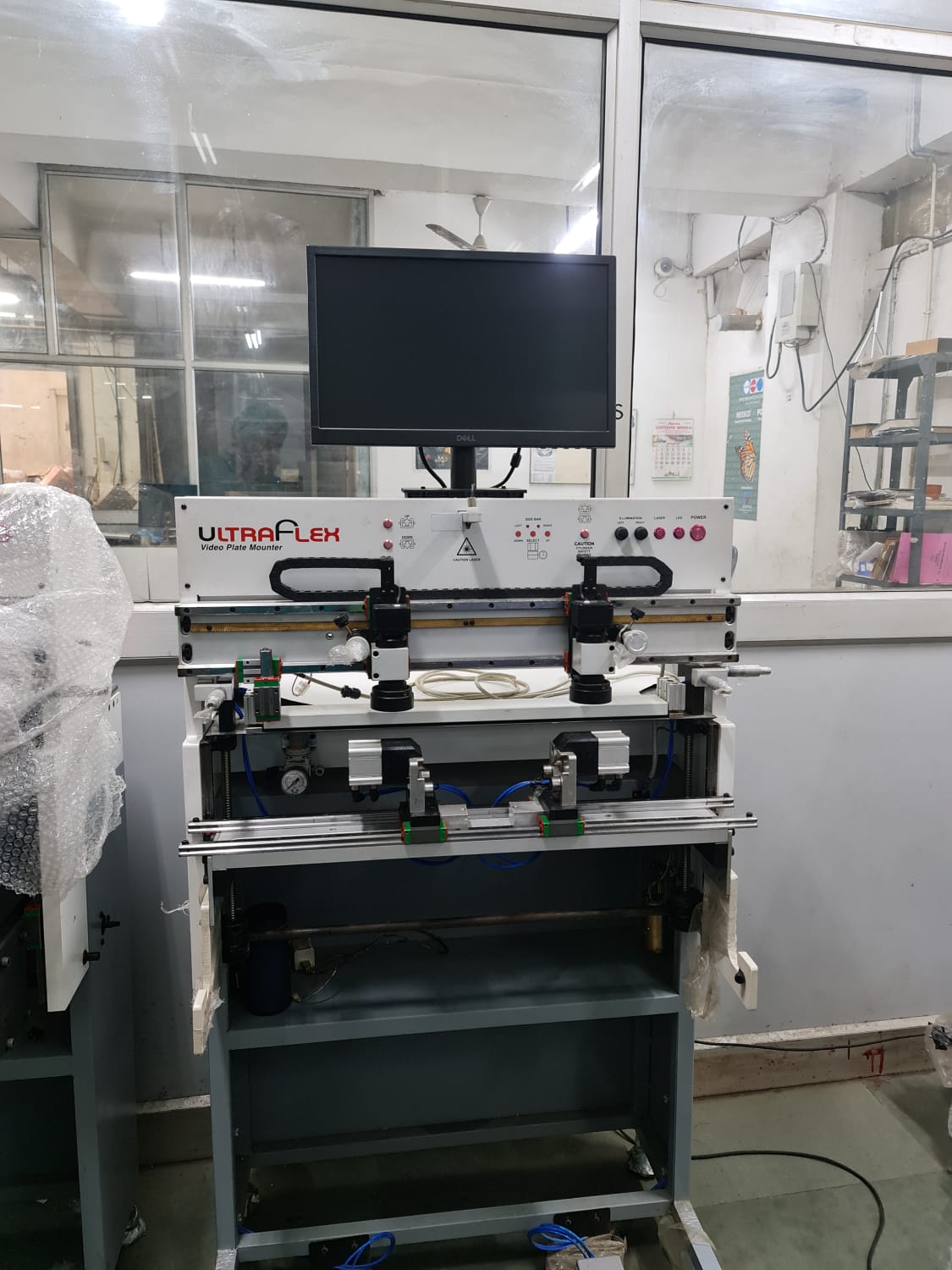
Ultraflex Plate Mounter
He insists that for a perfect and quick make ready, “a communication between the plate mounter and the machine is imperative.” Abhay also started making plate mounters. He asserts that with plates mounted on his plate mounters, the first meter of print which rolls out will be 99% in true register. This is his creativity. His machines and plate mounters are designed as perfectly complementary and compatible equipment  so as to make life easy for the machine operator. He claims that in 3-4 minutes you can perfectly mount an eight colour job on his plate mounter and have the machine running in full register within 3-5 meters. That says Abhay is our USP. Ultraflex machines offered by him are of international quality, fully servo driven with auto register control, it is value for money and affordable. Ever since, Abhay has already installed thirty-eight presses in India and abroad with the latest ten color machine being shipped to a prestigious customer in USA. This will be his first installation in North America and fifth machine being sold overseas.


Abhay has two sons Anuj and Akshay and a daughter Aallia. Both sons run the PSA labels division of Dutta Press while brother Rakesh manages the wet glue label business from Okhla. All family members are in business together as a joint family. UV Graphics and Dutta Press operate out of 66000 square feet factory in Noida and an 18000 square feet facility in Okhla with seven flexo presses in Okhla and six flexo presses in Noida. With a total of 280 employees, Abhay aspires that if God and Kismet helps UV Graphic will be a leading global supplier of diverse label equipment in 5 years. He proudly says, “we produce from nail to the hammer. In UV graphics we produce our own UV Systems, Plate mounters, Core cutting machines, Label presses, Slitter Rewinders, Semi Rotary Digital Finishing, Print Cylinders, Magnet Cylinder, Sheeting Cylinders, Hot Foiling Stamping Equipment, Screen Printing and almost everything that is needed for flexographic label printing and converting. We also make wide format Roll to Roll Hot Foil Stamping Machines for the tobacco industry.

The way Abhay Dutta is moving it will not be long before he achieves what he aspires.

Written by Harveer Sahni Chairman Weldon Celloplast Ltd. New Delhi August 2021

Sunday, May 2, 2021

Combatting the more vicious Covid-2

The continuous wailing of ambulance sirens, send a chill down one’s spine, another loved one from somebody’s family, suffering from the impact of second edition of covid-19, is on the lookout for a hospital bed and the much-needed evasive supply of oxygen as life support. It is ironic that in today’s time of technological advancement many unsuspecting innocent human beings are losing a desperately fought battle for survival against a more vicious and fast spreading variants of corona virus. Medical infrastructures are crumbling under the huge volume of patients reporting infections. Vaccination program is struggling to meet targets that keep becoming difficult by the day, the government has opened registration of people for vaccination, but it is a gigantic task which presently at the very outset, means reaching out to over 50% of the total population of almost 1.4 billion people which would be about 70 million people spread across a large geographical terrain in 29 states and 7 Union territories. Recently a newspaper reported the registrations for vaccinations coming at the rate of 55000 per second! A bigger danger is that much of rural India which accounts for almost 65% of the total population (90million) was largely unaffected and now the virus seems to be creeping there as well. The problem is not only India, as in today’s time given the travel mobility of people from all walks of life and with their relatives spread around the globe with different natural and adopted nationalities, the present dangerous second phase of the pandemic is a global problem and unless checked, it may reach very scary levels impacting the world at large. The second wave is so vicious that it has impacted every other home. It is heart-warming to see that governments around the world understand the problem and are coming forward to cooperate with each other in combatting this menace. On the domestic front we see religious bodies, NGOs, industry and many others doing their bit to defuse the pain and anguish due to the impact of the pandemic. The Indian label industry is also taking steps to contribute towards the safety and wellbeing of their workforce and wherever possible contributing to the society as well.

Kuldip Goel
The author reached out to many leading label manufacturers to assess the level of infections in the two phases of covid and their reactions to combat the menace.  The author, his most family members including both sons K D Sahni and Pawandeep Sahni, MD of Omet India Pvt. Ltd. and 4 employees in his company Weldon Celloplast Ltd. tested positive. Kuldip Goel president LMAI (Label Manufacturers Association of India) and Chairman/MD of Any Graphics NOIDA  reported 25 of his team including 14 of top management along with his son Naveen went through the ordeal. He restricts himself from saying he helped his people during the hard time but prefers to use the word support instead. Besides ensuring the job security of his people, providing financial and medical support they even arranged counselling to almost 100+ people in bringing them out from depression. Kuldip along with his colleagues in board of directors of LMAI are already planning to import Oxygen concentrators for the needy. Abhay Datta Director UV Graphic Technologies where 4 people were infected including himself and his son, has prepared guidelines and implemented them for awareness and safe working within the business. He has developed UVC disinfection devices for articles to contain spread of corona. He is unhappy on how the government has dealt with the outbreak, he says, “It is a bad situation, really sad that the government has failed to control it.” Twelve persons including himself and his plant head in Anuj Bharagava lead Kumar Labels suffered infection, but Anuj went ahead and made a makeshift clinic with Oxygen & IV facility at his NOIDA factory. As also helping communities by enabling concentrators and oxygen cylinders. He too is concerned about the handling of the spread, “It is a terrible period for India, and humanity. We wish things were better anticipated and planned by the authorities. However still, we are all doing our best to help each other. Sad to see some people trying to profiteer by selling drugs and services in black” he says.

Nirav Shah
In central and west India there is a bigger concentration of label companies and there too most are impacted though some have succeeded in limiting the impact of the pandemic.  LMAI honorary secretary and Director of Indore headquartered Pragati Graphics and Packaging has been deeply involved in arranging hospital beds, medicines, oxygen, oxygen cylinders, etc. for a lot of people from and around Indore. He has also arranged two oxygen concentrators which are being given to needy people. Commenting on the 25 people infected in his company he said, “To me the picture looks gloomy. The industry was slowly picking up as the demand was growing. This wave of pandemic has again brought the industry to its knees and the situation will become very bad if the wave of Covid does not recede soon.” Nirav Shah heading Letragraphix in Ahmedabad had to re-engineer his production plans to meet timelines and service his customers efficiently since 20-25% of his workforce got infected. He has stood by his employees in full even during lockdown and providing whatever support was needed. On the social front Nirav finds satisfaction from the fact that they have donated sanitisers, ration kits and food packets besides supporting an NGO called Karma Foundation on regular basis. He states that these are unpredictable times which have taught many lessons to everyone to get adjusted to a new normal of work culture and pray for the world to heal soon.

Vinod Vazhapulli of Skanem
Mumbai based Skanem India Pvt. Ltd. (Formerly Skanem Interlabels) a subsidiary of Skanem AS headquartered in Norway with presence in 8 countries also reported 15% to 20% of workforce as infected in its 4 sites within India. Vinod Vazhapulli Managing Director informed that the company has taken care of their employees by paying before time in full without any deductions whatsoever ever since the start of pandemic and supporting wherever help was needed. The company had them covered under the Insurance scheme with a coverage of Sum insured of Rs. 2 Lakhs especially for Covid by Skanem India, thereby ensuring that all their Medical and treatment expenses are taken care of under Cash less transaction schemes. Online counselling sessions / Yoga classes etc. were organized ensuring that any kind of anxiety or mental dis-order that would have developed due to the pandemic or extended lock downs are handled by experts, taking care of the mental wellbeing of their employees. As a social endeavor They have provided Medical aid , Food & PPEs to the Maljipada village where the Mumbai plant is, during the peak of Lock downs last year. Vinod says, “ there has been an impact of this outbreak on our Industry, the recovery had commenced but with this 2nd wave it is again pushed back to uncertain times”.

Raveendran
South India based Rajeev Nair CMD of Stallion Group informed that 25 % of their team including 5% from management were impacted, he is worried that the business that went down in the first phase of covid had started to recover is now again adversely impacted in the second phase. Raveendran of Seljegat in Sivakasi is thankful that they have been cautious with their workforce, so the infections were minimal, just two employees and his younger brother were impacted mildly and recovered. They have in place a strict protocol of checking temperature, oxygen levels and providing sanitisers. They also provide herbal immunity boosting tea to all workforce who must maintain safe distance and are divided into two shifts. Except for a week of lock down, they have been working right through and in fact are in 100% production. They provide separate buses for women and other workers making several trips to maintain distance and transport them to and fro safely. They have even invited government officials to study their systems that have helped in curtailing the infection. We see similar situation in J K Fine Prints Mumbai, Director Himanshu Kapur who is son of Surender Kapur the founder president of LMAI says, “We had just one infection between the two phases, we have given full financial support to our workers as also provided them and their families with masks, sanitisers and other needs” he further adds, “After the initial jolt, I now feel that label industry will not be so drastically impacted. We  will see  growth coming from Tier 2 and Tier 3 cities who will patronise organised retail for their needs”.

Sandeep Zaveri of Total Print

The best response came from LMAI past president Sandeep Zaveri heading Total Print Solutions Pvt. Ltd. Mumbai, he says, “Between the two phases none in our company got infected due to strict norms maintained by us and supporting our team with full salaries and food needs” he adds, “I think God has created this for us all human beings to go slow, spend quality time with our near and dear ones”.


Many NGOs(Non-Government Organisations), religious bodies, companies and individuals are contributing in whichever way they can reduce the sufferings of people. Donations and help from these groups keep pouring in and exhibits the caring that emanates from these groups. However, in contrast we have reached a situation when politicians continue to play the blame game accusing each other for the sufferings of population, with their eyes on the next election and access to country’s coffers they are insensitive to the pain people are going through. Allowing election rallies and religious gatherings of hundreds of thousand people not following covid norms has contributed to the massive spread. The central government says state government is wrong and vice-versa while the innocent citizens gasp for that breadth which will come loaded with some oxygen so that they may still survive to be with their loved ones another day. It is so unfortunate that we talk of financial outlay of billions in our budgets yet a commodity like oxygen that is an imperative for survival has become a political point for our leaders blaming it on logistics. The pain and suffering do not end for the relatives of those who have lost their fight against covid and passed away, there is neither the means to take the bodies to cremation grounds nor the space to cremate them. Will residents of another developed country understand this kind of situation?  All this while the needy yearn for that breadth which will decide if they exist the next day or not. Added to this the unscrupulous citizens who look at this as an opportunity to make more money, they make the Shylock in Shakespeare’s story "Merchent of Venice" appear as a reasonable person, he may have just asked for a pound of flesh from just one borrower, here these black marketeers are trading in oxygen, essential medicines and life support equipment to draw unreasonable profit from the lives of a suffering generation. 

History will not and should not pardon such unethical persons who have no feelings that a grandparent, a parent, a spouse, a sibling or an offspring are so  precious part that one yearns for them to be there always and losing them is not imaginable. Courts in India appear to be understanding the gravity of the situation but who will teach the politicians who are the executive running the country. It is not just watching on TV that people are suffering and dying, but it is now being felt and being experienced by all households largely. A friend, a relative, a business associate, a colleague or a loved one just vanishes losing out to the pandemic leaving a void and a hollow feeling whereby the tears have no place to go.


Written by Harveer Sahni Chairman Weldon Celloplast Limited New Delhi May 2021

Reproduction permitted by giving credit to author and link to blog http://harveersahni.blogspot.com 


Wednesday, April 14, 2021

"Evolving and shifting trends in self-adhesive labels"

In my early years when I worked for my parental company Weldon Sales Corporation established in 1939, manufacturing stationary products like Weldon Fountain pen inks and office glues besides a range of stationary products, I remember that we used to affix paper labels on glass bottles using water-based adhesives. Initially these were solutions of gum Arabic and later we switched over to starch based adhesives produced by us captively. These worked well on glass bottles or paper-based packaging, the only challenge was that we had to wait for the adhesive to dry before putting these into secondary or tertiary packs as the labels would shift if packed wet compromising the appearance of the product. The same issue was encountered by the beer industry which continues to face it, at least for some brands that still rely on adhesives that do not address this problem. Since glass packaging was heavy and was susceptible to breakages in transit the introduction of plastic HDPE (High Density Polyethylene) bottles came as a big relief at that time. HDPE that was invented in 1953, started being initially imported and later produced in India by Polyolefin Industries Ltd. a Mafatlal Group Company under license from Hoechst Germany, in the late 1960s. HDPE plastic bottles came as a big innovative development for the liquid packaging industry. When we at Weldon started using outsourced Plastic bottles, later manufacturing them in house, labelling them brought fresh problems. The labels affixed with water-based adhesives, on drying would fall off in transit or get wrinkled. This was because of the reason that HDPE is a low energy polymer and for normal water-based adhesives to form a permanent bond is a problem.  For some round bottles we started using wrap around labels as then the label would come around and get pasted paper to paper. It was during this period after 1965 that the earliest self-adhesive labels started being produced in India and in the 1970s their usage in packaging of product started to increase. These labels would bond instantly, would not need drying and would not shift in packaging , also aiding the aesthetics so their usage spread quickly and widely. It was that time we at Weldon also shifted to self-adhesive labels or pressure sensitive labels. The rest of evolution of Self-Adhesive labels is history and is still an ongoing process.

Adhesives: Pressure-sensitive adhesive(PSA) labels is now one of the fastest growing segments in a world of diverse labeling technologies. It provides accuracy of clean labeling and options to use a variety of adhesives for  application on different surfaces in most environments, including temperature, humidity, exposure to UV, etc. Advancements in products and their packaging require labels to perform in extreme and demanding parameters. Some food and pharma products require the labels to perform at very low temperatures, typical are for ice cream, pharma and vaccines that require extremely low temperature for storage. Synthetic adhesives that are in use nowadays harden at very low temperatures and tend to fall off so must be formulated to withstand the application and storage conditions. These adhesive soften at high temperatures therefore signages and labels that must be used for outdoor in diverse environments, withstand UV light and heat build up due continuous exposure to sun also need adhesives specially formulated to perform for the duration of their lifetime. Direct PSA labels application on food products like fresh fruits and vegetables is now in use and labels must be certified safe for direct food contact and that they should not have adhesive or inks from which plasticizer may migrate into the product. Coming to labeling on low energy surfaces like HDPE bottles mentioned above, though the label sticks well but in these days of increased incidence of anti-counterfeiting, pilferage and tampering, the label with standard general purpose adhesive can be pulled off cleanly by an experienced hacker or counterfeiter. So, the adhesives are an important and integral part of evolving trends in self-adhesive labels. A lot of development has been done on these lines and continue to be taken up to produce special formulations that conform to the specific requirements.

Substrates and embellishments: As customers grow in numbers, segments, literacy, urbanisation and geographical spread, the packaging development managers are attempting to create innovations in partnership with label printers to woo the consumers, increase the shelf appeal of products and increase brand recalls. Moving from simple label substrates like uncoated maplitho or uncoated woodfree paper, now the selection of substrate is as per the imagination or creative ideas of the label developers. The label face materials can be selected from a wide range of options available like semigloss paper, metallised papers or films, textured paper, various clear or opaque films, fabric, cork, lenticular films, holographic paper or films and anything that emanates out of a creative designer’s mind. As for embellishments, there was a time when either using a cast coated paper or a good varnish were the only options, but now a whole world of new ways to embellish labels has erupted. Using multiple printing technologies to get the best of every printing process, adding value to win customers and beat competition is becoming a necessity for printers. Today we see labels being made in-line in a single pass employing a combination of flexographic printing for spot colours or pantones, offset to create vignettes or skin tones, screen for higher deposition of ink, rotogravure to get the best results of metallic inks, cold foil, hot foil, using a variety of varnishes to create effects like textures, high gloss, matt, silk finish or just spot varnish, embossing and debossing to bring amazing results in the finished labels. We see printers create labels with raised effects like dew drops, print that seems to give the look and feel of wood and fruits with pulp, giving a natural effect. Adding further to the capabilities, now printers are employing digital printing either in combination as mentioned or as repass to do variable printing and or personalization. The options are getting to be limitless.

Security Labelling: Increasing number of instances of duplication, counterfeiting and pilferage has created a need for security to be made an important part of labeling. Counterfeiting products is a problem not only limited to pharmaceuticals industry, but it also affects 5 to 7 percent of global trade. It has impacted other industries as well, such as electronics, automotive parts, spirits, consumer products and high-end cosmetics. Earlier security labels were only with security cuts incorporated at the time of die cutting, then specialized stocks with overt and covert features like the Void labels started being used followed by destructible labels. Holograms also have been largely employed and is now hologram production is a large segment of label industry. With development in pre-press and printing technologies printers use micro printing which is not visible to naked human eyes and other such printing methods used in printing currency to inbuild security in labels. Barcodes are also being largely employed to play an important role in security in labels besides aiding variable statutory information, track n trace information, inventory and logistical data. A very important development in recent times has been Intelligent labels that include near field communication (NFC) or radio frequency identification (RFID) to perform a wide variety of tasks. Integrating these capabilities with traditional labels is one of the most dramatic development in labeling.

Printing Equipment: The narrow web self-adhesive label manufacturing commenced in India in the first half of 1970s on small, about 4-5inches label presses imported from far eastern countries mostly from Japan at that time. These small narrow web presses that did block printing were extremely slow about 5 meters per minute but still did the printing and die cutting inline in a single pass, that was its USP. It may appear strange to the younger printers of today that there were no drying arrangements in these presses. Printers would print and then hang the printed rolls of labels on a clothesline for drying before rerolling them on a core and sending to customers. Shop floors of narrow web label printers would look like washing yards referred to in India as “Dhobhi ghat”. The printing technologies with time went through continuous changes. The flatbed block printing made way for semi-rotary intermittent letterpress using polymer plates. With improvement in Flexo ink and plate technology, rotary label presses with central impression drum (CI Label Presses) found their way into print shops. These provided faster speeds at increased widths of 7 inches(180mm)-10inches(250mm) and as the buyers became more demanding on colours, speeds and performance, together with further evolution of prepress, advancements in plate making and registration controls, the CI narrow web label presses moved out making way for modular presses using water-based inks with hot air dryers. However, CI presses continued to be used for other applications like lami-tubes and mid-web flexible packaging. Label presses have over the years evolved to print wider web widths of 330mm, 430mm, 530mm and at last Labelexpo presses over 650mm were displayed. Printing speeds have also escalated to over 200meters per minute. In an evolving scenario of rising demands for perfection in print and printers facing challenges in reproducibility, colour variations due to viscosity changes in ink trays and set up wastage, were releived when UV inks, UV lamps for drying and short web path became a standard part of presses. The UV printing also enabled printing and converting filmic labels after addition of corona treaters inline to enhance print adhesion. Some label companies have of now reverted to include a combination of hot air and UV as some food products have witnessed migration of photo initiators in UV inks migrating into the food causing contamination, so the option to print with water-based inks comes in handy to service such requirements. LED UV also is being seen as replacement as there is energy cost saving and better as regards migration issues. Ideal solution maybe Electron Beam curing which is costly but that has still to be accepted by Indian label industry. There is hardly any installation with EB curing for production of narrow web labels in India.

Other evolutions that happened include label presses designed for quick change overs to enable a large number of jobs per day, servo drives to eliminate gears coupled with advanced vision camera systems to achieve perfect registrations in both machine and cross direction without human intervention, better matrix removal, web cleaners to eliminate pinholes and print aberrations, web turn bars to print both sides of the web along with the delam-relam function for enabling printing on back or the adhesive coated side of the web. Movable lamination stations and embellishing stations like foiling add value to the printed labels. Multiple die-stations to enable functions like embossing, debossing, slitting besides simple die cutting or sheeting have become a standard function demanded by high-end printing companies. Change of heavy magnetic cylinders was a cumbersome and time-consuming job requiring manpower and lifting arrangements. Now in a couple of minutes one can slide-out and slide-in a magnetic cylinder.

The pandemic that surfaced in end of 2019 and drastically impacted the whole world and made businesses suffer for all of 2020 and when we are hoping for it to taper off in 2021 providing relief to mankind, it has started to resurface. It has prompted the industry to re-engineer their working. The aim now is to work with less. Workflow management, increased automation, clean room manufacturing, inventory controls, effective management systems, etc.  are the buzzwords that even smaller entrepreneurs understand and are making efforts to implement them.  Automatic butt slicers/reel changing systems to achieve continuous 24X7 production when needed, waste management equipment sucking waste matrix right from the die cutting stage and shredding and inline inspection/colour management systems to reduce rejections which were earlier a preference of only a selected few, but these are now a part of standard equipment configurations envisaged commonly by Label printing  companies planning expansion or planning new setup. The evolution and shifting of trends in self-adhesive labels have been an ongoing process and printers need to adapt the changes as they originate to stay fit, competitive and innovative.

Author's footnote: Each parameter listed above and many other parameter's like inks, special adhesives, coatings and machine design are subjects that are to lengthy to be accommodated into one article and need separate coverage. 

Written by Harveer Sahni, Chairman Weldon Celloplast Limited, New Delhi-India April 2021