Harveer Sahni

Harveer Sahni
Author Harveer Sahni

Avery Dennison

Avery Dennison
Sustainability at Avery Dennison
Showing posts with label Weldon. Show all posts

Thursday, December 15, 2022

Mumbai to Toronto, successful in digital labels.

Born to Malayali parents in the south Indian state of Kerala, Hari Nair CEO of Digital Labels in Toronto  does not sound like a Malayali, on the contrary he sounds like a typical Mumbaikar (Local longtime residents of Mumbai). The Malayali people are a Dravidian ethnolinguistic group originating from the present-day state of Kerala in India, occupying its southwestern Malabar coast. They are predominantly native speakers of the Malayalam language. They constitute the majority of the population of Kerala. It is pertinent to mention here that Hari is proud of his Indian heritage and firmly believes in the oneness of being an Indian rather than be recognized as a part of separate religious or caste-based segment of the society. Long years ago, Hari’s parents had moved residence to Mumbai, where he grew up. They lived in Santa Cruz, close to airport. He did his schooling from Kalina Education Society and  college in Parle college. He followed this with Masters in Organic Chemistry from Bombay University. Finally, he completed his MMS (Master of Management Studies) from Sydenham Institute of Management Studies, Mumbai. Post education in 1989 he along with a few others were hired by Suresh Gupta former Chairman Huhtamaki-PPL, which at that time was Paper Products Limited (PPL) promoted by the late Sardari Lal Talwar and his family. Paper Products Limited or PPL was later acquired by multinational Huhtamaki. Sardari Lal Talwar’s son in law, Suresh Gupta had joined PPL when it was facing tough times. Suresh Gupta fondly called SG, was in the process of transforming the company from purely owner driven to  professionally managed one. An elaborate program of in-house training was put in place. The program was designed by SG and his colleagues to suit their specific needs, may they be technology, sales, customer or people handling. They were transforming the company to project their acumen in offering the latest in packaging. So, he hired these youngsters and trained them. He would not let them to take it easy. They were initially trained in flexible packaging, learning every part of the process including slitting. Hari mentions, “SG had long term vision.” He achieved success by implementing his ideas. These new incumbents included 6 or 7 persons to be groomed as his core management team. Hari Nair was one of them and who considers Suresh as his mentor and remains in awe of his capabilities to transform a company that was just Rupees 35 Crores when Hari joined and under SG’s leadership PPL had crossed Rupees 2300 Crores when SG retired.

Hari Nair on shopfloor with colleague
Hari started his career at Thane (Mumbai) plant of PPL in flexible packaging division. When SG introduced Shrink Sleeves 1993-94, Hari was sent to Fuji seal Japan for training him and taking other persons from the company along with him, for training. In 1997 he was moved as General Manager to Hyderabad plant of PPL. Hari came to Canada in 2001 from his last posting in India at PPL Hyderabad. When asked why he moved to Canada, he is not sure, but then says, ”I always thought it will be good for his daughter plus I was fascinated by the west.” Each time he visited these countries on his business trips, he was in awe of the infrastructure, the roads and facilities. Comparatively, he felt India was always "work in progress" and in his lifetime, it will never be like this in India. He yearned to live in these countries and drive on these roads, though today he says, these were stupid reasons. He feels as one matures and looks back; the realization comes that they were not the right reasons however his vison for his daughter Mythili getting better education has worked well. Since so many children are coming to Canada to study, she would also have had to do that but now that she is here, it is working out for her, she is a doctor and moving on well with her life. When they shifted to Canada his family had no clue what they were going to be up against, on arriving in Toronto they were all holed up in one room of a town house in which four families were living, sharing kitchen. It was an extremely challenging situation from the life they had been leading back in India.

On landing in Toronto, he tried looking for jobs in the field that he was experienced in and approached companies in similar fields. Sandeep Lal the then owner of Metro Labels called him for an interview and in response felt Hari was overqualified and he did not have a position for him at that time. For a full year thereafter, Hari did not get a break and he was so distressed that he even sent a message to his mentor SG that he might want to come back to PPL. The experienced mentor and a professional management leader that he was, SG advised him that while he was welcome to return, yet he did not want Hari to regret later and feel he did not try hard enough. SG asked him to wait for some more time and try some more, things will work out. That was the motivation coming from a mentor that made him hang on, it was the encouragement that changed his mind. A year later while he was contemplating moving out of the packaging industry, he saw many youngsters joining banks as the jobs were there on offer. On a suggestion from a friend, he did a course in financial securities hoping to get a bank job. He was then living at Kingston Ontario and met almost all the bank manager there, looking for a job.


While he was searching for a job in banks, Hari stayed connected and following up with Sandeep Lal at Metro Labels. A year had elapsed and one fine day he got two calls, one from a bank offering him a teller’s job for 10 dollars an hour and that too for just 10 hours each week which was not enough to feed a family, and the second job offer came from Sandeep Lal which Hari accepted and joined Metro Labels as an estimator. The job was entirely different from what it was in  India, the workload was heavy. One of the first lessons he learnt was that in India if you are dealing with large customers the price for a particular customer remains same for all quantities of same label but in Canada, each job is estimated and quoted separately. In 6 to 8 months, he became the plant manager for Metro Labels. A year down the line he felt the discomfort as the environment was a lot different from the time, he worked in Paper Products in Mumbai. After having spent over two years  there he quit Metro Labels and joined another label company Labelad. He joined as a supervisor and gradually moved up and stayed there for the next 7 years. While in PPL he had worked a General Manager and had handled from production to selling more like as an entrepreneur but in Canada the work system was entirely different and here Hari worked completely in production.


Hari with Ramkumar of ASL PrintFx 
During his tenure at Labelad, while he was attending a Fasson seminar, the speaker mentioned that there were two big opportunities in North America and those were flexible packaging and digital printing. Sitting at a round table along with his colleague Chris Henderson from sales in Labelad, referring to digital printing, Hari said to Chris, “this is the future.” They parted on that note and forgot about the incident. Six months later Chris was at Hari’s office asking him if he remembered his comments on digital and whether he wished to start something. With an affirmative reply, both indulged, and Digital labels was born. Chris had spent 14 years in Labelad and it was an ideal combination with Hari as the production person and Chris as the Sales expert. From experience Hari felt that the HP Indigo 4000 series could not sustain a business expense but when the 6000 series came it became a different story and once it was two years of launch of that model, they felt comfortable to buy the press. Within six months they came in contact with Charlie Maclean President from ASL Printfx and decided to get into an association with ASL investing in Digital Labels, taking a small part of the ownership. Since they also had interest in digital. It was a win-win situation as ASL could use the digital capabilities of Digital Labels who could in turn have access to ASL’s sales network. ASL has grown and is very focused in high-end jobs like wine and spirits and for short runs and personalized variable print jobs, Digital Label’s capabilities are an important resource.

Digital labels are into manufacturing of all segments of labels, shrink labels and decals, but mostly concentrating on short and specialized runs. To start they had huge challenges as both partners were into service before and had no business background, so banks were reluctant to fund them. Working capital dried up soon. Once they got over the initial hiccups and proved their capabilities it became smooth sailing. The first 6 months were tough as buyers did not trust them since they were new in labels business but then a Godsent opportunity came to them when a scented candle manufacturer who was having trouble with current vendors of labels, approached them. That business came to them as a big saviour. Once orders from that customer came in, they were operating better and later when ASL came into the picture, things changed for good.

Chris and Hari have worked tirelessly, and their efforts have been fruitful as Digital Labels has been growing in the last few years at around 25% each year. Their business is now around 7 million Dollars, and they plan and make efforts to reach 10 million in the next 3-4 years  from organic growth alone. They presently operate from a premises admeasuring 8000 square feet and the space it is fully utilized. Due to shortages faced following the pandemic, they had to increase their inventory. They rented a lot of space around their present premises so that they could maintain enough stocks to service their customers well. They operate with 25 employees, presently working 8-10 hours basis. They are a slim trim enterprise who are very careful with expenses and very focused to grow their business. Commercial real estate in Toronto is expensive so they feel that for any expansion that becomes imperative, they will try to rework their present setup and increase the working shift for the time being.


His wife Surekha with whom Hari got married in 1994, is from Goa. She is a social worker by training and now since 2007, she is working for the social services division of the city of Toronto. Their daughter Mythili was born in 1995. Hari remains connected with all his friends in India. But has no business with India. He still remains in awe of Suresh Gupta whom he looks at as a mentor and feels he has yet to meet anyone as smart, knowledgeable and professional as him.


Nostalgically and pensive in thoughts he says, “Whatever I learnt in my journey in profession so far, it has been from him"!


Written by Harveer Sahni Chairman Weldon Celloplast Limited, New Delhi December 2022


Sunday, March 20, 2022

"From Cartons and commercial printing to 100% labels!"

Narinder Chhatwal hailed from a family of traders in Lyallpur, a city which is now in Pakistan after the partition of India in 1947. Lyallpur was named after the founder of the city the then Lieutenant-Governor of the Punjab, Sir James Lyall, for his role in establishing the canal colonisation project. In 1977 the Government of Pakistan changed the name of the city from Lyallpur to Faisalabad ('City of Faisal') in honour of King Faisal of Saudi Arabia, who made several financial contributions to Pakistan. Faisalabad is the third-most-populous city in Pakistan after Karachi and Lahore, respectively. It was in the turbulent times of 1947 during the division of India into India and Pakistan, that the Chhatwals migrated to New Delhi. After completing his schooling, Narinder Chhatwal took up a job in the iconic Kwality Restaurant in coveted location, New Delhi’s Connaught Place, a venture set up in 1940 by P L Lamba and his brother-in-law I K Ghei who grew it as a multilocation restaurant chain. Narinder worked there until 1961. There was a strong urge to have his own business, so he set up a unit to produce ice cream cups but as situation warranted then, he left this venture and rejoined Kwality Restaurant yet again in 1964. Despite the stable job, the entrepreneur in him was restless and the urge to set up his own production unit re-surfaced and he finally quit the job permanently to start a printing unit nostalgically named Kwality Carton Manufacturing Company, in a single room rented at Kirti Nagar, New Delhi in 1966-67 using the manually fed treadle letterpress printing machine. He manufactured Ice cream cups, lids, cartons for Ice cream bricks and in fact a host of printed packaging items. In 1971 he could get an allotment for an industrial plot from government at Naraina Industrial Area and he moved the unit to this location where from, they operate to this date.

A little over a year after moving into their Naraina factory they bought their first offset printing press, a 712 single colour Dominant, a year later they bought another similar press and followed it up with a 714 Dominant. Falling short of space, the adjoining building was available, so they bought it as they were growing. In 1982-83, expanding further they acquired a two colour Planeta. Once into offset printing, Kwality was in expansion mode, they were adding equipment every alternate year. At this time, they renamed the company as Kwality Offset Printers. In 1986 Narinder Chhatwal’s son Rajeev an 18-year-old had joined business. Rajeev did his initial Schooling at Springdales School Delhi followed with graduation from Delhi University. The post partition Punjabi families who left all that they had, back in what had become Pakistan were hard working and were quick to start from scratch to regain their stature by sheer hard work. The second generation were all following their father’s footsteps and would be helping their parents in the work, spending time after school or college on the shopfloors of their startup units. For them, the shop floors became the training ground, and they learnt the nuances of business hands on. Rajeev was no different, with a  father like Narinder mentoring him and passing on the experience to his son who was a quick learner, he settled down in the business quickly. He however did go for a short training program at Heidelberg Germany. With his joining in, the business accelerated and soon the space in their Naraina factory was again falling short. In 1988, they bought out yet another next-door unit to make room for more production space so now the factory is operating from three adjacent plots. The same year they bought their first four colour offset press a secondhand Roland. Expansion became a routine process. They believed and were convinced that as far as possible it is better to operate from a unified single location in one city. This way the management which was Narinder Chhatwal, and his son Rajeev Chhatwal were not split and would remain a support to each other.

Until 1995 Kwality offset was producing Cartons, some commercial printed items and wet glue labels. In 1995-96 they decided to become a hundred percent label manufacturing unit which was only wet glue labels. The story of their entry into wet glue labels is interesting. In the early 1990s when the number of breweries started to grow and bottling speeds were on the rise. To label bottles at 250 bottles per minute, the labels needed to be perfectly die punched and stacked to run on highspeed lines. The normal flatbed dies would not work well. Kwality, because of their experience in ice cream cups and lids production were well versed in ram die punching and their workers were well trained in the process. Their manufactured labels ran extremely well on the high-speed labelling machines at breweries and distilleries and soon the word spread of their capabilities. This helped them get the orders from many other breweries and liquor producing companies. It was just a matter of time that they became the largest suppliers of wet glue labels in north India, though they were supplying pan national. It is interesting to note that normally people print and then get into label finishing equipment, here because of their knowledge of finishing the ice cream cup lids by hydraulic ram punching got them into high end big volume label printing. Their first customer for beer labelling was a government owned Haryana breweries at Sonepat making a popular brand of beer those days “Rosy Pelican.” Their success in making the perfectly die-punched wet glue labels also got them their first break in corporate world with orders from the multinational brand owner Nestle.

It was in the year 2000 when self-adhesive labels were gaining in popularity, the Chhatwals invested in a Mark Andy 2200  narrow web label press and in the following year, they also increased their investment in sheetfed offset by installing a six colour Heidelberg press. In 2002 they installed another sheetfed offset a five colour Roland with UV and online coater. Hereon, expansion became an ongoing process, they added three Mark Andy presses, a Gallus and a Xeikon in 2018 to make their entry into digitally printed labels with an ABG Digicon series 3 finishing and embellishing machine, which also has hot foil stamping , embossing and screen-printing capabilities. These investments enabled them to add multiple security features on labels. Increasing their footprint in flexo they also set up inhouse platemaking with Kodak Flexcel. Rajeev’s father Narinder Chhatwal passed away in 2008 until when, he was still attending business, though the reins had been passed on to his son Rajeev.

Rajeev’s other siblings include a younger brother who is into real estate and a sister who is a homemaker. His wife Shalini is also a home maker. His son Krish completed his business management from Sydney and joined business at Kwality offset four years ago. Two of those initial years were passed in facing the pandemic and last year in 2021 he got married. Krish’s wife Sanya, an expert in baking, after completing a course from APCA Malaysia, is running her own business, a bakery named Delhi’ce in Gurgaon making specialty cakes. Rajeev’s daughter recently completed her study in architecture and is now pursuing her career as an architect.

Having put in place a full-fledged team to manage all production, Rajeev, and son Krish personally look after sales and marketing. While Krish looks after all new customers, Rajeev manages and caters to, and successfully retains all old customers. The present spread of business is with three flexo presses, one digital label press Xeikon, Abg digicon, one Roland and one Heidelberg sheet offset press in a shopfloor admeasuring approximately 60,000 square feet. Total workforce is 130 persons all in one location at Naraina Industrial Area New Delhi. With no more space left for expansion at present location, they have bought a 2200 square yard plot at Manesar south of New Delhi for another factory to fuel their further expansion. When asked about future plans, Rajeev expresses that they are not really concerned about just volumes, they are more oriented to implement better and innovative technology and be profitable to grow the bottom line instead of focusing on bigger turnovers. Kwality has been growing at about 10 percent per annum and they are committed to maintain the growth rate. Conscious about the environment they have tied up with approved and certified waste management agencies as also cooperating with Avery Dennison on their waste management endeavours. They even try and source most of their paper materials from FSC certified vendors. Despite the aftereffects of pandemic, the father-son team are committed and firm to keep the expansion and investment in new technologies an ongoing process. Their resolve years ago to give-up cartons and other commercial printing to stay with 100% manufacturing of labels is unique in today’s situation. These days offset printers do integrate forward to produce labels and vice-versa label printers, in an effort to grow turnovers, expand into print packaging. They wish to remain specialty label printers, investing into innovation.

Written by Harveer Sahni, Chairman Weldon Celloplast Limited New Delhi March 2022

PS: Printing Magazine may publish this article giving credit to author Harveer Sahni and Blog https://harveersahni.blogspot.com  

Monday, August 23, 2021

Abhay Datta, a printer's tryst with machine building

On any given day, 96-year-old S.N. Dutta, Satya Narayan Dutta, the patriarch of Dutta family of Dutta Press New Delhi, can be seen strolling on the shop floors of their printing or machine building units, interacting with workers, and imparting instructions. The man is active and an institution himself in printing. Dutta was born on 15th of August 1926, long years before the partition of India, in a family that hailed from Lahore, then a part of British ruled united India. His father was the head of accounts for Indian railways. Sometime in the 1940s as a young man, he developed an interest in printing so went to a family acquaintance, Kedar Nath Mehta, a master printer in Amritsar for a one-year training in the art of printing. They used to print on Chandler & Price platen presses and supply labels to Punjab based distilleries in Hamira and Khasa. Chandler & Price was founded in 1881 in Cleveland, Ohio and manufactured a series of hand-fed platen jobbing presses, as well as an automatic feeder for these presses.

Chandler and Price Machine
Love marriages were rare in those days before the partition of India, however S.N. Dutta during his training days at Kedar Nath Mehta’s facility, developed a liking for Mehta’s daughter and eventually married her. Post partition the Dutta’s moved to their Haveli, a traditional townhouse mansion in Darya Ganj Delhi. The Haveli was a heritage building that had earlier belonged to one Sir Syed Ahmed Khan, one of the Navratans of Mughal King Akbar. It was allotted to Duttas on migration from Lahore to Delhi after partition for a sum of Rupees 4000 only. In 1951 S.N. Dutta started his maiden startup venture “Dutta Press” with a Chandler and Price machine on the ground floor of their Haveli. He bought the printing press for Rupees 1200.00 and did not have the money to put an electric motor on it. So, initially the machine was foot operated with a peddle. As a memento and a reminder of their past, the machine still stands tall on a pedestal in the lobby of their Okhla factory. Thereafter from 1951-1965 Dutta was on the move continuously, he also set up his own typesetting and composing section, then added two more machines, following it up with buying a new Heidelberg GT Platen press for just four thousand Rupees, then in the mid 1970’s a Mercedes Super Cylinder Press from Printer’s House in Faridabad, Nibolo and some more letterpress cylinder machines. Customer base acquired during this period included those from segments like beer, whiskey and lubricants with main customer being Mohan Meakin. S N Dutta has two sons Rakesh and Abhay, as business had grown and the boys were now grown up, it was time to move to the next level of business. In 1980 they moved to a new factory in Okhla and imported their first Heidelberg KORD offset press and Heidelberg TP Foil stamping machine from Germany. Those were tough times of needing import license for all imports, yet firm resolve made them to move on.

Heidelberg Weisloch Factory
Abhay Datta the younger son of S.N. Dutta, born on 16th August 1961, is an Alumnus of St. Xaviers School Delhi. He was never a serious student but had other technical interests. Barely 16 years old and in school, he started experimenting with making music systems. On finishing school, he along with his friend Joseph George set up their maiden startup venture Systm India to make and sell music systems. Abhay proudly mentions that in a couple of years his company’s turnover was higher than that of Dutta Press. Young boys in business families are prompted to spend time in family production units and Abhay was no exception and whatever exposure he got was by way of his father mentoring him to have a penchant for perfection and zero tolerance in whatever he did. One fine day his father came to him and complained, “you make so much noise testing your music systems, speakers etc., neighbours are irritated . It is not a respectable business. He appealed to Abhay that they needed help in the printing business and that he should wind up this music equipment business and join him in the printing business. Obedient as he was with immense respect for his father, Abhay could not refuse his father’s request. Abhay’s elder brother Rakesh was better in finance and other marketing activities. In just a matter of minutes Abhay decided to hand over the music business to his friend Joseph and moved on to the printing business at Dutta Press. He was sent to Heidelberg training center in Germany for training in print technologies where he spent time in the Wiesloch factory understanding mechanics and engineering of offset presses. It was an eye-opening experience for him. In India we did not have CNC machines, no auto cad computers, all the planning was done manually on huge drafting boards. It was there in Germany that he gathered an eye for perfection, low tolerances, fine finishing, good appearance and machine safety norms. This was as his father had mentored him to be a zero-tolerance person.

UV Coating Machine
Once back in the Okhla factory Abhay had to begin at the lowest rung of the ladder. He was required to clean up the machines, sweep the floor, take care of staff, serve them tea and support them in small errands besides operating all the machines personally. He learnt to run all the machines like an operator, make negatives/positives and offset plates and foil stamping blocks himself. Those were days when there were no PS plates, so he learnt all the chemistries hands on. Graining offset plates, putting sand, marbles etc. in graining machines, he did all that himself. He was a total worker like any laborer in the factory doing all kinds of jobs that included printing varnishing cutting packing and dispatch. The experience has rubbed on so well on him that even today on the shop floor in hot and humid conditions with perspiration trickling down his torso he enjoys remaining amongst his workforces. He is a hardcore technical and shopfloor production-oriented person while brother Rakesh manages the white-collar part of management. With Abhay’s penchant for perfection, he proudly mentions that we made quality, such that print buyers would come looking for them. Since they were supplying to breweries and distilleries, they came across a challenge; solvent base varnishes on labels scuffed and needed to be replaced with Water based varnishes, but these would not work on existing hand fed varnishing machines produced locally due to slow drying. Abhay was given a task by his father to make a machine that could coat aqueous varnishes at high speeds. He developed an automatic machine with the help of Sanjay Gupta of Ronald Machinery and added an anilox roll with a motor and hot air dryer to do the varnish. It worked and that was when his tryst with machine building commenced. Later he started manufacturing fully automated high-speed machines to do aqueous and UV coating with anilox rollers and chamber doctor blade systems.

Abhay Datta on Shop Floor

After that there was no looking back in machine developments. Abhay was young, success encouraged him to research, experiment and develop more from a shed in the driveway of their Okhla factory, it has been a long journey with lot of hurdles. He then started converting hot stamping machine for own use and sales. Since in earlier days they had bought a Heidelberg hot stamping machine, from experience gained, Abhay could convert die cutting machines and the Chandler and Price machines into hot stamping machines. When stamping foil suppliers became aware of his capabilities to make hot stamping machines, he became an accredited suppliers to many companies who indulged in hot stamping. In 1992 he successfully started making UV coaters and till 2016 they have supplied over 250 offline UV coating machines in India and Abroad.


During his 1995 visit to Drupa, he was fascinated by an Aquaflex label press printing Smirnoff Vodka labels. Unlike the sheet fed converting, the press was unwinding, printing, embellishing, laminating, die-cutting and delivering finished labels at the end of line in a single pass. Abhay was convinced that this is the future. Those days there was no WhatsApp where he could take videos and upload to inform his family about the equipment. Wanting his father and brother to also look at the machine before deciding, he made a trunk call, described the machine and requested them to come and see. Three days later both his father and brother flew into Germany, they saw and fell in love with the machine. They became friends with the founder of Aquaflex, signed the deal to buy a press and also became the sole selling agents in India. They opted for an eight colour press with rotary hot foil stamping. It was a bold decision as rotary tooling for hot foiling was very expensive, cold foil was not there that time and most of their production for liquor labels needed foiling. In their factory they already had 20 Heidelberg hot foil machines running, they used to buy used Heidelberg platen machines and convert them into hot foil stamping machines by retrofitting, all done by Abhay himself. The Aquaflex ordered by them was displayed at Labelexpo Singapore in 1996 and then shipped to India for Dutta Press to start printing labels on a narrow web press. Till the end of the millennium 1999 they were only printing wet glue labels on this machine. Pressure sensitive adhesive (PSA) labels production commenced only in the new millennium in 2000, they kept adding Aquaflex presses in regularity.

Ultraflex Label Press
Between 1996 and 2003 as agents, they sold nine machines to customers like PPL, ITC, Modi Federal, Sai Packaging and others. They added four more press at Dutta Press. In 2001 Aqua flex got sold to Chromos USA . At this time when he was under pressure to offer a press to his customers, he met a software engineer who suggested the name of Shanti Pal Ahuja of Multitec and once the two met, they instantly decided to get together to build label presses. Abhay invited Ahuja to his facility and have a look at the Aquaflex label presses and to do reverse engineering of the press. A complete unit was removed from the Aquaflex and sent to Multitec facility in Faridabad. It was completely meticulously redrawn and the first Ultraflex machine was developed and sold to Nishi Labels in Ahmedabad and the second machine was exhibited at Nehru Centre in the first “India Labels show” which later became Labelexpo India. That machine got sold on the very first day of the show to Khosro Moradi, of Farah Banfash Manufacturing Company, Iran. Few years down, having sold over a dozen presses, their partnership fell apart and Multitec renamed their press as Ecoflex and Abhay Datta retained the name Ultraflex that he would build himself one day. Until such time for their own label manufacturing they invested in Bobst label presses

CNC Machines at UV Graphics
Passionate about making machinery himself, in 2017 after they bought their 3rd Bobst M5 press, Abhay visited Florence and was inspired to build his own flexo press. On return from Florence in September 2017, he dug deep into the Flexo Machines and studied other equipment that would enable him to build a narrow web label press. Keeping cost down and not compromising in automation he started planning a machine with zero waste and instant make ready. He launched his first Ultra flex made in his company UV Graphics. 


Ultraflex Plate Mounter
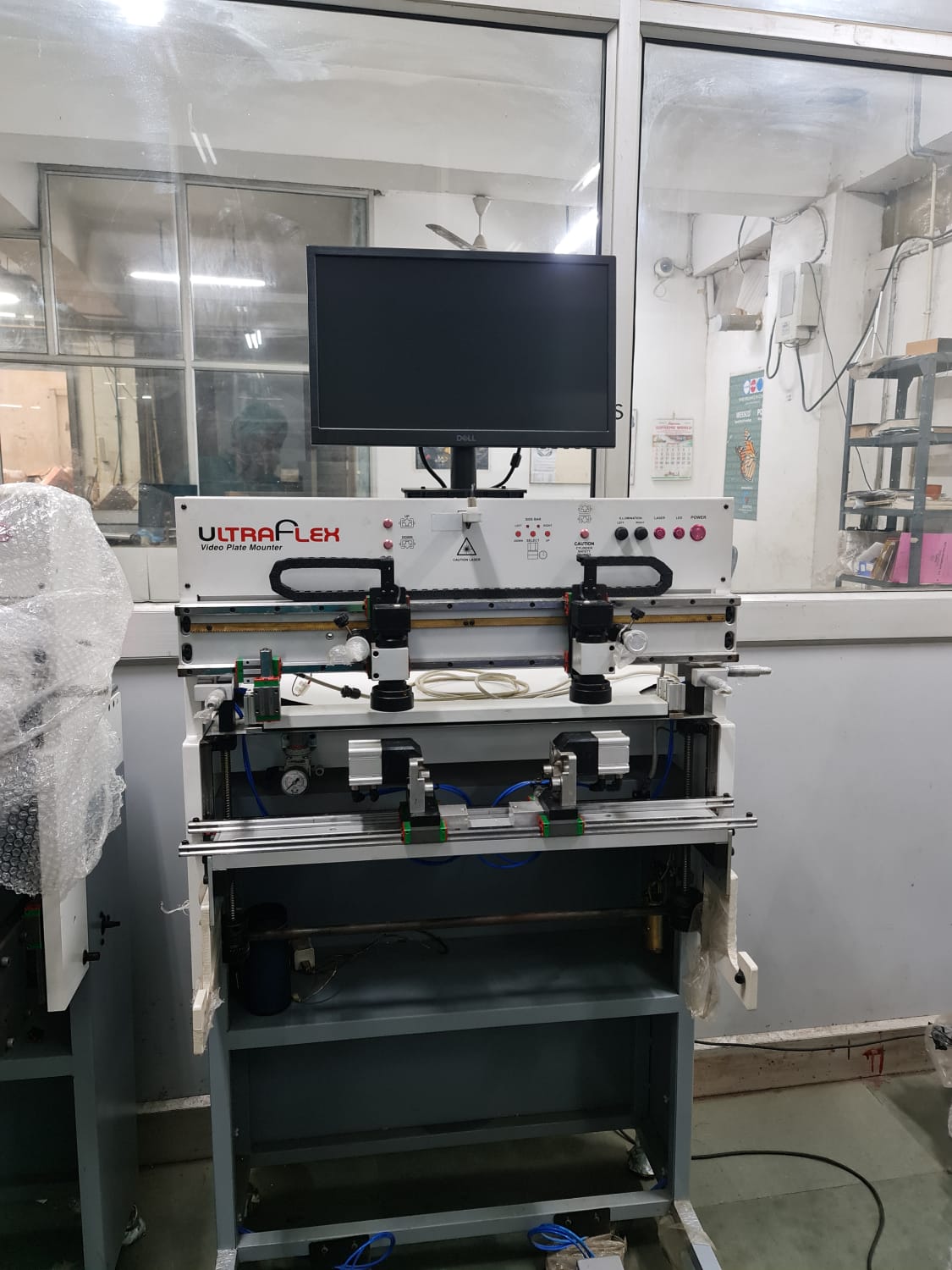
He insists that for a perfect and quick make ready, “a communication between the plate mounter and the machine is imperative.” Abhay also started making plate mounters. He asserts that with plates mounted on his plate mounters, the first meter of print which rolls out will be 99% in true register. This is his creativity. His machines and plate mounters are designed as perfectly complementary and compatible equipment  so as to make life easy for the machine operator. He claims that in 3-4 minutes you can perfectly mount an eight colour job on his plate mounter and have the machine running in full register within 3-5 meters. That says Abhay is our USP. Ultraflex machines offered by him are of international quality, fully servo driven with auto register control, it is value for money and affordable. Ever since, Abhay has already installed thirty-eight presses in India and abroad with the latest ten color machine being shipped to a prestigious customer in USA. This will be his first installation in North America and fifth machine being sold overseas.


Abhay has two sons Anuj and Akshay and a daughter Aallia. Both sons run the PSA labels division of Dutta Press while brother Rakesh manages the wet glue label business from Okhla. All family members are in business together as a joint family. UV Graphics and Dutta Press operate out of 66000 square feet factory in Noida and an 18000 square feet facility in Okhla with seven flexo presses in Okhla and six flexo presses in Noida. With a total of 280 employees, Abhay aspires that if God and Kismet helps UV Graphic will be a leading global supplier of diverse label equipment in 5 years. He proudly says, “we produce from nail to the hammer. In UV graphics we produce our own UV Systems, Plate mounters, Core cutting machines, Label presses, Slitter Rewinders, Semi Rotary Digital Finishing, Print Cylinders, Magnet Cylinder, Sheeting Cylinders, Hot Foiling Stamping Equipment, Screen Printing and almost everything that is needed for flexographic label printing and converting. We also make wide format Roll to Roll Hot Foil Stamping Machines for the tobacco industry.

The way Abhay Dutta is moving it will not be long before he achieves what he aspires.

Written by Harveer Sahni Chairman Weldon Celloplast Ltd. New Delhi August 2021

Saturday, July 24, 2021

Marks Emballage, an international banker’s foray into Label Manufacturing

Marks Emballage factory at Baddi

In May 2018, the Indian label fraternity was amazed to read the news of an upcoming relatively young label company Marks Emballage announcing the confirmation to buy two Gallus Labelmaster presses in one go. This one step would take this nondescript label manufacturing company into the big league. The author has been in the Indian label industry for over four decades. As far as memory recollects, there have been instances when two presses have been ordered by printers to be delivered one after the other with a gap of time, but the unique instance of two presses to be delivered and installed in just one go is a first one such occurrence so far, this is history for the Indian label industry! By rough estimates, a 4 billion Dollar labels industry (not label stock but finished labels) growing at an average of 10-15% per annum surely needs such investments regularly to meet the 400-500 million Dollar growth in demands of labels. Leading Mark Emballage, Aadtiya Kashyap, a former international banker, is the courageous one who made his foray into the Indian label industry and announced his first significant expansion investment with a bang.

Aaditya and Khushboo
Aaditya was born and brought up in Mumbai, an Alumnus of St. Xavier’s School Mumbai (He prefers to call the city Bombay as he has called it all his life). Later he finished his graduation from the prestigious Ruia College, Mumbai, in Mathematics. He had considered a career in computers and did a couple of courses in that, but he graduated in the subject since he was good in mathematics. While in Ruia college, he fell in love with Khushboo Singh, who was pursuing BA in the same college. After a courtship lasting almost five years, they decided to tie the knot and got married in 2008. After graduation, Aaditya got his first job in the international bank J P Morgan, where he worked for the next seven years. This job was a good learning experience in how systems in business work and how different departments work. He was the only one in the organization at that time who got four promotions in seven years. Those were many learning years that added to his experience. Looking back, he is happy that he worked there, as the experience has been helping him when in business. 


Aaditya’s wife Khushboo belongs to a successful business family involved in pharmaceuticals, so it was a matter of time that his In-Laws prompted him to consider entrepreneurial options. The suggestions ranged from indulging in pharmaceutical products to items connected to pharma. Khushboo’s grandfather Samprada Singh took it upon himself to mentor Aaditya. Samprada Singh, the founder of Alkem Laboratories, had a significant influence on Aaditya. He was a true visionary and an impactful leader whose life was full of beautiful lessons of courage, resolve, hard work and indomitable willpower. His journey from a tiny village in Bihar to establishing India’s largest pharma company is just an extraordinary one. His life story portrays the old English adage, “From tiny acorns grow mighty oaks.”

Initially, Aaditya spent time in Alkem Laboratories to learn various aspects of the pharma business. First, he spent time with the purchasing team before moving on to “Doctor’s gifting”, a concept that was a contact-building and promotional cum marketing exercise undertaken by pharma companies to stay connected with doctors. A year down the line, he moved to Galpha laboratories owned by his Father-in-law N K Singh taking care of the same portfolio of doctor gifting until a government notification limited the scope of “doctor giftings”. At this time, he faced another change of job profile or considered another line. In his time spent with the purchasing team at Alkem & Galpha, he had gained much knowledge about packaging and its nuances. Khushboo, being born into the pharma business family, was a natural fit to take up professional responsibilities. As business was in her blood, she joined her father’s company, GALPHA which she had joined immediately after college in 2004-2005, primarily taking care of production planning, purchase of packaging and raw materials. The circumstances, as they evolved, led Aaditya to consider making a foray into packaging.

Meanwhile, Aaditya and Khushboo decided to move to Baddi to set up a pharma unit extension of GALPHA, manufacturing formulations. Aaditya’s experience as a banker kept bringing to him the realization that if two people are doing the same thing, then the output is restricted. He started looking at some other venture. His brother-in-law Dr J P N SINGH (Khushboo’s sister’s husband), who also is looked upon as a mentor by Aaditya, was making pet bottles, suggested label manufacturing and that, eventually led him to decide on labels. JPN had prompted, “all the bottles I make will have labels made by you on them”. His father-in-law NK Singh and grandfather Samprada Singh all agreed that labels were good business. So, in 2011 the decision was taken to set up a label manufacturing unit. The initial two and half years were spent trading in labels, outsourcing them from different vendors and supplying to group companies. During this period, he spent much time with the printers at their factories, getting the right kind of labels and in the process learnt the basics of label manufacturing from prepress to plate making and finally converting. He is indebted to Datta Ram Fulsundar of Aarya Printpack - Mumbai, with whom he had confided about setting up his unit, yet the printer agreed to teach and train him all about manufacturing labels.

Since Aaditya had made up his mind to invest in a label press and print labels himself, JPN mentoring him on, suggested; that to test the heat, one should check with just a finger touch before putting your hand in, meaning start the operation at a tiny stage and go thereon. In November 2013, Aaditya, with his wife Khushboo as a partner, launched their maiden startup venture, Marks Fine Printers in Baddi Himachal Pradesh, in a 2000 square feet industrial shed with just one Chinese stack type flexo label press. While Khushboo continued to look after GALPHA Laboratories Baddi, Aaditya got full time into setting up the label unit. The first order, even though it came from a family-owned company GALPHA laboratories, the experience was, as Aaditya says, “Exhilarating! It was like scoring a maiden cricket century.” For the next two years, they catered to family-owned pharma companies. The biggest challenge was getting the suitable operators and people to run the press but then time elapsed, which has taught him to manage that. 2 years after initiation, Aaditya seemed to have tested the heat and confidence, invested in a Bobst label press. Once the operations were well set, it was time to get customers beyond the family companies. The natural step was to rope in companies that were contract manufacturers to the group. Subsequently, they ventured out to service customers outside the family reach, initially it was all pharma as they had much experience in the segment, but later, they got into all segments like Food, FMCG, Liquor and others. He remains indebted to the four mentors that including his father. It is their advice that made this possible. Aaditya always wanted to be like his father, who taught him; "The name that you earn, always has more value than the money earned".  Walking on his father's footsteps, Aaditya has ensured a good name for himself along with setting up a successful business. Once established, it was time to get experienced professionals in and systemize the whole operations. They looked around and slowly got their team together.

C K, Aaditya with Ferdi and Sameer of Gallus 
In packaging requirements for pharmaceuticals, the size of labels is relatively small, but when Aaditya started to look at other segments, the label size was much bigger, which meant that with the same inputs and infrastructure, the costing would be different, turnover would grow bigger. This was an exciting realization, and the vision to expand started getting more precise. Initially, Aaditya had planned to add a press every three years, but this new realization prompted him to grow exponentially. He established the new company Marks Emballage Pvt. Ltd. in 2018 to invest in two Gallus label presses in one go. Hoping to make a substantial impact in the Indian label industry with their big move, however, as luck would have it, they started printing on these two presses in April 2020 when the pandemic hit across. Covid has been a difficult time for Marks Emballage. The first few days were a mixture of too many different feelings inside, from the fear of the unknown, concern for employee’s safety, responsibilities to serve the customers. Despite the uncertainties, they gathered themselves and planned to navigate through the difficult time. This was possible only with the total dedication of their team, who put up great courage and kept the business going and growing. They realize that going into the future, leaner companies and more automation will be the way forward. Cloud technologies, robotics, artificial intelligence, and virtual reality combined will reduce human physical contact and dependence. This will be the biggest shift for all businesses and Marks is no exception. This goes on to validate their investment in the right equipment, processes, certifications, and team.

Author with Aaditya on shopfloor
Besides having residence in Mumbai, Aaditya and Khushboo now stay in Chandigarh with their 8-year-old daughter Kiara. While they complement each other in work yet look after different businesses. Marks Emballage Pvt. Ltd. is a fast-growing company headquartered at Chandigarh and operates out of factories at two locations in Baddi. The plant is spread over 30,000 square feet and equipped with some of the finest equipment like print kits from Gallus, Bobst, AVT, Prati , Pantec and Xrite. A team of 60 people is creating a work culture of excellence. Talking of new ideas and projects and the vision for the next five years, Aaditya says, “We have too many ideas to implement. I am working on many exciting new projects in technology, consumer products, packaging, and pharma. We aspire to roll out at least one new project every year for the next five years. This is the time for us to spread our wings before getting into a consolidation mode in 5 years. 

CK Gadhia of Marks giving student of year awards


The journey has just begun”. Marks Emballage has, as a part of its CSR initiative, invested in sponsoring the annual “Printweek Student of the year” award. They are very keen to backup educational initiatives for encouraging the new generation to take up print as a career. 


As he plans his way forward in the label and packaging field, Aaditya makes a fervent appeal to peers, “I would like to appeal to all the fellow label printers that we should all work with better collaboration and work with each other rather than work against each other. Together we can have great strength to backup print education to ease our recruitment needs, have complimentary print technologies to avoid idle capacities, and have a better say in purchase or sales negotiations. The advantages are just many. It is time to team up and grow the industry together. We need to increase the overall pie. While we are all doing the basics of waste management today, the need of the hour is to attack the problem from the very base. We are studying and closely following linerless labels and believe that they can be a game-changer for our industry. As per industry reports, only 5% of the laminates and self-adhesive label stock is reused or recycled. This area demands our closest attention. 


Marks Emballage is a company to watch, as an ambitious team aspires to grow 10-fold by the end next five years. With a young, dynamic leader like Aaditya Kashyap at the helm, hoping the pandemic's after-effects soon end, this company will be moving fast to achieve targets and move tangentially, investing in technologies in synergy.


Written by Harveer Sahni Chairman Weldon Celloplast Limited New Delhi July 2021
Saturday, June 12, 2021

Sigma Middle East labels- Rising from humble beginnings.


UAE or the United Arab Emirates consists of seven independent city-states or emirates: Abu Dhabi, Dubai, Sharjah, Umm al-Quwain, Fujairah, Ajman, and Ras-al-Khaimah. Total population of all the emirates of UAE put together is much less than that of New Delhi India at 11.42 million with only 20% Emiratis and rest are expats making it the highest percentage  of  expatriates in any country in the world. The Indian expatriate population at 28% is the largest group in UAE. It is surprising that there is a substantial number of label printing companies there with more printers joining in year after year. In the start of the new Millennium, one could count the total number of label printing companies to around 10 which has now grown to over 40. Even though leading printers speak of intense competition and depleting margins yet there is a steady news of expansions and new companies joining the bandwagon of label printers. Obviously, it is not the local demand but due the business environment, conditions and facilities, the printing companies reach out to customers not only in the Middle East but also to Africa, Europe, and USA. It is a global hub from where they produce and export. It is normal to hear label printers in the region expressing difficulties due to a small market and intense competition, in such a situation it is heartwarming to see someone who comes from a fragile financial status, jumping into label printing and starting to register smart growth. One such person is Jagannath Wagle who endeavored to take the risk of setting up from virtually nothing, his maiden label venture, Sigma Middle East Labels that has started rising from humble beginnings.

Jagannath Wagle
It is rare to find humble people these days. Humility is putting pride behind, staying grounded to reality, have faith in oneself and learning from one’s modest beginnings to continuously move ahead with firm resolve and keep evolving. That is how Jagannath Wagle talks with respect and nostalgia about his humble background and times when he was growing up. this: As if living with his parents in a one 300 square feet room flat in Mumbai’s western suburb Nala Sopara along with two brothers was not crowded enough, to help the son of a family friend in village, his mother brought the boy to Mumbai to stay with them.” Jagannath’s father, an auditor with the government of India’s audit department had to manage within the meagre means to support a family of 6 people living in one room. However still they managed to impart the right education to all the children. Jagannath’s mother was a homemaker in true spirit, managing the household and the children by taking home tuitions, he reminisces fondly about her being an excellent cook.

Jagannath Wagle studied up to class 10th in Little flower English school in Nala Sopara followed by joining father Agnel technical college in 1992. Unfortunately, due to Mumbai riots in 1992 he could not attend college, had to drop a year, and later joined an institute in Vasai to complete the secondary school education. Later he wished to join an engineering college but could not afford the capitation fee demanded by institutes those days so as an alternative he studied to graduate with B.Sc. degree in Physics from Mumbai University in 1998. Due to the financial stress, a relative in Delhi suggested for him to join the Coast Guard but his mother did not relent as she wanted him to study further. He finally went on to get a B.Sc. (tech) degree that was equivalent to an engineering degree. Thereafter he started making applications for job in various organisations and also to start with, he accepted a job with a relatively small company TechGyan at a meagre salary of Rs.4000.00 per month (Approximately 55 dollars). He had a lot of interest in computers so had acquired knowledge about them and as a business to augment his earnings he started assembling computers for customers on job work basis charging Rs. 2000.00 per computer. He had already catered to almost 50 customers. At this time, he started getting interview calls from companies like HDFC, Wipro and Reliance. He was excited that he got selected in Reliance at a salary of Rs.18000. per month to start with. It is strange and a matter of kismet as to how life leads you to your eventual Karma Bhoomi, the land where one eventually works or performs his life’s deeds, this is as expressed in Indian literature. Before Jagannath could join Reliance, his family got a call from his mother’s brother in Dubai who had been tricked by someone to invest in a label manufacturing unit, knowing nothing about labels and he needed help. He requested the family to send Jagannath to Dubai.

Ajman
Like any young man Jagannath also had aspired to work in distant lands like Europe and USA but for the Dubai offer by his uncle, he was hesitant as he knew nothing about labels, his knowledge was limited to computers and engineering. His mother impressed upon him to go to Dubai and support her brother who needed help and who else he could rely upon except family at this time.  The decision was made and on 28 January 2004 Jagannath Wagle landed in UAE which everyone impulsively refers to as Dubai due to its being recognized as the face of UAE. He started to work with his uncle in Ajman, as a salesman on a salary of 1500 Dirhams per month. Though he started as salesman, but his job profile eventually became all in one, heading the label business with a team of only 3 persons just like a startup entrepreneur. Jagannath knew that with UAE having one of the highest per capita income, it would be expensive and difficult to manage in the income promised and more difficult if he got married. To make success of his career he plunged head on into the business he had no knowledge about. Customers and suppliers became his teacher and taught him all about plates, cylinders, color management etc. he was a fast learner. A business that was 10000 Dirhams per month when he joined and his uncle was pumping in money each month to sustain expenses, became 100,000 per month  in just a year’s time, all this with just one two color small tacky boy press. Any label printer will understand the  effort that must have gone into achieving this.

Pooja Wagle
In 2005 Jagannath convinced his uncle that to remain in business they needed another machine. A used 1980 model 7” 3color Mark Andy 830 was acquired. In today’s time of advanced servo driven modular presses that equipment sounds irrelevant yet by 2007 he was able to reach a sale of 350,000 Dirhams per month by working 24 hours every day, the Tacky boy press became redundant. Jagannath’s salary was enhanced to 3500 and he got married to Pooja from Bohisar in Mumbai. Pooja also came from a very humble background, the father having passed away, her mother taught children of poverty-stricken people. She was working as a credit card salesperson with ICICI bank. They came in contact through a matrimonial website and the marriage was arranged by parents with the couple having never met each other. Once married the couple faced financial stress and there was need to move up in life.


Part of Sigma old factory shed
There was no scope for further expansion with the existing Mark Andy 830 press, discontent crept in, Jagannath contemplated on starting on his own or returning to India, but his wife Pooja put her foot down that there was no way she will go back to India and bring up her children there. Meanwhile Jagannath’s cousin had joined the label business and took over the management. Jagannath decided to initially start his own trading business of making non adhesive liners for cores. Having no money to start manufacturing himself he started out sourcing converting also from his uncle’s company for whom he was working. He was so respectful toward his uncle because of whom he was in Dubai and had indulged in learning the label business, that he made sure not to touch any customer who was buying from them. He even kept working simultaneously with uncle during the day and after office hours for his trading business because he wanted to let his cousin to complete his MBA before he left that business completely. Once free Jagannath decided to get full-fledged into labels but making sure he never touched his uncle’s customers. He started getting his jobs done from a company called German labels and as luck would have it sometime later the owner of that company decided to quit business and sell the machine.

Old factory shed
Jagannath wished to buy that press but did not have the funds, so he requested the owner to accept instalments, fortunately as he was destined, the owner agreed to handover the press with 50% down payment and 50% in 6 months. Now the 50% down payment was also not there but a determined Jagannath Wagle refused to give in. In due course of time his two brothers and the friend who lived with him in Nala Sopara had all moved to Dubai and were in good jobs. They all came to rescue and pooled in money to help him buy the Mark Andy. The trade license he took in 2009 was converted to a manufacturing license in 2010. So, in January 2010 Sigma Middle East Labels Industries LLC  started their maiden venture operating with a 250mm preowned Mark Andy 830 press in an 1100 square ft shed in Ajman with just one operator and a helper. Hard work and sheer perseverance produced good results and at this time a difficult situation cropped up. The only operator he had met with an accident and in emergency had to go to India. It was during the Eid period when business is at a peak in UAE, not being the one to be left behind, Jagannath himself operated the printing machine for the next three months. When a container of stocks arrived, he and his only helper would unload and moved goods into the shed and stack them. As at that moment he could not afford help and this incident will always keep him grounded to reality. Watching him make the gigantic offer many suppliers came forward to support him. He is extremely appreciative of Ajay Mehta of SMI Coated products for his support in supplying material on credit to his start-up venture.

Multitec
In 2012 when his sales from just one press reached 150,000 to 200,000 Dirhams per month, it was time for Sigma to move on to the next level and acquire another bigger press, he wished to install a European brand, but paucity of funds made him decide on an eight color all UV Multitec 330mm label press which was installed in 2013. It was his first modular press and was a big jump for Jagannath. Even though he lost some money initially as his costing was not right but soon, he took corrective steps towards growth, “This was my biggest learning curve” says Jagannath. 

Bobst at New Premises
Two years down the line in 2015 a jubilant Jagannath fulfilled his dream of acquiring a European label press, a Gidue MX370 , 8 color all UV, 1 die station, delam-relam, cold foil and lamination was installed along with and some more additional equipment, also adding more shopfloor space. The fast unplanned expansion led to problems in cash flow and in 2016 Sigma ran into financial stress and troubles. Payments to suppliers were delayed and supplies became restricted. A person having risen from grass roots and not the one to give up, Jagannath kept constant touch with his vendors assuring them safety of their investment and in the meanwhile putting in enhanced efforts to nurture his company to good health. By 2017, recovery had started. Sigma moving ahead acquired yet another Gidue like the one they had. 

Brotech Finishing
Here on, a more professional approach was put in place, targets planned and achieved, more ancillary equipment including a Chinese press 5 colors with UV and hot air in 2019 to print the liners for cores was added and the second Gidue like the one bought before was bought. Yet again mentions Jagannath that SMI was there to support him, he remains indebted to them. However, learning from past experiences, he sold the Multitec press so that he did not run into financial stress again. The one 1100 square feet shed had multiplied to become 4 sheds and continued growth had become a reality at Sigma. The first used Mark Andy 830 that he had, was given to a friend in Oman at low price to help him.

New office


In 2020 things became comfortable, Sigma moved from the four 1100 square feet sheds to a plush well planned 12000 square foot facility with well-furnished and equipped offices. 


Going Digital with Konica Minolta


They invested 5 million Dirhams adding a Konica Minolta, foiling equipment and Esko and Asahi plate making system. 


Reception of new premises

In early this year 2021 Jagannath decided that his company had to upgrade to latest equipment to be more efficient in production, he sold the first Gidue he had bought and replaced it with a brand new fully loaded Gidue M5. Jagannath has finally put Sigma on its road to success and bigger business, he attributes the his journey so far to the inspiration that he got from a Indian picture “Guru” based on the life of Dhirubhai Ambani the founder of Reliance Industries Ltd. He still quotes the dialogue from that film, “If I am doing well why not for myself ?”. 


The credit for this amazing journey largely goes to the woman behind Jagannath, his wife Pooja who solidly supported him right through, besides bringing up their only daughter. Pooja is a partner in the company holding the purse strings as the financial controller. No business succeeds without a good team Jagannath and Pooja carefully built their team as a family and took only people from grassroot levels and trained them, two of their teammates had joined as labour/helpers and now work as business development executive bringing in half a million Dirham business each. During their struggling days, Jagannath’s brother in law Kishor Vedpathak quit his job in Mumbai to come and support him, he now looks after Sigma as admin manager. Looking back, he reminisces that his first big break was when he got a big order for 100,000 price marking rolls from Centre Point Chain retail stores. He plans to enhance capacity again later this year with yet another flexo press plus another digital press. Up from just two employees when he started on his own, he now works with 55 employees including four designers inhouse, Sigma has registered a sale of 25 million Dirhams last year growing 30% in a pandemic year!

Jagannath in his new office

Deep in thought and with a smile he mentions that he wishes to be if not the biggest, he will try to be one of the biggest label printers in UAE in 5years time. He is confident that he will continue to lead Sigma Middle East Labels to keep rising to higher levels.

Written by Harveer Sahni, Chairman Weldon Celloplast Ltd. New Delhi June 2021

Print magazines my reproduce the above article by giving credit to author.