On any given day, 96-year-old
S.N. Dutta, Satya Narayan Dutta, the patriarch of Dutta family of Dutta Press
New Delhi, can be seen strolling on the shop floors of their printing or
machine building units, interacting with workers, and imparting instructions.
The man is active and an institution himself in printing. Dutta was born on 15th of
August 1926, long years before the partition of India, in a family that hailed
from Lahore, then a part of British ruled united India. His father was the head
of accounts for Indian railways. Sometime in the 1940s as a young man, he
developed an interest in printing so went to a family acquaintance, Kedar Nath
Mehta, a master printer in Amritsar for a one-year training in the art of
printing. They used to print on Chandler & Price platen presses and supply
labels to Punjab based distilleries in Hamira and Khasa. Chandler &
Price was founded in 1881 in Cleveland, Ohio and manufactured a
series of hand-fed platen jobbing presses, as well as an automatic feeder
for these presses.
 |
| Chandler and Price Machine |
Love marriages were rare in those
days before the partition of India, however S.N. Dutta during his training days
at Kedar Nath Mehta’s facility, developed a liking for Mehta’s daughter and
eventually married her. Post partition the Dutta’s moved to their Haveli, a
traditional townhouse mansion in Darya Ganj Delhi. The Haveli was a heritage building
that had earlier belonged to one Sir Syed Ahmed Khan, one of the Navratans of
Mughal King Akbar. It was allotted to Duttas on migration from Lahore to Delhi
after partition for a sum of Rupees 4000 only. In 1951 S.N. Dutta started his
maiden startup venture “Dutta Press” with a Chandler and Price machine on the
ground floor of their Haveli. He bought the printing press for Rupees 1200.00
and did not have the money to put an electric motor on it. So, initially the
machine was foot operated with a peddle. As a memento and a reminder of their
past, the machine still stands tall on a pedestal in the lobby of their Okhla
factory. Thereafter from 1951-1965 Dutta was on
the move continuously, he also set up his own typesetting and composing section,
then added two more machines, following it up with buying a new Heidelberg GT Platen
press for just four thousand Rupees, then in the mid 1970’s a Mercedes Super
Cylinder Press from Printer’s House in Faridabad, Nibolo and some more
letterpress cylinder machines. Customer base acquired during this period
included those from segments like beer, whiskey and lubricants with main
customer being Mohan Meakin. S N Dutta has two sons Rakesh and Abhay, as
business had grown and the boys were now grown up, it was time to move to the
next level of business. In 1980 they moved to a new factory in Okhla and
imported their first Heidelberg KORD offset press and Heidelberg TP Foil
stamping machine from Germany. Those were tough times of needing import license
for all imports, yet firm resolve made them to move on.
 |
| Heidelberg Weisloch Factory |
Abhay Datta the younger son of S.N. Dutta,
born on 16th August 1961, is an Alumnus of St. Xaviers School Delhi. He was never a serious student but had other technical interests. Barely 16
years old and in school, he started experimenting with making music systems. On
finishing school, he along with his friend Joseph George set up their maiden
startup venture Systm India to make and sell music systems. Abhay proudly
mentions that in a couple of years his company’s turnover was higher than that
of Dutta Press. Young boys in business families are prompted to spend time in
family production units and Abhay was no exception and whatever exposure he got
was by way of his father mentoring him to have a penchant for perfection and
zero tolerance in whatever he did. One fine day his father came to him and
complained, “you make so much noise testing your music systems, speakers etc.,
neighbours are irritated . It is not a respectable business. He appealed to
Abhay that they needed help in the printing business and that he should wind up
this music equipment business and join him in the printing business. Obedient
as he was with immense respect for his father, Abhay could not refuse his father’s
request. Abhay’s elder brother Rakesh was better in finance and other marketing
activities. In just a matter of minutes Abhay decided to hand over the music
business to his friend Joseph and moved on to the printing business at Dutta
Press. He was sent to Heidelberg training center in Germany for training in
print technologies where he spent time in the Wiesloch
factory understanding mechanics and engineering of offset presses. It was an eye-opening
experience for him. In India we did not have CNC machines, no auto cad
computers, all the planning was done manually on huge drafting boards. It was
there in Germany that he gathered an eye for perfection, low tolerances, fine finishing,
good appearance and machine safety norms. This was as his father had mentored
him to be a zero-tolerance person.
 |
| UV Coating Machine |
Once back in the Okhla factory
Abhay had to begin at the lowest rung of the ladder. He was required to clean
up the machines, sweep the floor, take care of staff, serve them tea and support
them in small errands besides operating all the machines personally. He learnt
to run all the machines like an operator, make negatives/positives and offset
plates and foil stamping blocks himself. Those were days when there were no PS plates,
so he learnt all the chemistries hands on. Graining offset plates, putting sand,
marbles etc. in graining machines, he did all that himself. He was a total
worker like any laborer in the factory doing all kinds of jobs that included
printing varnishing cutting packing and dispatch. The experience has rubbed on
so well on him that even today on the shop floor in hot and humid conditions
with perspiration trickling down his torso he enjoys remaining amongst his workforces.
He is a hardcore technical and shopfloor production-oriented person while brother
Rakesh manages the white-collar part of management. With Abhay’s penchant for
perfection, he proudly mentions that we made quality, such that print buyers
would come looking for them. Since they were supplying to breweries and distilleries,
they came across a challenge; solvent
base varnishes on labels scuffed and needed to be replaced with Water based
varnishes, but these would not work on existing hand fed varnishing machines produced
locally due to slow drying. Abhay was given a task by his father to make a
machine that could coat aqueous varnishes at high speeds. He developed an
automatic machine with the help of Sanjay Gupta of Ronald Machinery and added an
anilox roll with a motor and hot air dryer to do the varnish. It worked and
that was when his tryst with machine building commenced. Later he started
manufacturing fully automated high-speed machines to do aqueous and UV coating
with anilox rollers and chamber doctor blade systems.
 |
| Abhay Datta on Shop Floor |
After that there was no looking
back in machine developments. Abhay was young, success encouraged him to
research, experiment and develop more from a shed in the driveway of their
Okhla factory, it has been a long journey with lot of hurdles. He then started converting
hot stamping machine for own use and sales. Since in earlier days they had
bought a Heidelberg hot stamping machine, from experience gained, Abhay could
convert die cutting machines and the Chandler and Price machines into hot
stamping machines. When stamping foil suppliers became aware of his
capabilities to make hot stamping machines, he became an accredited suppliers
to many companies who indulged in hot stamping. In 1992 he successfully started
making UV coaters and till 2016 they have supplied over 250 offline UV coating
machines in India and Abroad.
During his 1995 visit to Drupa, he
was fascinated by an Aquaflex label press printing Smirnoff Vodka labels.
Unlike the sheet fed converting, the press was unwinding, printing, embellishing,
laminating, die-cutting and delivering finished labels at the end of line in a
single pass. Abhay was convinced that this is the future. Those days there was
no WhatsApp where he could take videos and upload to inform his family about
the equipment. Wanting his father and brother to also look at the machine
before deciding, he made a trunk call, described the machine and requested them
to come and see. Three days later both his father and brother flew into
Germany, they saw and fell in love with the machine. They became friends with
the founder of Aquaflex, signed the deal to buy a press and also became the
sole selling agents in India. They opted for an eight colour press with rotary
hot foil stamping. It was a bold decision as rotary tooling for hot foiling was
very expensive, cold foil was not there that time and most of their production
for liquor labels needed foiling. In their factory they already had 20 Heidelberg
hot foil machines running, they used to buy used Heidelberg platen machines and
convert them into hot foil stamping machines by retrofitting, all done by Abhay
himself. The Aquaflex ordered by them was displayed at Labelexpo Singapore in
1996 and then shipped to India for Dutta Press to start printing labels on a
narrow web press. Till the end of the millennium 1999 they were only printing
wet glue labels on this machine. Pressure sensitive adhesive (PSA) labels
production commenced only in the new millennium in 2000, they kept adding Aquaflex
presses in regularity.
 |
| Ultraflex Label Press |
Between 1996 and 2003 as agents,
they sold nine machines to customers like PPL, ITC, Modi Federal, Sai Packaging
and others. They added four more press at Dutta Press. In 2001 Aqua flex got sold
to Chromos USA . At this time when he was under pressure to offer a press to
his customers, he met a software engineer who suggested the name of Shanti Pal
Ahuja of Multitec and once the two met, they instantly decided to get together
to build label presses. Abhay invited Ahuja to his facility and have a look at
the Aquaflex label presses and to do reverse engineering of the press. A
complete unit was removed from the Aquaflex and sent to Multitec facility in
Faridabad. It was completely meticulously redrawn and the first Ultraflex machine
was developed and sold to Nishi Labels in Ahmedabad and the second machine was
exhibited at Nehru Centre in the first “India Labels show” which later became Labelexpo
India. That machine got sold on the very first day of the show to Khosro Moradi,
of Farah Banfash Manufacturing Company, Iran. Few years down, having sold over
a dozen presses, their partnership fell apart and Multitec renamed their press
as Ecoflex and Abhay Datta retained the name Ultraflex that he would build
himself one day. Until such time for their own label manufacturing they
invested in Bobst label presses
 |
| CNC Machines at UV Graphics |
Passionate about making machinery himself, in
2017 after they bought their 3
rd Bobst M5 press, Abhay visited
Florence and was inspired to build his own flexo press. On return from Florence in
September 2017, he dug deep into the Flexo Machines and studied other equipment
that would enable him to build a narrow web label press. Keeping cost down and
not compromising in automation he started planning a machine with zero waste
and instant make ready. He launched his first Ultra flex made in his company UV
Graphics.
 |
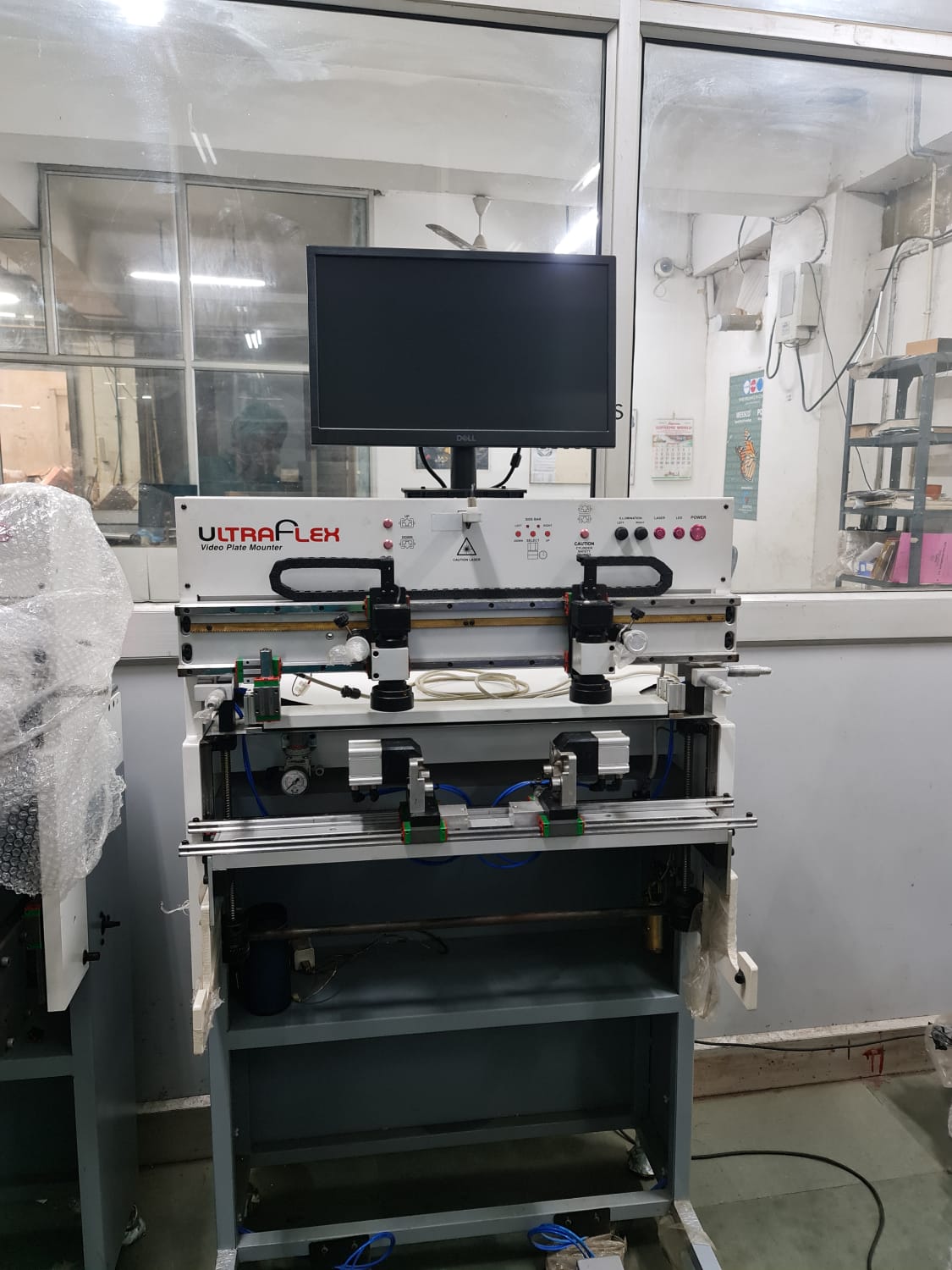
| Ultraflex Plate Mounter |
He insists that for a perfect and quick make ready, “a communication
between the plate mounter and the machine is imperative.” Abhay also started making
plate mounters. He asserts that with plates mounted on his plate mounters, the first
meter of print which rolls out will be 99% in true register. This is his
creativity. His machines and plate mounters are designed as perfectly
complementary and compatible equipment so as to make life easy for the machine
operator. He claims that in 3-4 minutes you can perfectly mount an eight colour
job on his plate mounter and have the machine running in full register within
3-5 meters. That says Abhay is our USP. Ultraflex machines offered by him are of
international quality, fully servo driven with auto register control, it is
value for money and affordable. Ever since, Abhay has already installed thirty-eight
presses in India and abroad with the latest ten color machine being shipped to
a prestigious customer in USA. This will be his first installation in North
America and fifth machine being sold overseas.
Abhay has two sons Anuj and
Akshay and a daughter Aallia. Both sons run the PSA labels division of Dutta
Press while brother Rakesh manages the wet glue label business from Okhla. All family
members are in business together as a joint family. UV Graphics and Dutta Press
operate out of 66000 square feet factory in Noida and an 18000 square feet facility
in Okhla with seven flexo presses in Okhla and six flexo presses in Noida. With
a total of 280 employees, Abhay aspires that if God and Kismet helps UV Graphic
will be a leading global supplier of diverse label equipment in 5 years. He
proudly says, “we produce from nail to the hammer. In UV graphics we produce our
own UV Systems, Plate mounters, Core cutting machines, Label presses, Slitter Rewinders,
Semi Rotary Digital Finishing, Print Cylinders, Magnet Cylinder, Sheeting Cylinders,
Hot Foiling Stamping Equipment, Screen Printing and almost everything that is
needed for flexographic label printing and converting. We also make wide format
Roll to Roll Hot Foil Stamping Machines for the tobacco industry.
The way Abhay Dutta is moving it
will not be long before he achieves what he aspires.
Written by Harveer Sahni Chairman Weldon Celloplast Ltd. New
Delhi August 2021