Harveer Sahni

Harveer Sahni
Author Harveer Sahni

Avery Dennison

Avery Dennison
Sustainability at Avery Dennison
Showing posts with label India. Show all posts

Sunday, December 8, 2024

Labelexpo India 2024 showcases transformation.

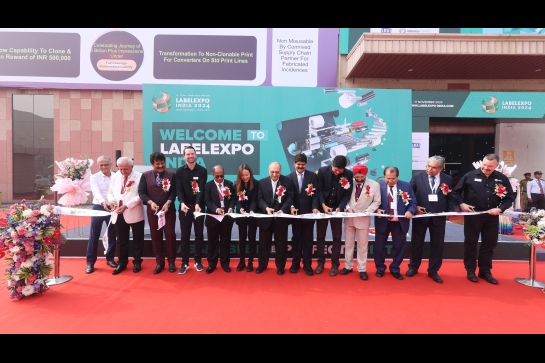
Opening Ceremony
This was the first Labelexpo India after the holding company Tarsus PLC, the erstwhile owners of Labelexpos were acquired by Informa markets, a global organizer of events in various global verticals. Since the new owners decided to retain the same team of labelexpo,  the smooth transition and continuation was evident. 

It was the largest show until now. The show was held at India Expo Mart, Greater Noida with a 30% higher floorspace than the 2022 edition. The largest ever number 13724 visitors came to show from, besides India,  many countries including those in Middle East, Russia and Africa. Normally we see only label printers and non-exhibiting suppliers as visitors to the show, this time it was a welcome change to see quite a few brand owners/Print buyers as visitors studying the nuances of label manufacturing. It is felt that with the growing need for customized runs and increasing number of startups, some label buyers may be considering captive label production as well. 

Rajesh Chadha President LMAI


Inaugurating the Labelexpo India 2024, Jade Grace Managing Director welcomed the visitors to this important event. In his welcome address, Rajesh Chadha President LMAI assured LMAI's continued support  and delivering value to the label fraternity.  After consultations with LMAI and other stakeholders, Informa Markets have decided to hold the next edition of this important event at the same venue in 2026.


For the past two consecutive editions of Labelexpo India we have witnessed the absence of European and American flexo label presses running live at the event, though some made their presence felt through their local agents or Indian subsidiaries. However still, there were many flexo label presses displayed, and most of them were Indian made ones followed by a few from China. It is an indication of a transformation that one can expect Indian and Chinese manufacturers of flexo presses, tooling and consumables will have increasing number of exhibitors at Labelexpo Europe. The transformation is happening by the evolution of technologies taking place in these Asian neighbours. Fewer Chinese companies came as exhibitors due to Visa restrictions, which may change with thaw in the relations between the countries. Of course, we cannot write off the western manufacturers who lead the way to evolution by creating equipment that transforms from production of only labels to produce multiple products like Flexible packaging, Lami tubes and Folding Cartons. Their focus is now moving to wider presses, which are hybrid, incorporating diverse printing and converting technologies resulting in lesser wastages, quick changeovers, increased embellishments, sustainable production and processes. The presses now being offered integrate flexo, offset, screen, gravure and digital inline in a single pass.

Pulisi stand
Digital label printing has also continued to grow in India. Most prominent companies including HP, Domino, Durst, Xeikon, Konica Minolta, Pulisi, etc. displayed their digital presses and label printers’ interest was seen in with serious intent. Indian label industry being mostly dominated in numbers by family managed middle and lower end companies find the high-end digital presses being beyond their immediate reach even though their desire to acquire digital printing capabilities was seen in substantial measure. Printers exhibited a lot of interest in entry level tabletop digital printing equipment. These digital printers though are priced lower, but their higher printing cost confuses converters. Those who understood the power of digital making its necessity felt in label manufacturing, did make purchase decisions at the show. Given the trend of the middle level label companies looking at entry level equipment, it indicates that it is just some more time before they graduate to the bigger digital label and package printing equipment. The transformation has begun. The industry is and firmly marching towards digital label printing and converting.


On the material side while the global leaders Avery Dennison displayed their innovations and advances especially in the RFID label technologies and linerless labels. UPM too exhibited their new and sustainable product offerings. A substantial number of Indian labelstock manufacturers put their best in front rubbing shoulders with the multinational material producers. Prominent amongst them were SMI, MLJ, Capri, Stic-on, Dubble, Desmat and many others. Silicone liners specialist Loparex exhibited their diverse range of backing papers, films and linerless materials. Sustainability seems to be catching up the attention of all in the self-adhesive label’s ecosystem. From equipment suppliers to material suppliers are now talking of sustainability endeavours and the imperative need for the 4R’s, reduce, reuse, recycle, and recover. Indeed, this is a welcome transformation. Yet, there is a lot more needed, and the onus is also on brand owners and print buyers to impress suppliers to implement sustainable manufacturing practices and to use FSC certified products and to conserve energy.

Harveer Sahni's book launch
In the second half of 14th of November, the opening day of Labelexpo India 2024, the author’s book titled “Untold stories of Indian label industry” was launched at the HP stand in presence of Industry leaders and media. Prominent were Yoav Lotan, Appadurai and team from HP, Anil Sharma, Pankaj Bhardwaj and Saurabh Agarwal from Avery Dennison, Rajesh Chadha president and his leadership team of LMAI, Media presence included Labels & Labeling, Printweek, Packaging South Asia, Packman, Press Ideas along with a host of industry friends and supporters of the author. The Hp team hosted the event supported by Avery Dennison, LMAI (Label Manufacturers Association  of India and Pragati Pack. 


The book UNTOLD STORIES OF INDIAN LABEL INDUSTRY”  Author: Harveer Sahni, chronicles history of Indian labels industry from the very beginning when the first self-adhesive label was produced manually. It covers success stories, lives of leading  label printers and coverage of important label events in India. It also dwells on the most defining moments, the young czars of label industry and the women who lend glamour to the vibrant label Industry. It is the first of its kind of endeavor anywhere in the world. It is a 320-page coffee table book with rare pictures.


Lighting the lamp before Awards evening
On the second evening of Labelexpo India the LMAI Gallus-HEIDELBERG Label Awards night was held to commemorate the finest of label printers in India. An outstanding event curated under the exacting and fine detailed planning leadership of event chairman and past president of LMAI Kuldip Goel. The virtual who is who of Indian label industry was present. The event interspaced with entertainment slots was attended by over 700 delegates from the global label industry. 


Felicitating Ferdi and his wife


A touching part of this evening was bidding farewell to Industry stalwart Ferdinand Ruesch IV, senior vice president, global key accounts at Gallus, popularly known as Ferdi who is retiring after 40 years of dedicated service to the global printing and packaging industry. It was a nostalgic moment and will remain memorable forever. 


The evening ended with music, dance and partying, looking forward to yet another vibrant LMAI event.

 More images:

LMAI BOD with event organiser Hemal


LMAI Board of Directors


With Ashima Ahuja of Multitec                                                             Pradeep Saroha of Informa 


Monotech Stand

Multi Hi-tech


Written and compiled by Harveer Sahni Chairman Weldon Celloplast Limited New Delhi November 2024




Tuesday, November 24, 2020

Creative Graphics; Service to flexographic printers at their doorstep!

Digital Flexo Plates

Flexographic printing has evolved from being a basic printing technology to a technically advanced process that can turn out quality prints comparable to those produced by the best of printing processes. The credit of this advancement goes to the development of prepress and printing plates. Prepress is the term that we refer to as the process to make ready the press, the design layout and transforming the design into data files that will eventually lead to producing the photopolymer plates to print the files on to paper or other substrates. A technically strong prepress ensures success in producing the right kind of printing. Deepanshu Goel, an Alumnus of New Delhi’s prestigious Hindu College from where he completed his B.Sc. Electronics in 1994, joined his parental business of manufacturing communication cables that was started by his father 35 years ago. Having been a topper in studies, he was not comfortable in the cables business and wished to do something different and more to do with evolving technologies. In 1998, a friend who was having a stack type flexo press suggested that he start flexo plate making business. Even though he had no knowledge of flexography yet, Deepanshu quit the cable manufacturing business in 2001, to start a plate making business.

At that time in 2001, when he did not even know what was CMYK which stands for "Cyan Magenta Yellow Black" the four basic colors used for printing color images, with a meager investment of 35000 Rupees, two employees and himself to help, he started his polymer plate making business Creative Graphics in East Delhi’s Vishwas Nagar. Those were difficult days since Deepanshu had no previous knowledge of the process. He acquired literature to understand the nuances of plate making and got hands on learning as they progressed.  Soon he had to relocate due to property sealing initiated by the Municipal Corporation Delhi, for non-permissible commercial activity in residential colonies. They moved their operations to a 1000 square foot factory in Noida’s Sector 10 from where they later shifted to Sector 9 in Noida. Mistakes happen when you are indulging in a technology that is alien to you, he bought machines that were not ideally suited for flexography and instead were meant for offset printing. Since the mindset was clearly focused on to flexographic printing plate technology and not Offset printing, the machines were sold off and new equipment that was suited for flexo plate making was acquired. In an effort to further educate himself and enhance his knowledge of plate making Deepanshu acquired literature published by BASF printing systems Germany which in 2005 became a part of the Flint group. Technology for the process at that time was not freely available so he was able to sharpen his skill by reading and practically implementing what he learnt from the literature. No doubt he made mistakes but those were taken in his stride to learn the intricacies’ of producing the perfect plates for flexographic printing.

Until 2008 Creative was making plates manually with help of small basic machines. Those were struggling days. Learning and finetuning as they went along, they associated with Flint who supported them in gaining required knowledge. In 2008 they moved to their own 3000 square foot premises in sector 8 Noida. The same year they bought the “nyloflex® Combi F III” from Flint, a Compact all-in-one system for back, main and post exposure, washout, drying and light finishing of flexo plates that would produce consistent quality due to process automation. Deepanshu Goel’s very first customer was a small flexo printer followed by printers having small stack type presses making flexible packaging and catering mostly to snack producers.  The actual break came when he started to supply metal backed UV coating plates for calendar and brochure manufacturing to Rajesh Batra lead Surya Print Process New Delhi, this was their take off point. Creative Graphics’ first Narrow Web flexo label customer was Vijay Jain led A & A labels New Delhi, who were at that time producing labels for Modicare. After this there was no looking back and it was just sharpening and perfecting skills. They also started to diversify into other segments like corrugated board, flexible packaging, stationery, etc.  besides expanding their reach to other printers in the fast-growing label industry. The flexo plate business is such that no single customer is very big, realizing this fact, for Deepanshu expanding customer base was an imperative for growing his business.

In 2008 yet again Creative Graphics acquired another 3000 square feet premises also in Noida’s Sector 8 taking their total shopfloor area to 6000 square feet. Once the economic slowdown of 2008-2010 ended, label business which was growing even during the recessionary period started looking up furthermore. In 2012-13 there was a rush of flexo press installations and it proved beneficial for the photopolymer plate business and helped Creative Graphics to grow. Added to this there was a substantial shift within the pharma, liquor, lube oil and other FMCG industries from wet glue to self-adhesive labels. Then in 2009 they bought and installed Kodak ThermoFlex Mid II Platesetter that helps turn prepress into a controlled, digital manufacturing process and enhance the quality of flexographic printing, reduce cycle times, and improve process control by eliminating variables in the plate manufacturing process. Having firmly established themselves in narrow web flexo label business, in 2012 they bought the Esko Spark digital imager followed by installing yet another processing line and a series of equipment from Dupont.

Once he was fully settled and operational in the flexographic plate making business, Deepanshu Goel decided to drive growth into his business, both organic and inorganic. He brought his total business under one company that is Creative Graphic Solutions India Private Limited. In 2017 he went on an expansion and acquisition spree by first starting operations in Mumbai then starting the Hyderabad unit that he has put under management of his brother and then acquiring the Nagesh Bakshi lead Chennai based Colordot. In 2018 he started his Baddi (Himachal Pradesh) unit bringing the total number of manufacturing units to five. Being in a service industry where time is the essence for a printer to cater to needs of large customers, he tries to be multilocational and near his label printer customers. In 2019 he moved his main unit in Noida to an 800 square meter plot in Noida’s sector 58 with 24000 square foot shopfloor. In first week of December 2020, he will be commencing production at his 6th facility at Ahmedabad. Creative Graphics is presently working out of a total 50,000 square feet shop floor area across its five units in India employing 280 people. While in this pandemic year the growth has been flat yet in preceding times, they have continuously registered 15-20% annual growth. Since as mentioned earlier in this article that a large and ever-increasing customer base is an imperative in driving this business of photo polymer plates to higher levels, Creative Graphics has done quite well. Total number of customers has reached between 700-800 out of which 250-300 are from the narrow web labels industry which is the biggest segment of their business.


Deepanshu Goel’s wife Sarika is a home maker, his elder son Tanul is a budding cricketer studying in class 12 and the younger son Utsav is in class 6., both are studying at Pathways School. When asked whether his sons will join his business Deepanshu is clear in his mind and says, “I cannot say, they will decide for themselves as I did for myself. Times are such that decisions must emanate out of interest and passion to achieve success”.


Looking at future Creative is trying build capabilities to project themselves as solution providers. While upgrading themselves with timely investment in technology to enhance their capabilities, they are also trying support growth of flexo label industry by providing sponsorship to industry related knowledge delivering events. When asked how he sees himself in 5 years, he says “we strive to double our turnover in maybe 2 to 3 years with both organic and inorganic growth”.  On the evolution of different print technologies entering the label industry, he is not worried and insists that all will grow. Market share may get divided but by the natural growth in demand, volumes will still grow and there will be enough business for all.  In fact, he is confident that flexo is evolving as a substitute for other printing technologies. He does get a little pensive when we talk of sustainability and environmental concerns as most plates after being used up either go to landfills or are incinerated. For this he feels the larger producers of plate material who develop the chemistries are the right people to address this problem. 

Written by Harveer Sahni Chairman Weldon Celloplast Limited New Delhi November 2020

Printing magazines are permitted to reproduce this article only by giving credit to the author and mentioning the blog address http://harveersahni.blogspot.com


Monday, September 16, 2019

History of Indian Label Industry part 2D


This is the final part of History of Indian Label Industry” up to third quarter of 2019 written by the author. The history would look incomplete if mention was not made of those who started their label journey from scratch or very humble beginning and then rose to a pinnacle achieving success not only in the home market but also internationally and continue with their journey to greater heights.

Ole Rugland MD-Skanem who acquired Interlabels with
Gautam and Bhavin Kothari promoters of Interlabels
From the start of new Millennium in 2000 until the time of writing this part of the history, enormous changes have come about in the Indian label industry. Label printing companies who started from virtually nothing, grew and spread to multiple locations. Some of the bigger ones on the way, decided to sell out to or partnered with foreign companies who were entering the Indian market for label manufacturing. Label, being a miniscule portion of the total packaging cost of a product, does not deliver very large turnover as compared to that of package printing or flexible packaging companies. However, it does generate relatively higher profit margins than that of high turnover package printing industry. For this reason, we did not see any label companies in the earlier part of the new Millennium who could reach a coveted target of Rupees 100 Crore or a Billion Rupees as annual sales turnover. However, some packaging companies or multinationals who invested in labels as well, were above this figure. It was incredible that at least three Indian startup companies who started their business purely with stickers that later evolved as labels, grew to cross Rupees 100 Crores turnover or more in 2018-2019.

Manish Desai-Mudrika Labels
First among them is Manish Desai led Mudrika Labels. Sandeep Desai working at a greeting cards company started trading in stickers that he outsourced in 1975 and a year later he started screen printing them at home. His 10-year-old cousin, Manish was always excited to see stickers being made. In 1977 Sandeep moved his sticker manufacturing to a 500 square feet factory in Malad. In 1985 they started outsourcing pregummed sheets and get them printed on offset to finally finish them to be stickers at their factory. They grew and expanded into packaging, making cartons and corrugated boxes. Sandeep eventually moved into packaging and the young Manish who had labels in his heart, in 1996 expanded into labels with Kopack label presses and later many Gallus presses. He further expanded integrating backwards to produce self-adhesive labelstocks and collaborated with a Korean company to produce heat transfer labels. By 2019 Mudrika labels were working out of 100,000 square foot shop floor, 550 workforce to achieve a Rupees 160 Crore (1.60 Billion Rupees) annual sales turnover.

Kuldip and Naveen Goel of Any Graphics
With their awards


The second person to achieve this Kuldip Goel of Any Graphics started from very humble beginnings. At a tender age of 14 years he started making stickers by screen printing manually himself to earn some money while still in school. He did this in his one room home. Despite extreme hardships in life he remained honest and focussed on providing the best in quality and indulging in innovation. In 1989 he started his maiden venture Stickline in Noida. By start of the millennium Kuldip’s company Any Graphics was recognised as one of the best label manufacturers in quality and one that never cut prices to get orders but prove their innovative capabilities to convince customers. From mere screen printing he went on to add dome labels and letterpress printed labels in his portfolio. In 2009 he moved to a 100,000 square feet clean sanitized dust free factory adding, Heidelberg Offset Presses, Orthotecs and a fully loaded Omet flexo and screen combination label press. He also became one of the largest makers of rigid boxes. By 2019 he had crossed the Rupees 100Crore sale without compromising profit margins and becoming one of the most awarded companies in India. In 2019 he commenced construction of a certified green factory spread over 15000 square meter plot size and 250,000 square feet shop floor.


T
Sanjeev Sondhi of Zircon with Pawandeep Sahni-Omet with
OMET Varyflex press 
he third printer who grew in similar pattern, a stout follower of Lord Shiva who greets people with, “Jai Bhole Ki”
(Victory to Lord Shiva, lovingly referred to as Bhole) Sanjeev Sondhi, started his career as a medical Representative and carried on in the profession switching jobs until 2005 when he decided to trade in Barcode labels, printers and accessories. He was looking for bigger things in life! Two years later in 2006 he launched his maiden start-up venture Zircon Technologies India Limited with a Mark Andy 2200 Label press in Dehradun. Being a salesperson himself he drove the company in fast mode expansion and in a few years added multiple Mark Andy and Omet label presses which include the high-end combination Omet Vary flex 430mm. In just 15 years of inception Zircon crossed the Rupees 100 Crore reaching 120 Crores annual turnover mark coming purely from label manufacturing, “a record in itself”! While other successful label companies at this stage would look for foreign suitors, Zircon in 2019 was the first totally indigenous label manufacturing company planning to go public to raise capital for future expansion. They got the approval from SEBI in November 2018 with plans to open a 90-100 Crores public issue. Waiting for an appropriate time to launch their public issue Zircon continued to grow and invest in expansion. Sanjeev hoped to invest 80 percent of the receipts in expanding labels business while the rest in other allied products. Sanjeev was even looking at inorganic growth by indulging in Mergers and Acquisitions. With 3 factories in Dehradun and one in Chennai Sanjeev Sondhi aims to grow multi-fold with blessing of Bhole (Lord Shiva).

Having achieved such success through sheer commitment and hard work it is natural for companies like the three mentioned above to look at other avenues in synergy with their business to achieve a faster growth. All the above, while they continued to be proud of their beginnings and aware of the evolution, started to study or invest in new technologies.  We had reached a time when multiple labelling technologies surfaced, and future had many surprises in store. From the primitive times when a label had to be either tied to a product or riveted on to it or affixed with a wheat flour paste, we believed to have reached a pinnacle when self-adhesive or pressure sensitive adhesive labels that were developed and grew to establish as a predominant labelling technology. Initially it was the manually applied wet glue adhesive paper labels that were in use. With development of starch and dextrin-based glues and availability of automatic wet glue labelling equipment, wet glue labels became the most widely used method of labelling. Most of the organised industry employed packaging lines incorporating wet glue labelling. It was used in all segments like pharmaceuticals, Liquor, cosmetics, oils and in fact most of the products that were packed in glass bottles or metal cans. When plastics, mostly HDPE (High Density Polyethylene), started to evolve as a preferred packaging material for glass bottles and cans due to ease of manufacturing, reduction of freight due to lighter weight per can, possibility to produce in different shapes and colours, labelling with starch or dextrin based adhesive became a challenge. This change was taking place during the 1970s and 1980s. Since HDPE is a low energy material, paper labels with water-based adhesives made from various gums, starches and dextrins would not anchor on to the containers or would fall off in transit. Labels with pressure sensitive adhesives or stickers had already started being made initially by screen printing methods and later by offset printing, these labels would stick well just by application of pressure. They did not have to wait for drying and could be packed instantly after labelling while the wet glue labels would have adhesives oozing out on the sides and attracting dust and shifting in packing process, adversely affecting the aesthetics. More and more companies were opting for these stickers.
Heat Transfer Labels for pens
Towards the end of last century self-adhesive labels evolved in roll form and the automatic labelling equipment for pressure sensitive adhesive labels became available. Many companies did resist shifting from wet glue to self-adhesive due to the high cost of label applicator replacements. This is a big challenge that the likes of printers mentioned above faced and yet with their firm resolve they became a part of the change that brought them success. As the retail became dependent on customer choices and there was need for better decorated labels, self-adhesive labels became the preferred labelling technology and grew at fast pace. In between screen printing on containers also started but a slow process that did not have much decoration as compared to printed labels, it did not grow as a preferred process. Self-adhesive grew so much that it became almost 50% of all the labels produced in India. As we entered the new millennium and started looking also into future the thought process for future of labels is becoming extremely diverse and evolving in different tangents. Shrink sleeves came in to take away a big market share given the possibility of 360 degrees visibility. Wrap around labels also became extensively used in the beverage segment. Heat transfer label technology that had originated as Therimage Label technology developed by Dennison Manufacturing company in USA in the 1990s did not flourish then because Avery, who acquired Dennison, did not promote it as it was not in sync with their core business of self-adhesive labels. Once the patents expired, the Heat Transfer Labels or HTL reappeared in the second decade of new millennium and started growing. In mould labels is another labelling technology that had found usage in many segments and started registering growth in large volume usage. At this time, I try and link the changes to the three above who understood the need to expand the scope of labels in their business portfolio. While Mudrika as I mentioned invested in heat transfer labels, Any Graphics into innovative labels and rigid boxes and Zircon also started moving into brand security and innovative packaging including spiral wound containers.
Matrix waste in addition to liner waste
Around this time environmental concerns also impacted the self-adhesive label industry as almost 50% of the converted product is waste going to landfills. Much work was being done on this to reduce the liner tonnage by opting for thinner filmic liners that can be recycled and by developing linerless labels. Digital printing on to the products is another technology that may replace some of the usage of self-adhesive labels. All said and done, the sheer market size in India and the inertia, brings business to all label technologies and for this reason the self-adhesive labels market continued to grow at double digit rates. The industry will keep evolving both in terms of quality and innovation as also taking environmental concerns in its stride.

In over a year, as another decade ends, the author will update the history on the outcome of such endeavours. The total History as chronicled by the author until now is now available on this blog on links as below:

Part 2 D: Above

Written by Harveer Sahni Chairman Weldon Celloplast Limited New Delhi July/September 2019

Note: No one is authorised to reproduce, copy or reprint this article until permitted by the author in writing. 

Thursday, February 14, 2019

SMI celebrates 25 years, reaching 100 million square meters production!


On the 2nd of February 2019, India’s largest indigenous labelstocks manufacturer Ajay Mehta led SMI Coated Products Pvt. Ltd. headquartered in Mumbai celebrated their 25th year of existence, in grand style. Over two hundred guests who were shown their impressive factory were in awe of what they saw and felt proud that their industry mate could set an example of success impressing the mantra; “Make in India”! The event also exhibited the typical Punjabi will and firm resolve to work hard and find success even while starting from scratch. Ajay’s father Om Prakash Mehta suffered the first jolt of leaving home in Multan, now in Pakistan, empty handed he came to Delhi after the partition of India and then moved to Kolkata where he set up his print lamination business. He had settled down well there with business growing when the second jolt hit him, once again he had to leave everything in Kolkata due to the turbulent days of Naxalite movement in the 1960s. Leaving behind all that he had made he with his family moved to Mumbai when his son Ajay was just 10 years old. Om Prakash Mehta was a very brave man and took all the adversity in his stride and moved on in life. He re-established his print lamination business as S M Plastic Industries in Mumbai named after his wife Shakuntala Mehta. In 1983 Ajay joined business and they started fabric lamination but when the business stopped growing the Mehtas decided to quit that business and establish a new business in 1993 producing self-adhesive labelstocks in their new enterprises S M Industries which was later renamed SMI Coated Products Pvt. Ltd. 


They started production with a 20inch coater. Ajay Mehta, his son Rohit, wife Swati and daughter in law Saloni. All contributed their efforts in growing SMI to where it has reached today. Ajay and Swati’s daughter Nikita, after training in vocal music in USA is pursuing a career in singing also in USA.


For the 25th year celebration SMI invited the virtual who is who of the label industry to showcase their manufacturing facility. The outstation guests were all put up in the iconic ITC Grand Maratha Hotel. On the 2nd morning multiple groups in different buses were taken to Ambernath for factory visit. Earlier in the preceding days they had arranged for the local label printers of Mumbai and surrounding areas to visit their factory. 


The event was extremely well managed so that smaller groups were taken around for a one-hour factory tour so that everyone got a chance to visualise and understand the capabilities and manufacturing as well as quality control systems employed by them. On arrival the guests were first given an impressive presentation of SMI’s journey, achievements and awards. SMI has been recipient of over 20 domestic and international awards.


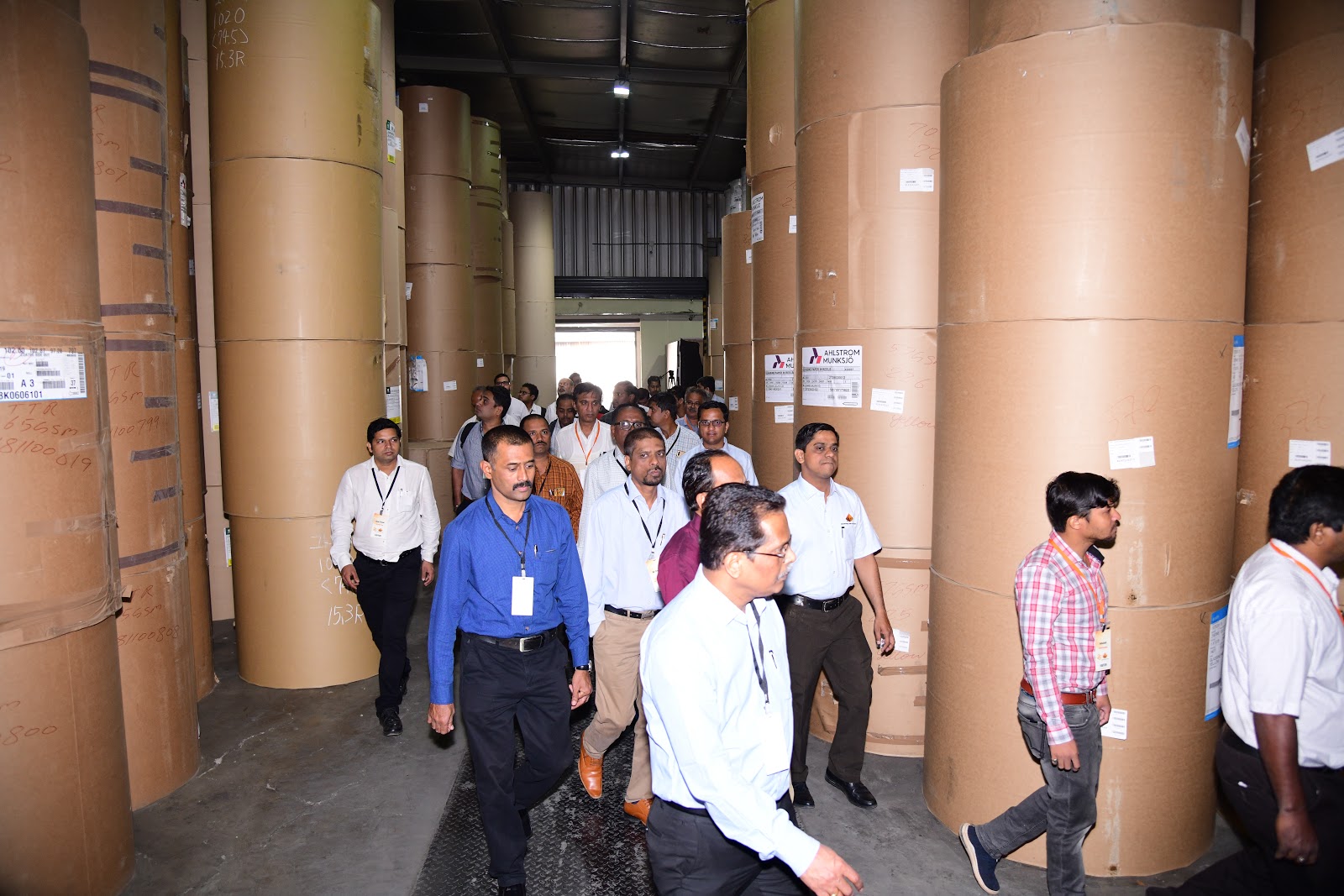
The factory is set up in a 25000 square meters plot with a 13000 square meters shop floor. With seven coaters; two hotmelt adhesive coaters, two acrylic emulsion adhesive coaters, two silicone coaters, one recently installed tandem coater and a host of finishing and material handling systems they consume 1350 tons of paper each month to produce 100 million square meters of pressure sensitive labelstocks per annum. 


The Tandem coater recently installed is capable of coating silicone and adhesive in-line in a single pass with automatic turret reel changing for continuous production. 


Eight story motorised movable stacking system helps the store material with optimum utilisation of space. An ERP aided workflow ensures smooth storage and movement of materials from receipt to despatch.


Well-equipped laboratories for testing and quality control of both inward materials and finished goods guarantees delivery of perfect quality material in each reel supplied to their 200 customers spread in 22 countries. 50% of SMI’s turnover comes from exports that constitutes over 300 SKUs offered by them. 


Besides the Ambernath factory they also have a stock point and slitting facility in Dubai, UAE. The father son duo of Ajay Mehta and Rohit Mehta, with their dedicated team of 225 team members work tirelessly to achieve a steady growth rate of 15-20% per year. Commenting on the future Rohit wants to consolidate strength and expand into new areas of self-adhesive materials. While they see potential in exports of their products, yet they intend to cater largely to the Indian market which with a large population, is growing at a fast pace. More so in the face of a fast-growing organised retail spreading into remote parts of the country.

On the evening of 2nd February 2019 SMI arranged a gala dinner for all the visitors who came to share the celebrations of SMIs 25 years of growth. Speaking about the future prospect of the Indian Label industry Ajay Mehta says, “Label stock materials is a highly technical field with high turnover and low margins. 


Global players need to work together to improve the financial health of the industry.” He further adds, “The Indian Label industry is poised for quantum growth. This needs to be fuelled well with better margins. Intense competition should be handled by creating innovative solutions, instead of just indulging in a price war.” 


Ajay took time to honour and felicitate his team at SMI. 


It was a memorable moment when Ajay called his mother to the stage and recalled her contribution towards the growth of their business over the years. 


Suppliers and customers too spoke on their appreciation of SMI’s journey in the past 25 years.


Besides investing and contributing to social causes, SMI has also been an ardent supporter of the India’s Label association LMAI, Label Manufacturers Association of India. They have been regularly sponsoring LMAI events promoting fellowship and networking in the industry and supporting technical seminars for the benefit of members. In a magnanimous gesture Ajay Mehta has agreed to provide space in his Ambernath facility for setting up of a LMAI training centre for operators and a lab for providing testing facilities to LMAI members.


Written by Harveer Sahni Chairman Weldon Celloplast Limited, New Delhi February 2019