Harveer Sahni

Harveer Sahni
Author Harveer Sahni

Avery Dennison

Avery Dennison
Sustainability at Avery Dennison
Showing posts with label pressure sensitive adhesives. Show all posts

Wednesday, November 17, 2021

LMAI Webinar: Label printers' woes, price increases and shortage of inputs


Frequent increase in paper prices have been adversely impacting the printing and packaging industry in recent times. The print industry has been at the receiving end not just because of the price rise but also due to shortages of paper and that too at a time when demand is rising. The printers have suffered because of long lockdowns due to Covid-19 pandemic; they had hardly heaved a sigh of relief as the situation started to improve when prices began their upward movement followed by shortages or unavailability of critical inputs, adding to their operational problems. The self-adhesive label printing and converting industry is an extension of the sheetfed or unsupported web printing industry. Unfortunately, the impact of the present situation on label printers is more severe, given the complex nature of their major raw materials, the self-adhesive or pressure sensitive adhesive labelstock. Unlike the single layer substrate that paper or board is, the labelstock is a laminate with many inputs. The face materials vary from various kinds of paper substrates, films, foils, etc., then there is a range of pressure sensitive adhesives like emulsion and hotmelts in variants like permanent, removable, for low and high temperature applications that are formulated with various polymers, plasticizers, emulsifiers, and other chemicals. Lastly the release base papers and silicone formulations. All these inputs are facing price increases. Realizing the impact and seriousness of the situation, LMAI (The Label Manufacturers Association of India) initiated by the current President Rajesh Nema, organized a webinar titled "Knowledge - Accelerating Growth" on 30th October 2021. The panelists included Saurabh Agarwal-Avery Dennison, Ajay Mehta- SMI Coated Products, Prashanth Raveendran- Seljegat Printers and Manish Desai- Mudrika labels. The webinar was moderated by Jaideep Singh Secretary LMAI and coordinated by Anurag Mohan Management committee member.

Ajay Mehta
Ajay Mehta spoke on the gravity of the situation due to rise in prices with price increases being announced by paper mills frequently despite not getting their full requirements of materials. Forward contracts are made with paper mills but those are for quantities required and mills in general, charge prices prevailing at the time of dispatch. However still, the increasing international freight rates, reduced availability of raw stocks with mills and the upswing in demand impacts adversely. While the mills give a date whereafter new enhanced prices will be applicable, but the adhesive suppliers do not even give time for price increase and announce the new price with immediate effect. Paper mills supplying release base papers are either facing shortages of pulp so have lesser materials to offer or they to recover the losses incurred during lockdowns are directing their materials to markets where the get higher value for their products. He cautioned that by modest estimates, the label industry will stand to lose over Rupees 250 Crores annually and there is no way this loss can be absorbed, they have no alternative but to pass on the price increase to the printers. They do get resistance from some quarters but there is no way to compromise on this if one has to survive and keep the company in sound health.

Manish Desai

Manish Desai of Mudrika Labels mentioned that print buyers strongly resist the price increases by expressing that there are other printers ready to supply at lower rates, however according to him they must be persistent as there is no other option. The possibility to downscale the product specification by lowering substrate grammages and adhesive coat weights to keep the prices stagnant is not the right step and will lead to inferior quality and rejections at the customer’s quality control. Moreover, since many print buyers are now mentioning the standard brand labelstock usage in labels supplied to them, printers do  not have the option to consider alternate suppliers. He suggested to the labelstock manufacturers that since they interact with print buyers to get their materials approved, they should in turn also impress upon to approve price increases in tune with raw material price escalations. It would also be prudent for labelstock manufacturers to make forward contracts with raw material suppliers such that they in turn can give some breathing time for printers to settle down with new prices. Price rise is an ongoing process in growing economies and eventually the industry settles down with it in 3-4 months, unfortunately now it is at a challenging time and too frequent. He further added that amongst their customers, with privately owned companies it is easy to get price approvals as one can deal directly with senior management and justify the need for higher prices. Contrary to this, it takes 3 to 6 months to get approval from multinational companies as they have multiple layers of management and the price approval is a long-drawn process and by the time the approval comes, the prices may already have increased some more.

Saurabh Agarwal


Saurabh Agarwal of Avery Dennison mentioned “'The significant increase in demand post the improvement in pandemic impact, especially in the large economies of the world, while the supply environment continuing to remain constrained has been the single biggest reason for the serious inflationary pressures. The rising oil and energy prices and the prevailing ocean freight crisis intensifies the impact and is now impacting almost every region. At Avery Dennison, all our efforts are geared to continue serving our customers in the best possible way during these volatile times, while at the same time keeping them informed of the prevailing situation.”


Prashanth Raveendran of Seljegat Printers was more focused stating that they have reached a level of success by continuously investing in the finest equipment to manufacture labels to international standards and creating innovative products. He said, not getting the appropriate and remunerative price for their products will hamper their growth and not justify their huge investments. He stressed that if some print buyers do not understand the situation and do not agree to give the right prices, unfortunately and sadly we will have to forego such orders. After all, we have to service our financial commitments.

Priyank Vasa
To get a wider view on the topic the author interacted with some more industry constituents. Priyank Vasa of Ahmedabad based Unick Fix-a-Form says, “The recent price hikes and inflation in raw materials has got us wondering how long we can sustain a healthy margin while continuing to offer the best rates and quality to our customers. Production efficiency has been impacted in the past two years because of the pandemic. Looking at the current situation, it is tough to offset increasing cost of raw materials with an improved efficiency. Labels have become a commodity, unlike older days where one could reap the benefits of developing a product for years altogether. Product  diversification could be the key which could offer a good balance between profitability and volume. Current market conditions do not offer many niche segments where business could thrive. Sustainability of the margins will take the driving seat vs the volumes. Expansion models must be feather light as nature of our industry needs repetitive investments that come with an interest burden.”

Mahendra Shah
Mahendra Shah of Renault Paper Palghar, a part of Manohar Packaging group says, “We call ourselves manufacturers of labels but technically, we are just converters without any consumer brand-value which can be encashed at a later part of our entrepreneurial tenure. Our current or past investments do not last long, due to fast changing technology. If you do not capitalize your investment in the first one thousand days, your time and energy is wasted in just recouping the investments done. Really, is this why we became entrepreneurs? Competition was always there and will remain in future, the only difference is the mindset. Now with fast evolving technologies we need to achieve the  return on our investment at a faster pace. As first-generation entrepreneurs, we took harsh calls and succeeded, with this huge price impact on our inputs now, we all need a fearless attitude to go for price increases from our customers before it is too late. We may lose some customers but with clear thoughts I am sure we can all make our business profitable and sustainable.” 

Anuj Bhargava


Anuj Bhargava of Kumar labels asserts that the price increase must be passed on and it is an imperative for survival. Another point he mentioned is that the industry is not realizing that people are a necessity in a company to work efficiently and the cost of people has dramatically increased post covid. So that cost combined with the enhanced raw material costs is a “Killer.” If label printers do not pass on the impact of the combined cost increase, then definitely it is a formula for suicide.


The PSA or self-adhesive labels industry is already at crossroads whereby evolution is leading to a lot of demand growth going off to different evolving technologies like shrink sleeves, inmold labels, wraparound labels and direct on product digital printing. Expansion in capacities coupled with commercial and other offset printers, facing pressure from the online communication, also investing in label manufacturing is bringing about intense competition and pressure on profit margins. Label manufacturing also has another challenge which is becoming a matter of concern and that is the waste management. Adhesive coated waste matrix and the release liner that form more than 50% of the laminate is either going to landfills or being incinerated. Facing pollution controls and attending to environmental concerns the printers must now invest in measures that support sustainable and environmentally safe production processes. At such a time when input prices are going up putting margins under pressure, their woes keep on escalating, prompting them to get together as an industry and ponder over workable solutions to counter the concerns that are arising. The positive side is that in a large country India with a huge young population, the growth is evident and there will be enough for all label manufacturing technologies.

Written by Harveer Sahni Chairman Weldon Celloplast Limited New Delhi November 2021

Printweek India's edited version of this article  is also available at; https://www.printweek.in/Features/label-printers%E2%80%99-woes,-price-increases-and-shortage-of-inputs-55396  


Sunday, March 14, 2021

Price increases leave printers in a dilemma!

The adverse impact of lockdowns has not really worn off when a very awkward situation is now confronting the labels and printing industry at large. Prices of paper and all essential inputs are moving skywards disrupting the cashflows that appeared to be getting back to normalcy. It is a strange situation whereby there is a volume growth in demand and reduced availability of pulp and other materials coupled with compulsion of paper mills to recoup the losses incurred due to lockdown, driving up the paper prices. Stuck in between, the label and printing industry is compelled to swallow the increases with intense pressure on their operating margins and working capital requirements. The phenomenon is evident globally, as paper sellers are directing supplies to wherever they find a bigger demand around the world and can command higher prices. There are also logistics challenges owing to shortage of containers. One wonders if this surge in demand is real or there is an element of stockpiling. If it is the latter, it may result in a market crash once the normal working returns that would be even more worrisome. It is mentioned by analysts that the present spurt in prices is due to increased demand coming from China’s domestic consumption increasing dramatically. Surely these are unprecedented increases happening leaving a premonition of adversity amongst the printing and packaging fraternity.

The price increases in paper are coming continuously at regular intervals of time. Asia Pulp & Paper (APP) which is one of the largest pulp and paper company in the world, wide their notification dated 22nd  January 2021 increased prices of all grades of paper by 100$ per ton then on 1st February 2021 they increased the prices by another 100$ per ton and also withdrew the reel discount they were offering, yet again on 1st March 2021 they increased the prices by yet another 150$ per ton. With such a steady rise on monthly basis, one is left wondering when and where this will stop. SAPPI another global supplier of label, packaging and specialty papers, on 3rd March 2021 announced an increase of 7-11% in prices. In the case of labels, both the face stock and the release paper have suffered cost escalation. Vinyl Acetate Monomer or VAM is an important part of pressure sensitive adhesives used for manufacture of self-adhesive labelstocks and tapes. Owing to a whopping increase in demand from China VAM prices also witnessed a continuous upward trend to reach an increase of more than 20% so far in 2021. This too directly impacts the cost of producing self-adhesive labelstock and eventually labels.  Many polyethylene (PE) and polypropylene (PP) producers in Texas USA have shut plant operations because of the winter storm in mid-February 2021 sending prices of films  upwards due to shortages. This increase in prices of polymers directly impacted price of label films and filmic labelstocks. The increase for different films varies between 12-25%.

As if the raw material price rise was not enough the varying demand across different geographical zones in the world and shift in purchasing pattern of populations around the globe brought about a huge impetus to online retail business. This resulted in a logistic change of transportation from established routes and volumes causing disruption of smooth flow of materials and altering the planning for container needs. All this led to increased freight rates, coupled with increasing fuel prices the ultimate impact on the end product keeps on escalating.  It is surprising that such an unprecedented upward revision of all inputs in one go has never been witnessed before in the labels industry. The labelstock manufacturer is squeezed between the large raw material suppliers and the printers who are themselves under intense pressure of high equipment cost and facing print buyers who are not willing to increase buying rates. More so, considering that increasing number of label printers are bidding for the same business and are always ready to compromise a bit more, the situation is complicated.

Gautham Pai
Gautham Pai founder and Executive Chairman of Manipal Technologies Limited Manipal, expressing concern at the situation prevailing says, “The price increase of raw materials is significantly impacting the business. In addition, the supply chain disturbances and logistic cost increases have added to the overall costs increases. These increases at a time when buyers are still struggling with low demands and muted orders is a major concern.” U K Gupta Group Chairman & Managing Director, Holostik Group also feels, “Price increase in paper, solvents and adhesives have impacted the Label Industry badly”. Indian Labelstock producers have steadily grown in numbers and size as the industry registers double digit growth over the last many years. The industry players have gradually transformed from being manufacturers of  just commodity stocks like semi-gloss and uncoated wood free or maplitho to advanced specialized label materials, both coated, uncoated, filmic and specialty products like security label materials. Since all inputs in labelstock manufacturing have been adversely impacted and spreading the effect to the entire self-adhesive label industry, Ajay Mehta Managing Director of India’s largest indigenous labelstock manufacturing company SMI Coated Products Pvt. Ltd. brings forth the reality that the industry is facing by expressing, “The price rise in all raw materials of Label Stock solutions have gone up tremendously and we have to pass it on to the Label converters and unless the  Label converting industry joins hands, to take immediate action in getting a price rise from Label buyers , the Industry stands to loose INR 250 million per month, which is going to be extremely detrimental for the health of the industry”.

The pain and anguish at the emergence of this difficult unprecedented turn of events in words of, Ajay Agarwal, CEO of Syndicate labels New Delhi, “Price increase is nothing but a nightmare for the Label Printing fraternity and the biggest reason is that it disrupts the operations for all label Convertors. The process of transmission of the rate increase to the end customer is extremely difficult and is often characterised by a new round of negotiations, reverse auctions etc. and most likely it results in reduced margins for the label convertor. While price increase is a reality and need of the hour yet in face of the current increase in prices of raw materials, it still leads to a lot of pain.” Sharing the same concern, Himanshu Kapur Director, J K Fine Prints Pvt. Ltd. Mumbai agrees, “Price increase is a necessary evil for accommodating inflation, if done effectively it will benefit the entire supply chain else  operation will suffer long term. Unfortunately, the print buyers are also responsible for the collapse of an industry which was once an art form and now considered a commodity”. Rajesh Nema Director Pragati Graphics Indore and honorary secretary LMAI (Label Manufacturers Association of India), “Label industry is indeed facing tough times as cost of all inputs has gone up yet print buyers are not agreeing to price increases. Most of the self-adhesive label manufacturers are in yearly contracts with their buyers, it is difficult to make them agree to price increases during currency of the contract”.  According to Lakshminarayanan business unit head-Wintek at Signode India Ltd. : Impact of Prices is not only from raw materials, but it is also due to Inflation and logistics. There is  a strong demand for consumer goods and food packaging in the country. Nonessential packaging sectors is also regaining normalcy, but the price increases continue to challenge converters supplying due to their inability to pass on the  price increases to end-users, who in turn are driven by their cost pressures and not accepting to consider any price increase in current situation. Considering the greater need for working capital due to the steep increase in prices during recent weeks and the narrowing margins, inventory held by both converters and end-users remained below the average.

A brave Anuj Bhargava of fast-growing Kumar Labels NOIDA beamingly says. “Price hikes shouldn’t affect any organization’s normal profitability in the entire eco-system. All actions favorable to this intent should be taken so that a new equilibrium is arrived at with positivity” However he further adds, "that price hikes should be passed on so that profitability is not affected for anyone. New equilibrium is with revised prices for everyone.".

Kuldip Goel
LMAI President Kuldip Goel, Managing Director of Any Graphics NOIDA,  sums it up as a situation whereby in the covid times many in the industry have lost customers because when you take the increased price to them, your competitors who have their own pressures to strengthen their balance sheets so that banks are satisfied to lend more, are ready to offer without any profit or at a minor loss. Or if they have spare capacity and can retain their loyal customers they will attempt to take in new customers at unreasonable rates. It is not that the print buyer is not facing the impact of covid-19, the moment they see price escalation they will start exploring options to prevent the rise in cost of inputs. Printers at this time must evaluate as to how best they can handle the situation; price increase is imperative for them to sustain but then it needs to be seen how much of their business is dependent on that customer. One must strike a balance in price and cost optimization internally by trying to achieve more from their existing infrastructure and manpower. One must look within, reduce labour cost, wastages, save electricity, inventory control, and produce more with less.


At this time, the entire value chain is in jeopardy, each business product unit is customer of another, all constituents of the industry up to the print buyers need to empathise with their suppliers to bring some relief from this dilemma post continuous increase in input costs, that has descended on entire industry. It is appropriate at this time to mention a famous quote, “The journey is never ending. There's always going to be growth, improvement, adversity; you just got to take it all in your stride and do what's right, continue to grow, continue to live in the moment”.

Addendum: Messages received after posting the above article;

Aaditya Kashyap, Marks Emballage Pvt. Ltd.  Baddi; Already struggling to come back to normalcy from the pandemic-induced challenges, the increasing raw material pricing is like the last thing we could have wished for.  I see label printers in a very weak and vulnerable position completely squeezed out of business by increased prices from bigger players on the supply side and the dominant brands and buyers on the other hand who refuse to accept any price hikes. Would love to see that material manufacturers and suppliers work with printers to take the price hikes to brands and buyers. This is a difficult time for all, so need for all stakeholders to work together to find a win-win in this difficult times."

Rajeev Chhatwal, Kwality Offset, New Delhi: Very Strange Scenario no break on increasing RM prices. Business being run on negative profits!

Written by Harveer Sahni Chairman Weldon Celloplast Limited New Delhi March 2021

Note: Print magazines are free to reproduce this article subject to giving credit to author with blog address

Thursday, December 19, 2019

Environmentally conscious and sustainable in labels


Another day in life many years ago, we would love to light up a bonfire on a winter evening and sit around it warming ourselves and enjoying it. It was a common sight to see construction workers and other labourers huddled around a small fire they would light up by burning tree branches or dried leaves to warm themselves and ward off the cold. This incineration, which was a pleasurable exercise once, is looked at as non-acceptable now because it generates smoke and adds to the already high level of pollution in our cities. In the 1960s all our groceries were shopped wrapped in paper or carried in paper bags. In India we saw a lot of paper bags made even from old newspapers and old magazines adding an element of recyclability to the already used paper. 


In 1965 Swedish company Celloplast patented the single use poly bag to start an era of convenience in shopping with plastic bags. By late 1970s or early 1980s the polybag evolution had reached India and started to grow at a robust pace. It also became the preferred packaging material for a very diverse range of end products. Rapid developments were made to create multipolymer laminates to achieve better shelf life and barrier properties.   So much so that it became difficult to imagine a life without these plastic bags.


Mountain of garbage termed as landfil
Ironically by end of the last century the ill effects of plastic waste due to non-biodegradability became the most worrying factor for governments. The plastic bags littered around the globe remained plastic for years and would remain so for hundreds of years. Bangladesh became the first country in the world to implement a ban on thin plastic bags, after it was found they played a key role in clogging drainage systems during disastrous flooding. Other countries began to follow suit. Soon the awareness came about that plastic was not only clogging drains but also adding to soil quality erosion, affecting life of cattle who devoured these while grazing and endangered the sea with tons of plastic dumped in. The heightened awareness of all kinds of waste going to landfills; in fact, they are no more landfills but have become garbage mountains occupying expensive and already shrinking land space in cities and emitting poisonous gasses impacting environment and health of population. Climate control, banning single use plastics, finding alternative to multi-polymer plastic laminates due to these not being recycled, conserving resources, recycling, reusing, waste management, etc. became imperatives for all governments. Environmental protection and sustainability became the necessity and buzzword for a safe future of generations that follow us. Sustainability is explained as the avoidance of depletion of natural resources in order to maintain an ecological balance, in other words replenishing the mother earth with the natural resources that we use for our benefits.

Kimoha Solar plant
The author while returning from Labelexpo Europe in Brussels in the end of September 2019, stopped over to visit Dubai based label printing company Kimoha. While excelling in the world of labels Kimoha leadership had done a lot of work including investing for environmental protection, waste management and sustainability, setting example for others in the label industry to follow suit. Being fully aware that advancements and enhancement approaches are needed for the economic development of the present without compromising the capacity of future generations, Kimoha has taken steps to be sustainable and take care of the environment and its social well-being. They successfully completed the Green Building Initiative and are the first printing company within GCC to have the Gold LEED certification from the US GBC for its manufacturing facility. Under the new green clean energy initiative, they have commissioned own Solar Plant with Installed capacity of 1.0143 MWp, generating 30% of their power requirement. Kimoha Solar Plant is one of the largest Solar plant in the manufacturing segment within JAFZA. All the mechanical material handling systems are battery operated to cut off use of fuel and its associated pollution.
Integrated Waste Management System
Kimoha sources material from FSC certified partners as a responsible management initiative in protecting forests, being in paper industry.  The entire facility light management system is based on Motion & Occupancy Sensors. Occupancy sensors increase lighting energy savings by 23 %, auto turning off or turning down for amount of time with no movement. Skylights are used as natural lights here at Kimoha warehouse, thus further adding to Energy Management initiatives. As a part of its water conservation initiative, waterless urinals are installed in the facility washrooms. One waterless urinal saves approximately 3,250 gallons of water a year. The Solar cleaning system is also of dry wash robotic system which aids this program. On its Carbon footprint initiative, Kimoha has installed a state of art Integrated Waste Management System for auto extracting and compacting its label design and trim waste. Most of the paper waste is bailed, to reduce size and skip loads and sent to recycling vendors for a circular economy. Right from inception Kimoha has always believed in human capital and thus refrained from using Solvent Inks.  Kimoha also has a Sedex Member Mark which is a testimony to their responsible and sustainable business practices.
Back home in India the author tried to touch base with label printers in India to understand if they too were investing to make their industry and products environmentally safe and sustainable. It was heartening to note that the process has begun but it is just the beginning. To have a large-scale impact down the line, it appears legislation will provide the necessary impetus required in this direction. Noida based Any Graphics lead by Kuldip Goel is building a new huge new certified green factory spread over 15500 square meters that will be ready to move into in 2020. Kuldip Goel says: ‘The green manufacturing unit will be our contribution towards being environment friendly and sustainable. The process began right from the time when we started building the plant. For instance, we cannot uproot any trees from the new land without having a plan to re-plant and nurture them and plant maximum number of local varieties.’ Complying to the Green factory requirements they are procuring maximum construction materials produced from within 500 kms of the construction site, using minimum 50 percent old material and furniture from previous factory, minimum usage of wood, covered car parking, usage of less water and big fume taps to save water, natural sunlight inside the factory, usage of light and insulating Autoclaved Aerated Concrete (AAC) panels in the building, amongst others. They also plan to install both sewage treatment plant (STP) as well as an effluent treatment plant (ETP) at the new facility. ‘With the STP, they will be able to re-use almost 50 percent of our water that would otherwise just go down the drains. With the consumption of almost 40,000 litres of water a day, this will be a huge saving. They are also installing state of the art 600-700 KW rooftop solar power units. This will reduce 5.5 to 7.5 MT of CO2 emissions annually, equivalent to planting about 35,000 trees. Goel further added, “We have even studied air direction at the new site to maximize the impact of air flow and sun for most efficient use of solar light and energy. There is a list of above 40 requirements listed by The Indian Green Building Council (IGBC) that we must adhere to for our factory to be qualified as a green building and we are passionately working on each one of them”.
The author with Anuj Bhargava
Another Noida based Label Company Anuj Bhargava lead Kumar Labels who also produce labelstock for their captive consumption has put in place many processes in their production plan to make their contribution to environment and sustainability. They have shifted to 100% LED lighting in their factory. They plan to replace UV lams with LED UV lamps on all their presses by 2021, the process has begun. They have developed and commercialized SRTF (Single Release with Two Face stocks) which saves 50% release liner. Spreading the concept globally. Other endeavors include elimination of corrugated boxes and using multi-use plastic trays for dispatches within 200km distance which saved over 15 Tons of kraft each year. Selling labels on bagasse, mineral paper and recycled kraft label stocks (though to begin with the quantity is small). Work has started to use thinner liners. 70% of factory is on evaporative cooling instead of air conditioning, saving energy. No plastic bottles or cups are used for water or food, even during group dinners. Segregation of waste is done so that most unsupported material gets recycled. Employees are encouraged to shift closer to factory to avoid commute and save fuel. To set an example, owners have also moved closer to factory. Used UV lamps are disposed off through a recycler who removes the mercury.

The self-adhesive labels industry as it continues to grow, has been facing a gigantic task for disposal of side trim, waste matrix and liner waste. Almost 50% of the label material after conversion is waste and earlier converters were either sending the same to landfill or incinerating it. Both the actions are adversely impacting the environment and require urgent attention. Multinational labelstock manufacturers Avery Dennison has taken some pioneering initiatives towards this problem. The Company under their “Avery Dennison’s Recycling Services India program” has been concerned about the accumulation of waste and is on a mission to also reduce the amount of packaging materials used beside recycling and managing the waste generated. They in association with leading brand owners started collecting the label liner generated as part of the labelling operations centrally before passing these on to the appointed recycler for this Liner Recycling Program. The collected liner waste is then reprocessed, and this recycled pulp is used to create new materials such as cardboard, paper, and tissue. On another front they are interacting with converters to co-process or reprocess their leftover label matrix instead of landfilling it at no cost, given that the paper and film materials are sorted at the converter end. The matrix that is made from either paper or film material is usually discarded. As per Avery’s initiative through co-processing, paper matrix can be re-used as fuel in industrial processes. Through reprocessing, filmic matrix is converted to polymer pellets used to manufacture products like boards and benches.


Himanshu Kapoor of Mumbai based J K Fine Prints lists the processes that they have implemented in this direction: The have started liner recycling program with Avery Dennison, all plastic ink bottles are sent to MPCB(Maharashtra Pollution Control Board) waste handling unit, used UV lamps go to hazardous waste collection unit, they pack finished rolls in paper and not in plastic, all waste is shredded and sent to cement kilns to use as an energy source to replace natural gas, cores/boxes/packing materials etc. are reused to reduce carbon footprint, waste water from water purification system is reused for cleaning purposes, all ACs/fans/lights are switched off when not in use, Auto stop taps installed resulted in reduced usage of water and collection of used liner from end users and sending to recycle in pipeline.


Sustainability is important for many reasons including environmental Quality in order to have healthy communities and a safer planet for generations that follow, we need clean air, natural resources, and a nontoxic environment. Government has now realized the huge negative impact of this and due to their efforts to spread awareness, words like sustainability, environmental protection, circular economy, recyclability, reusable, etc. have become frequently debated topics in industrial conferences and CSR initiatives of leading industrial houses. Even the common people now are impacted and concerned about this problem. Label industry has been implementing many such initiatives to reduce the impact of waste. For a lot many years we have seen press manufacturers making the label presses with short web pass to reduce setup waste, usage of thinner filmic liners have been implemented at many places to reduce the tonnage of liner going into manufacture of self-adhesive labelstock and more so because the filmic liner can be recycled to produce other plastic products. In recent times we also witness the development of linerless labels to entirely do away with the liner by use of a filmic liner that is peeled off in the manufacturing process and laminated on top of the same label. One solution cannot cater to all labelling needs, every process has its advantages and disadvantages, but the heartening fact is that now the industry is taking steps both to reduce wastage and eliminate it from going to landfills and incineration. The social responsibility of the labels industry is evident!

Written by Harveer Sahni Chairman Weldon Celloplast Limited, New Delhi December 2019

Thursday, February 14, 2019

SMI celebrates 25 years, reaching 100 million square meters production!


On the 2nd of February 2019, India’s largest indigenous labelstocks manufacturer Ajay Mehta led SMI Coated Products Pvt. Ltd. headquartered in Mumbai celebrated their 25th year of existence, in grand style. Over two hundred guests who were shown their impressive factory were in awe of what they saw and felt proud that their industry mate could set an example of success impressing the mantra; “Make in India”! The event also exhibited the typical Punjabi will and firm resolve to work hard and find success even while starting from scratch. Ajay’s father Om Prakash Mehta suffered the first jolt of leaving home in Multan, now in Pakistan, empty handed he came to Delhi after the partition of India and then moved to Kolkata where he set up his print lamination business. He had settled down well there with business growing when the second jolt hit him, once again he had to leave everything in Kolkata due to the turbulent days of Naxalite movement in the 1960s. Leaving behind all that he had made he with his family moved to Mumbai when his son Ajay was just 10 years old. Om Prakash Mehta was a very brave man and took all the adversity in his stride and moved on in life. He re-established his print lamination business as S M Plastic Industries in Mumbai named after his wife Shakuntala Mehta. In 1983 Ajay joined business and they started fabric lamination but when the business stopped growing the Mehtas decided to quit that business and establish a new business in 1993 producing self-adhesive labelstocks in their new enterprises S M Industries which was later renamed SMI Coated Products Pvt. Ltd. 


They started production with a 20inch coater. Ajay Mehta, his son Rohit, wife Swati and daughter in law Saloni. All contributed their efforts in growing SMI to where it has reached today. Ajay and Swati’s daughter Nikita, after training in vocal music in USA is pursuing a career in singing also in USA.


For the 25th year celebration SMI invited the virtual who is who of the label industry to showcase their manufacturing facility. The outstation guests were all put up in the iconic ITC Grand Maratha Hotel. On the 2nd morning multiple groups in different buses were taken to Ambernath for factory visit. Earlier in the preceding days they had arranged for the local label printers of Mumbai and surrounding areas to visit their factory. 


The event was extremely well managed so that smaller groups were taken around for a one-hour factory tour so that everyone got a chance to visualise and understand the capabilities and manufacturing as well as quality control systems employed by them. On arrival the guests were first given an impressive presentation of SMI’s journey, achievements and awards. SMI has been recipient of over 20 domestic and international awards.


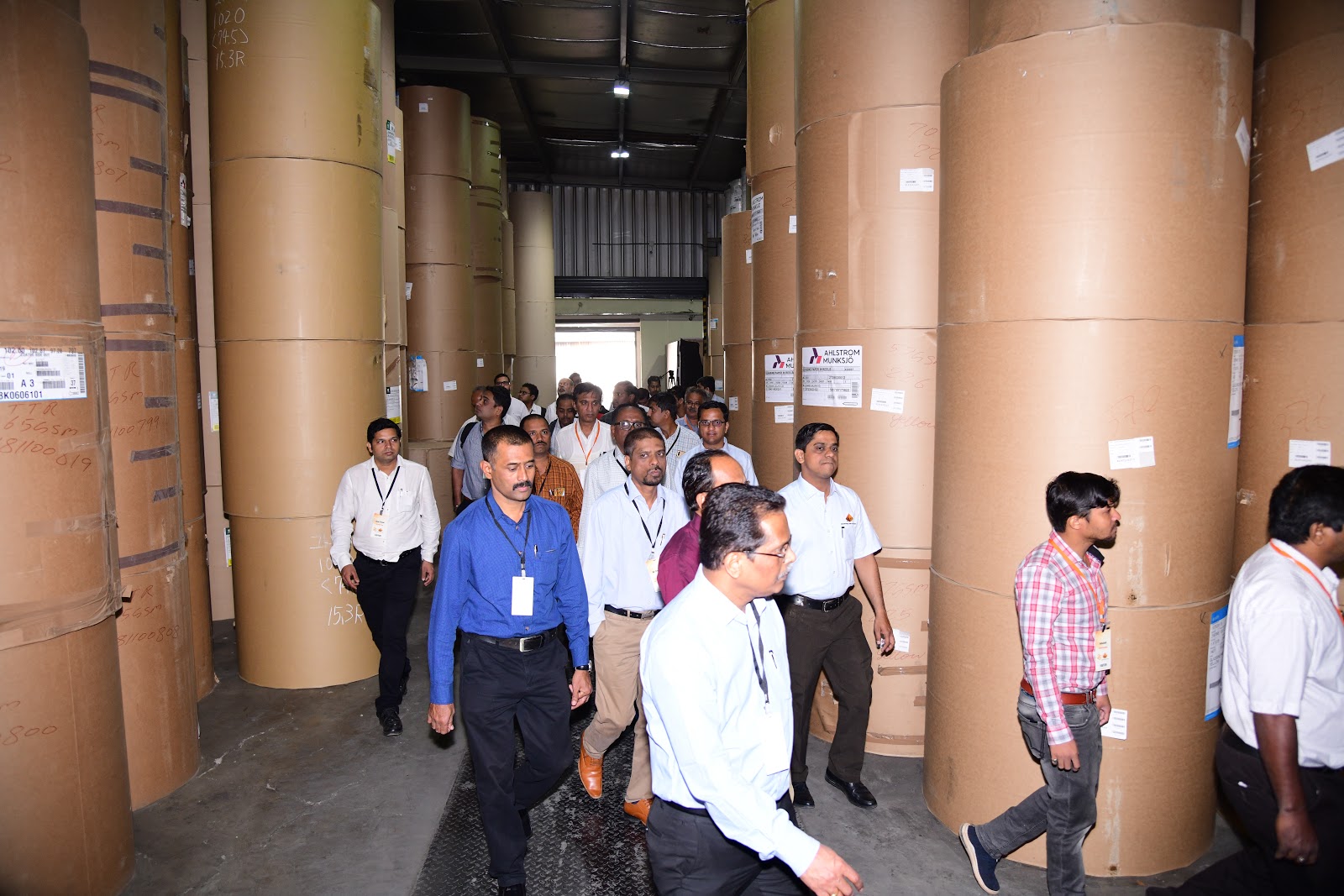
The factory is set up in a 25000 square meters plot with a 13000 square meters shop floor. With seven coaters; two hotmelt adhesive coaters, two acrylic emulsion adhesive coaters, two silicone coaters, one recently installed tandem coater and a host of finishing and material handling systems they consume 1350 tons of paper each month to produce 100 million square meters of pressure sensitive labelstocks per annum. 


The Tandem coater recently installed is capable of coating silicone and adhesive in-line in a single pass with automatic turret reel changing for continuous production. 


Eight story motorised movable stacking system helps the store material with optimum utilisation of space. An ERP aided workflow ensures smooth storage and movement of materials from receipt to despatch.


Well-equipped laboratories for testing and quality control of both inward materials and finished goods guarantees delivery of perfect quality material in each reel supplied to their 200 customers spread in 22 countries. 50% of SMI’s turnover comes from exports that constitutes over 300 SKUs offered by them. 


Besides the Ambernath factory they also have a stock point and slitting facility in Dubai, UAE. The father son duo of Ajay Mehta and Rohit Mehta, with their dedicated team of 225 team members work tirelessly to achieve a steady growth rate of 15-20% per year. Commenting on the future Rohit wants to consolidate strength and expand into new areas of self-adhesive materials. While they see potential in exports of their products, yet they intend to cater largely to the Indian market which with a large population, is growing at a fast pace. More so in the face of a fast-growing organised retail spreading into remote parts of the country.

On the evening of 2nd February 2019 SMI arranged a gala dinner for all the visitors who came to share the celebrations of SMIs 25 years of growth. Speaking about the future prospect of the Indian Label industry Ajay Mehta says, “Label stock materials is a highly technical field with high turnover and low margins. 


Global players need to work together to improve the financial health of the industry.” He further adds, “The Indian Label industry is poised for quantum growth. This needs to be fuelled well with better margins. Intense competition should be handled by creating innovative solutions, instead of just indulging in a price war.” 


Ajay took time to honour and felicitate his team at SMI. 


It was a memorable moment when Ajay called his mother to the stage and recalled her contribution towards the growth of their business over the years. 


Suppliers and customers too spoke on their appreciation of SMI’s journey in the past 25 years.


Besides investing and contributing to social causes, SMI has also been an ardent supporter of the India’s Label association LMAI, Label Manufacturers Association of India. They have been regularly sponsoring LMAI events promoting fellowship and networking in the industry and supporting technical seminars for the benefit of members. In a magnanimous gesture Ajay Mehta has agreed to provide space in his Ambernath facility for setting up of a LMAI training centre for operators and a lab for providing testing facilities to LMAI members.


Written by Harveer Sahni Chairman Weldon Celloplast Limited, New Delhi February 2019

Friday, February 23, 2018

Waste matrix removal in label production


Waste matrix stripping or removal in production of self adhesive labels is a very important part of label conversion and is an imperative that leads to a web of labels which can be dispensed on automatic label dispensers in high speed packaging lines. Even though it sounds to be a simple process of stripping the ladder like extra waste after die cutting of labels, yet it remains to be one of the most complex and problematic area of label converting process. A problem with waste removal, like matrix breaking or labels lifting with the waste ladder may slow down the machine or in some cases make it extremely difficult to remove it online. Converters may have to resort to removing the waste manually offline making the process unproductive and costly. A host of parameters affect the process and it is difficult to address the issue in a singular way. With so many variables that impact the waste removal process, it is difficult to predict a simple solution. It could be due to the shape of label, size of label, release liner, face stock, adhesive, die cutting process, speed of conversion, die blades or the design of the waste removal section that may affect the correct and efficient removal at the optimum machine speed. Any of these may impact the final result and slow down the machine and the printing process. No one solution can apply to all problems. The traditional waste rewinding system is gradually becoming unpopular due the fact that tension is the key to efficient waste rewind. The rewound waste matrix ladder roll has empty spaces from where labels have been die-cut and as the roll becomes bigger there is lot of irregular tensions leading to breaks. As the market becomes extremely competitive with rising prices of labelstocks printers tend to reduce the gap between the labels to 2mm making the process even more difficult. This article will dwell on most of the variables mentioned here above.

Release Liners: The most widely used base papers as release liners in self adhesive label materials are glassine, super calendared Kraft and clay coated Kraft. These are uniform caliper, densified and non porous papers that have adequate strength and accept a uniform coating of silicone giving excellent releasing properties to become a proper backing for self adhesive papers. In recent years due to possibility of recycling and reducing the tonnage of waste generated, filmic liners also are being used as backing in labels. Release liners play a major role in die cutting and in turn impact the waste removal process. The die blade has to cut through the laminate and stop at the face of the liner so has to achieve a perfect half cut or kiss cut. The uniform thickness or caliper of the liner is an imperative. If the liner has variations, it will create problems at die cutting and eventually at waste stripping. If the release gets thicker the die will pierce the liner making a through cut and exposing paper fibers to the adhesive.  This also may result in web breaks. If the liner gets thinner, the die will not cut resulting in labels lifting with the matrix. Release level of the liner is also very important. If the release level is tight the matrix will tend to break due to tension and if it is too easy, labels will tend to lift with the ladder. Uneven silicone coating or pinholes in coating may also create problems. If the labelstock prior to waste matrix removal goes through a nip roll that has excessive pressure between them, the edges may develop micronic nicks that may render the face paper susceptible to web breaks. The paper rolls may also develop these rough edges in transportation and mishandling. The web needs to be inspected thoroughly before taking up label conversion.

 Face Paper:  Paper and films are generally used as face materials. A fairly high strength paper will perform well if all other parameters are addressed. If the gap in labels is too small, 2mm or less, the matrix will tend to break repeatedly. Moisture content in paper should ideally be between 3.5% and 5.5%; sharp increase in moisture will affect the strength adversely. The tensile strength of paper at Relative Humidity (RH) up to 50% is maximum after which it moderately decreases with RH up to 65% and on further increase in RH, it drops sharply. The uncoated papers are hygroscopic, so they tend to absorb moisture faster than coated papers. Evidently weather and storage condition of paper does have an impact on waste removal. Even when using emulsion based adhesive if the adhesive is not dried properly, the face paper will tend to absorb the residual moisture from the adhesive and result in deterioration of paper and affect waste stripping. In case of filmic face stocks, weather may not impact but the condition of die and quality of die cutting does play a major role. If the die is damaged or blunt it may not cut properly resulting in label lifting or film tear.

Adhesive: Commonly available labelstocks are coated with either emulsion based or hot melt pressure sensitive adhesives (HMPSA). In both cases for a perfect waste removal it is necessary that the die cuts through the adhesive as well, as otherwise if the coated film of adhesive is not cut, labels will lift with the matrix. Emulsion adhesives have good die cut ability however hot melt adhesives for better die cutting properties have to be specially selected. In case of HMPSA if the waste is not lifted immediately after die cutting the adhesive may rejoin and lift the labels with the matrix.

Size and shape of a label: These are parameters that are customer driven based on their specific needs, so the converting company cannot request changes from customer.  Small labels have a very limited area of contact and reduced tack holding it to the release liner and with little force the label may fly off or lift off with the matrix. In such a case die makers suggest packing self adhesive foam in the die shapes so as to push the label back on the release liner. Other times printers have found limited success in addressing this problem by increasing speed of the web. Waste ladder removal of irregular and complex shaped labels with sharp corners like in a star shape, is even more complex to handle. This becomes even more difficult in substrates like BOPP where a small nick may lead to web break. Converters need to slow down the machine to a great extent to finish the labels online. Machine manufacturers have addressed this issue of handling complex shapes as explained later in this article.

Die design: The die has a definite role to play in waste matrix removal. The subject is extensive and can take a full article to dwell on the nuances. The blade angle, blade height and coating on the die are factors that lead to ease or difficulty of label conversion.  Thickness of the face materials, type of adhesive and thickness of release liners are all imperative inputs that are needed before a die is put into production. A die that is designed for paper material is not recommended for filmic materials. Blade angle for paper is kept wider so that after penetration of around 80% into the paper the rest of the cut happens by crush or bursting of the material before stopping at the surface of the liner. In case of filmic face material a sharper acute angle is needed to pierce the film as in case of a wider angle the film will stretch and not be cut. An acute angle blade appears to cut better but wears off faster than the wider angle blade dies. Depending on the materials used the die angle varies between 45degrees and 110 degrees. The blade height needs to be adjusted to cut through the face, which maybe paper or film or a laminate, and adhesive without piercing the release liner. If any of the parameters is not right, the waste matrix removal will become a challenge. If the blade pierces the liner even slightly, it may expose the release paper fibers to the adhesive and get stuck to them causing waste ladder breakage. If the blade does not cut through the adhesive, labels will lift with the matrix. In case of coated materials like direct thermal and thermal transfer the coatings on the paper are abrasive in nature and tend to make the die wear off soon. In such case laser hardened dies are recommended. Adhesive sticking and building up on the dies also results in uneven cutting and also resulting in early die wear off. This is more evident where aggressive high tack hot melt adhesives are used. For this reason special non stick, coated dies are available so that the adhesive will not stick to them. The standard gap between the magnetic cylinder and the anvil is also very important as in case of die wear off the gap increases resulting in spaces where labels are not cut and would lift off with the matrix and to get a perfect cut the die pressure is increased. This results in faster wearing off of the bearers leading to a smaller gap and over cutting. Care has to be taken in die storage and handling. Before commencing any job proper inspection of die should be done regarding cleaner blades, blunt edges or nicks. The dies need to be stored in an environment avoiding excess humidity which may result in rusting.

Machine manufacturers have been consistently making efforts to address the issue of waste matrix removal to aid faster converting. Some of the steps taken include; 1.Lifting the waste matrix immediately after die-cutting. 2. Taking the die to a larger diameter stripping roller that would support the waste ladder on separation rather than a thin diameter roll that would provide a sharp angle to waste being stripped off. 3. By rethreading the paper in such a manner that the label web is peeled off the matrix instead of the matrix being pulled off. 4. De-laminating the web and re-laminating it before die cutting as this would reduce the tension required to peel off. These measures did help to some extent but complex shapes and a host of issues and factors that impact this process have had machine manufacturers continuously researching this area to keep implementing changes. One such solution that came around some years back was suction of the waste matrix into a suction and shredding system. This does take care of the tension and also manages waste by cutting it to small pieces and compacting it, but such systems have other problems. They are expensive, large in size so difficult to be fitted on presses due to lack of space, costly to operate as they use extra motors, compressor or vacuum and very noisy to run. Yet there is a brighter side to it, there is development going on to separate the waste and recycle it inline so as to reduce the impact on environment.


The larger established press manufacturers seem to have reached a viable solution. Some years ago they have introduced a big innovation in the industry by designing a simpler contact system rewinder for waste matrix. The idea was very simple; instead of pulling only the matrix up to the rewinder, we pull the entire web up near the rewinder. Here the matrix is peeled off against an idle roll and immediately pasted on the rewinder. Basically this reduces the travel of the matrix from 1 meter to hardly 5 cm and the journey is even supported by a roll. This system has now become the standard with many label press manufacturers


“Simple solutions are invented to simplify the label converting process however It does not hold true for all jobs, when a problem comes it can be challenging and creating a solution can be another game changer”!


Written by Harveer Sahni Chairman Weldon Celloplast Limited New Delhi January 2018

NOTE: This article is exclusively written for magazine Label and Narrow Web USA. Publications desirous of reproducing the article may write for permission to Steve Katz editor LNW : skatz@rodmanmedia.com